
The Geometry of i - A Complex Relationship
Loading the math board and drawing, please wait…
In collections
Complex Math
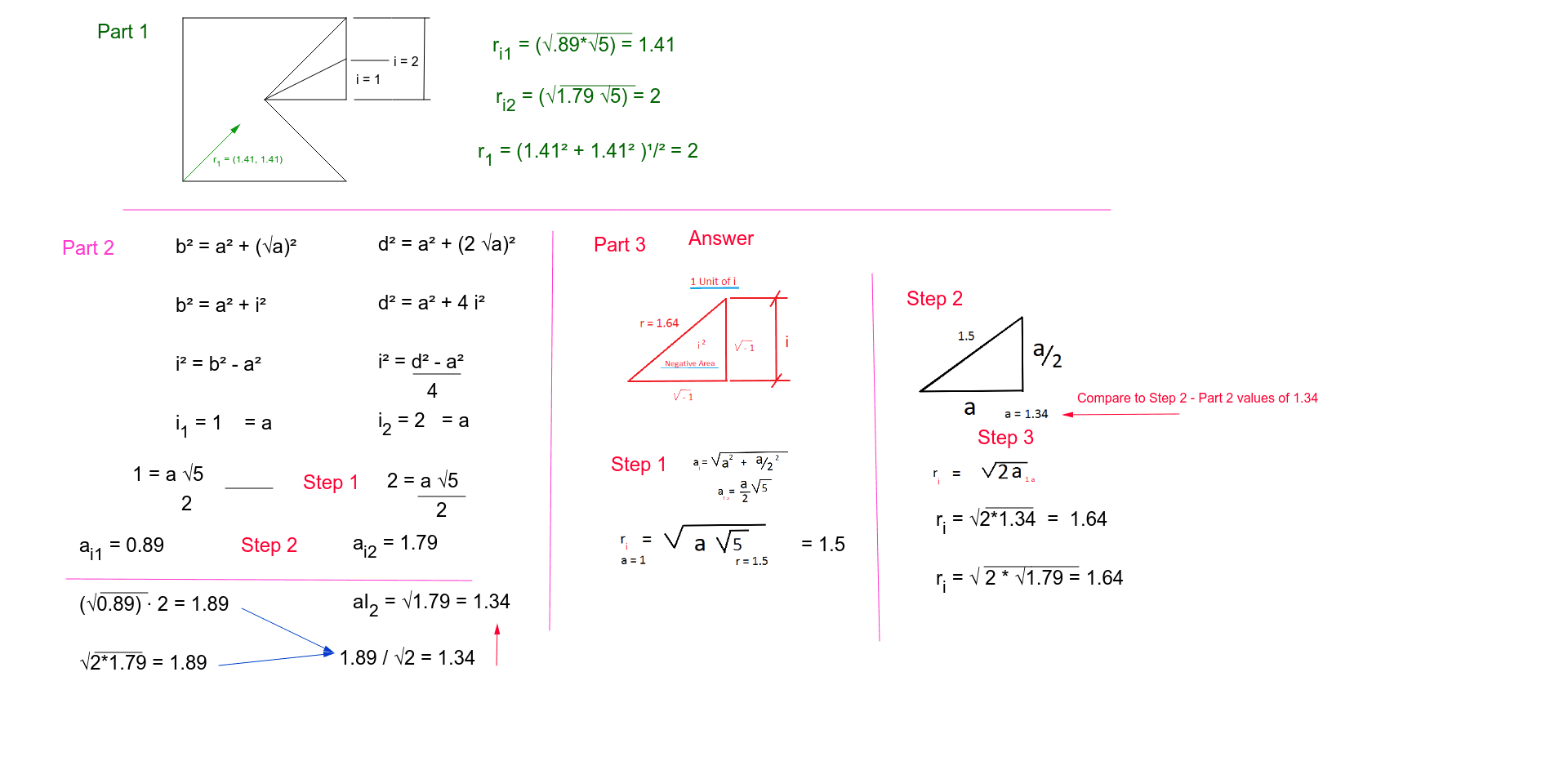
This example demonstrates the geometric representation of the imaginary unit i and its relationship with the Pythagorean theorem. It involves core mathematical concepts like complex numbers, geometric interpretation, and the Pythagorean theorem. The construction uses GeoGebra commands/objects such as Line, Mirror, Segment, Angle, Point, and Vector. Suitable for high school mathematics students to understand the geometric meaning and construction methods of complex numbers.
GeoGebra Commands & Parameters
Line(C, E) → aMirror(D, a) → D'Mirror(A, a) → A'Line(D, F) → bMirror(A', b) → A''Mirror(A, b) → A'_1Segment(A'_1, A'') → cSegment(A'', A') → dSegment(A', A) → eSegment(A, A'_1) → fSegment(A, A'') → gSegment(D, D') → hSegment(A', A'_1) → mSegment(B, G) → jSegment(B, A'') → kAngle(h, k) → αSegment(B, A') → lSegment(B, D') → nSegment(D', A'') → qSegment(T, U) → a_1Segment(T_1, U_1) → a_2Segment(T_2, U_2) → a_3Segment(T_3, U_3) → a_4Segment(T_4, U_4) → a_5Point(a_5) → VPoint(a_4) → WSegment(V, W) → b_1Segment(Z, A_1) → c_1Segment(Z_1, A_2) → c_2Vector((w, w)) → r_1Segment(L_1, M_1) → p_1Segment(L_3, M_3) → p_3Segment(L_4, M_4) → p_4Segment(P_1, Q_1) → pVector(R_1, S_1) → u_1Vector(V_1, W_1) → v_1Segment(B_2, C_2) → f_1Segment(D_2, E_2) → i_1Segment(F_2, G_2) → j_1Segment(L_5, M_5) → p_2Segment(L_6, M_6) → p_5Segment(L_7, M_7) → p_6Segment(L_8, M_8) → p_7Segment(L_9, M_9) → p_8Vector(H_2, I_2) → w_1Vector(J_2, I_2) → k_1