
Area Problem: Random Polygons and Binomial Distribution Simulation
Loading the math board and drawing, please wait…
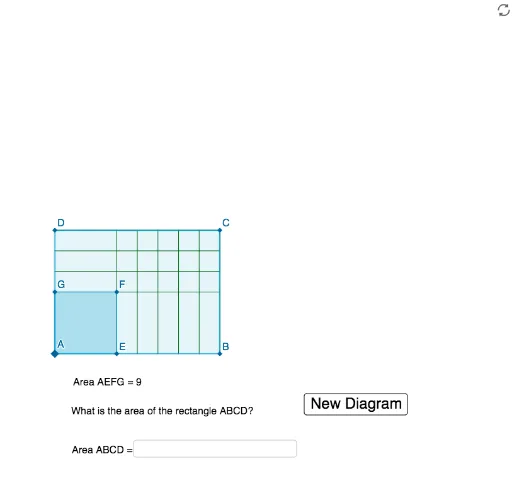
① This example demonstrates a visual problem involving area calculation combined with probability and statistics, where random polygons are generated and their areas are computed. ② Core mathematical concepts include area, subtraction, logic, binomial distribution, confidence intervals, and stochastic processes, highlighting mathematical modeling and statistical simulation. ③ Construction details: The GeoGebra commands used include Random to generate random points, Polygon to construct polygons, Sequence to create sequences, and Textfield for input boxes; objects include point A, side, polygons poly1 and poly2, functions f, g, h, i, lists list1 and list2, a button button1 to trigger calculations, and text boxes text1, text2, text3, and answerbox for output. ④ Suitable for high school and above, this example serves as an interactive tool for exploring the relationship between area and probability, or as a teaching aid for statistical simulation and experimental mathematics.
GeoGebra Commands & Parameters
Random(3, 15) → sidePolygon(A, (side, 0), 4) → poly1, f, g, h, i, P, QRandom(1, 5) → aRandom(1, 5) → bSequence(Segment[(side + n, 0), (side + n, side + a)], n, 0, b, 1) → list1Sequence(Segment[(0, side + n), (side + b, side + n)], n, 0, a) → list2Polygon(A, B, C, D) → poly2, a_1, f_1, e, g_1Textfield(empty) → InputBox1