
Area Paradox: Cut-and-Stick Area Reasoning
Loading the math board and drawing, please wait…
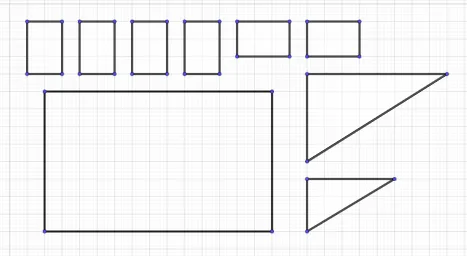
This example demonstrates an “area paradox” style phenomenon using a cut-and-stick construction: regions that appear to have different areas can be partitioned and reassembled so that the area relation becomes clear and verifiable. The key ideas are geometric dissection, area invariance under rearrangement, and coordinate-geometry reasoning (including the role of segment connections, slopes/differences, and consistent correspondences of pieces). Construction-wise, it is built in GeoGebra by creating and connecting foundational points (e.g., A, B, C, D, E, F, G and related derived objects) and forming polygonal pieces that represent the cut blocks and the recombined shapes. The GeoGebra commands reflected in the construction summary center on Segment and Polygon, with the many named objects (such as f, g, h, i and their derived variants) used to specify the boundaries and assembled regions. Suitable for secondary school geometry, area proofs through rearrangement, and exploratory learning in coordinate geometry and geometric construction.
GeoGebra Commands & Parameters
Segment(A, B) → fSegment(B, C) → gSegment(C, D) → hSegment(D, A) → iPolygon(E, F, G) → t2, g_1, e, f_1Polygon(H, I, J) → t3, j, h_1, i_1Polygon(K, L, M, N) → q1, k, l, m, nPolygon(O, P, Q, R) → q2, o, p, q, rPolygon(S, T, U, V) → q3, s, t, u, vPolygon(W, Z, A_1, B_1) → q4, w, z_1, a_1, b_1Polygon(C_1, D_1, E_1, F_1) → q5, c_1, d_1, e_1, dPolygon(G_1, H_1, I_1, J_1) → q6, j_1, k_1, l_1, m_1Segment(E, F) → n_1Segment(G, F) → p_1Segment(E, G) → q_1Segment(I, H) → r_1Segment(H, J) → s_1Segment(J, I) → t_1Segment(C, B) → g_2Segment(B, A) → h_2Segment(K, L) → f_2Segment(L, M) → i_2Segment(M, N) → j_2Segment(N, K) → k_2Segment(O, P) → l_2Segment(P, Q) → m_2Segment(Q, R) → n_2Segment(R, O) → p_2Segment(S, V) → q_2Segment(V, U) → r_2Segment(U, T) → s_2Segment(T, S) → t_2Segment(W, B_1) → a_2Segment(B_1, A_1) → b_2Segment(A_1, Z) → c_2Segment(Z, W) → d_2Segment(C_1, F_1) → e_2Segment(F_1, E_1) → f_3Segment(E_1, D_1) → g_3Segment(D_1, C_1) → h_3Segment(G_1, H_1) → i_3Segment(H_1, I_1) → j_3Segment(I_1, J_1) → k_3Segment(J_1, G_1) → l_3Segment(D, C) → m_3Segment(D, A) → n_3
AI Drawing Prompt Reference
Draw a geometric illustration showing an area paradox. Use cutting and sticking to rearrange seemingly differently sized regions, demonstrating area invariance. Include multiple polygons and segments connected by points, with some areas cut and reassembled, highlighting geometric dissection and coordinate geometry principles for educational exploration.
The prompt above was compiled from the original drawing commands and is for reference only.