
Area of Triangles: Dynamic Construction and Comparison
Loading the math board and drawing, please wait…
In collections
AREA
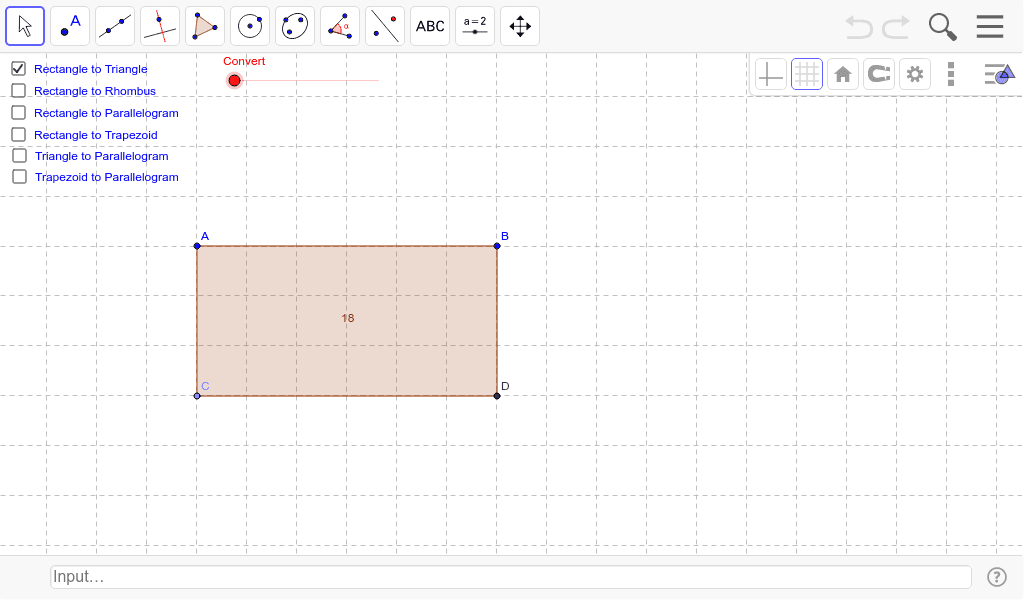
This GeoGebra example dynamically demonstrates the area of triangles, focusing on right triangles and general triangles, and explores how transformations such as rotation and reflection affect area. The core mathematical concepts include the triangle area formula (base × height / 2), congruence, symmetry, and the use of auxiliary lines (altitudes, medians) to decompose or rearrange shapes. The construction uses commands like Line, OrthogonalLine, Point, Intersect, Segment, Midpoint, Semicircle, Rotate, Angle, Polygon, and Mirror to build multiple triangles and polygons, measure their areas, and label angles. It is suitable for middle school to high school students to visually grasp area derivation, triangle congruence criteria, and geometric transformations, and can serve as a classroom demonstration or self-guided exploration tool.
GeoGebra Commands & Parameters
Line(A, B) → aOrthogonalLine(A, a) → bPoint(b) → CLine(C, a) → cOrthogonalLine(B, a) → dIntersect(c, d) → DSegment(A, B) → ePoint(e) → ESegment(E, C) → fSegment(E, D) → gMidpoint(f) → FMidpoint(g) → GSemicircle(E, D) → hOrthogonalLine(E, e) → iIntersect(c, i) → HSemicircle(B, H) → kSemicircle(D, E) → p_1Semicircle(H, A) → qSemicircle(C, E) → rSemicircle(E, C) → sRotate(E, -α, G) → E'Angle(E', G, E) → βRotate(B, -α, G) → B'Angle(B', G, B) → γRotate(D, -α, G) → D'Angle(D', G, D) → δPolygon(E', B', D') → poly1, d', e', b'Rotate(A, α, F) → A'Angle(A, F, A') → εRotate(E, α, F) → E'_1Angle(E, F, E'_1) → ζRotate(C, α, F) → C'Angle(C, F, C') → ηPolygon(A', C', E'_1) → poly2, e'_1, a', c'Midpoint(e) → IMidpoint(A, C) → JMidpoint(C, D) → KMidpoint(B, D) → LPolygon(J, I, L, K) → poly3, j_1, i_1, l, k_1Midpoint(j_1) → MMidpoint(i_1) → NMidpoint(l) → OMidpoint(k_1) → PRotate(J, α, P) → J'Angle(J, P, J') → θRotate(C, α, P) → C'_1Angle(C, P, C'_1) → ιRotate(K, α, P) → K'Angle(K, P, K') → κPolygon(J', C'_1, K') → poly4, k', j', c'_1Rotate(K, -α, O) → K'_1Angle(K'_1, O, K) → λRotate(L, -α, O) → L'Angle(L', O, L) → μRotate(D, -α, O) → D'_1Angle(D'_1, O, D) → νPolygon(K'_1, D'_1, L') → poly5, l', k'_1, d'_1Rotate(A, -α, M) → A'_1Angle(A'_1, M, A) → ξRotate(I, -α, M) → I'Angle(I', M, I) → οRotate(J, -α, M) → J'_1Angle(J'_1, M, J) → ρPolygon(J'_1, A'_1, I') → poly6, i', j'_1, a'_1Rotate(B, α, N) → B'_1Angle(B, N, B'_1) → σRotate(L, α, N) → L'_1Angle(L, N, L'_1) → τRotate(I, α, N) → I'_1Angle(I, N, I'_1) → υPolygon(B'_1, L'_1, I'_1) → poly7, i'_1, b'_1, l'_1Segment(A', C') → n_2Polygon(C, E, D) → poly8, d_1, c_1, e_1Midpoint(A, C) → QMidpoint(D, C) → RMidpoint(A, B) → SMidpoint(B, D) → TSegment(Q, T) → tSegment(S, R) → a_1Intersect(t, a_1) → UPoint(e) → VMirror(V, U) → V'Polygon(C, Q, V, B, T, V') → poly9, c_2, q_1, v, b_1, t_1, v'Rotate(A, α, Q) → A'_2Angle(A, Q, A'_2) → ϕRotate(V, α, Q) → V'_1Angle(V, Q, V'_1) → χPolygon(Q, V'_1, A'_2) → poly10, a'_2, q_2, v'_1Rotate(V', α, T) → V''Angle(V', T, V'') → ψRotate(D, α, T) → D'_2Angle(D, T, D'_2) → ωPolygon(V'', D'_2, T) → poly11, t_2, v'', d'_2Segment(C, D) → f_1Segment(C, V') → g_1Segment(V, B) → h_1Segment(Q, C) → l_1Midpoint(A, C) → WMidpoint(B, D) → ZSegment(V, B) → m_1Point(m_1) → A_1Polygon(W, C, D, Z, A_1, V) → poly12, w, c_3, d_2, z, u_2, v_1Rotate(A_1, -α, Z) → B_1Angle(B_1, Z, A_1) → α_1Rotate(B, -α, Z) → B'_2Angle(B'_2, Z, B) → β_1Polygon(B_1, Z, B'_2) → poly13, b'_2, b_2, z_1Segment(E, C) → n_1Segment(C, D) → r_1Segment(E, D) → s_1Midpoint(s_1) → C_1Rotate(E, α, C_1) → E'_2Angle(E, C_1, E'_2) → γ_1Rotate(C, α, C_1) → C'_2Angle(C, C_1, C'_2) → δ_1Rotate(D, α, C_1) → D'_3Angle(D, C_1, D'_3) → ε_1Polygon(E'_2, C'_2, D'_3) → poly14, d'_3, e'_2, c'_2Midpoint(A, C) → D_1Midpoint(B, D) → E_1Mirror(V, D_1) → V'_2Mirror(A_1, E_1) → F_1Polygon(V, V'_2, F_1, A_1) → poly15, v_2, v'_2, f_2, a_2Midpoint(A_1, F_1) → G_1Rotate(A_1, α, G_1) → H_1Angle(A_1, G_1, H_1) → ζ_1Rotate(V, α, G_1) → V'_3Angle(V, G_1, V'_3) → η_1Rotate(V'_2, α, G_1) → I_1Angle(V'_2, G_1, I_1) → θ_1Rotate(F_1, α, G_1) → J_1Angle(F_1, G_1, J_1) → ι_1Polygon(V'_3, I_1, J_1, H_1) → poly16, v'_3, i_2, j_2, h_2Polygon(E'_1, A', C') → poly17, c'_3, e'_3, a'_3Polygon(A, C, D, B) → poly18, a_3, c_4, d_3, b_3Polygon(C, E, D) → poly19, d_4, c_5, e_2Polygon(E', B', D') → poly20, d'_4, e'_4, b'_3Polygon(A'_1, J'_1, I') → poly21, i'_2, a'_4, j'_2Polygon(B'_1, I'_1, L'_1) → poly22, l'_2, b'_4, i'_3Polygon(J', K', C'_1) → poly23, c'_4, j'_3, k'_2Polygon(K'_1, D'_1, L') → poly24, l'_3, k'_3, d'_5Polygon(A, C, D, B) → poly25, a_4, c_6, d_5, b_4Polygon(I, J, K, L) → poly26, i_3, j_3, k_2, l_2Polygon(V'_1, A'_2, Q) → poly27, q_3, v'_4, a'_5Polygon(D'_2, T, V'') → poly28, v''_1, d'_6, t_3Polygon(V, V'_1, V', V'') → poly29, v_3, v'_5, v'_6, v''_2Polygon(A, C, D, B) → poly30, a_5, c_7, d_6, b_5Point(b_5) → K_1Polygon(V'_1, A'_2, Q) → poly31, q_4, v'_7, a'_6Polygon(B_1, Z, B'_2) → poly32, b'_5, b_6, z_2Polygon(V, V'_1, B_1, A_1) → poly33, v_4, v'_8, b_7, a_6Polygon(A, C, D, B) → poly34, a_7, c_8, d_7, b_8Polygon(E, C, D) → poly35, d_8, e_3, c_9Polygon(D'_3, E'_2, C'_2) → poly36, c'_5, d'_7, e'_5Polygon(C'_2, E, C, D) → poly37, c'_6, e_4, c_{10}, d_9Polygon(V, V'_2, F_1, A_1) → poly38, v_5, v'_9, f_3, a_8Polygon(J_1, H_1, V'_3, I_1) → poly39, j_4, h_3, v'_{10}, i_4Polygon(V, V'_2, V'_3, I_1) → poly40, v_6, v'_{11}, v'_{12}, i_5
AI Drawing Prompt Reference
Draw a right triangle and a general triangle to demonstrate the calculation of their areas. Show how the area changes when these triangles are rotated and reflected. Include auxiliary lines like altitudes and medians to decompose or rearrange the shapes. Measure and label the angles, comparing the areas and shapes of the transformed figures.
The prompt above was compiled from the original drawing commands and is for reference only.