
Area of Quadrilaterals: Dynamic Construction of Parallelogram, Rectangle, Rhombu
Loading the math board and drawing, please wait…
In collections
Deriving area formulas for Geometry
Surface nets 6th Grade
Deriving area formulas for Geometry
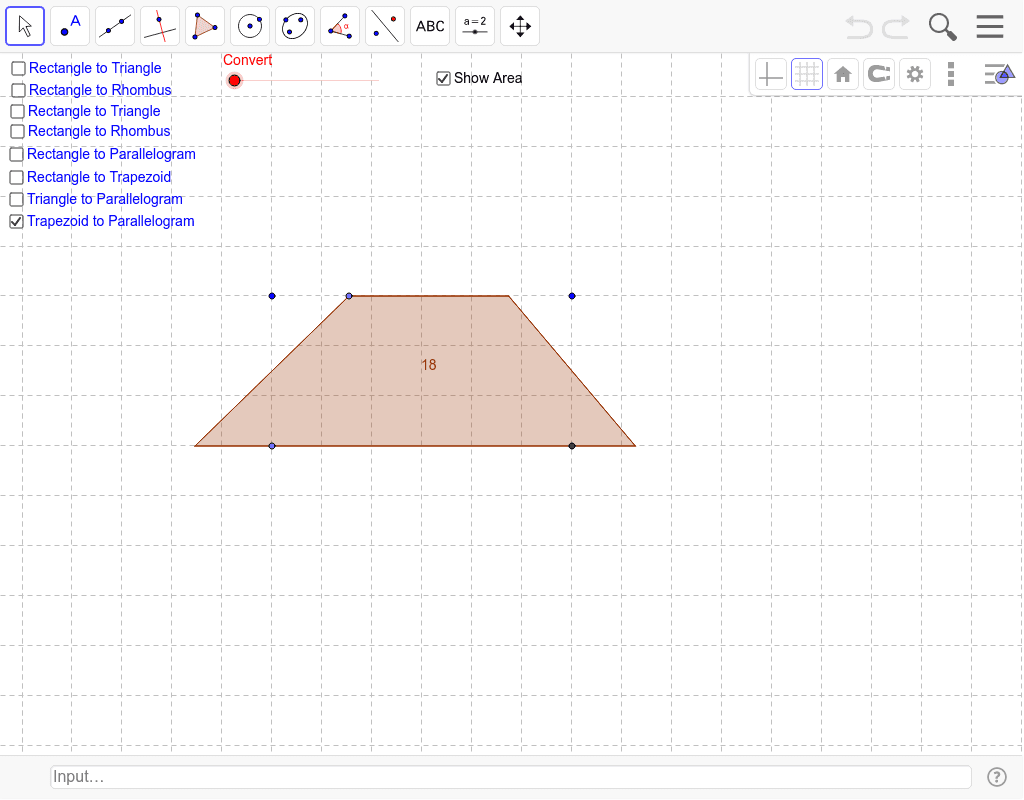
This GeoGebra example dynamically demonstrates the area relationships and construction of various quadrilaterals, including parallelograms, rectangles, rhombi, and trapezoids. The core mathematical concepts involve definitions of quadrilaterals, area formulas, symmetry, rotation and reflection transformations, and set-theoretic classification of shapes. The construction uses commands such as Line, OrthogonalLine, Point, Intersect, Segment, Midpoint, Semicircle, Rotate, Angle, Polygon, Mirror, and Circle, creating multiple points, segments, polygons, and auxiliary circles. Through rotation and mirroring, symmetric figures are generated, resulting in two polygons (poly1 and poly2) for area comparison. This resource is suitable for middle and high school geometry classes, helping students intuitively understand the derivation of area formulas for different quadrilaterals and the effects of transformations on area, as well as exploring area conservation and equidecomposition problems.
GeoGebra Commands & Parameters
Line(A, B) → aOrthogonalLine(A, a) → bPoint(b) → CLine(C, a) → cOrthogonalLine(B, a) → dIntersect(c, d) → DSegment(A, B) → ePoint(e) → ESegment(E, C) → fSegment(E, D) → gMidpoint(f) → FMidpoint(g) → GSemicircle(E, D) → hOrthogonalLine(E, e) → iIntersect(c, i) → HSemicircle(B, H) → kSemicircle(D, E) → p_1Semicircle(H, A) → qSemicircle(C, E) → rSemicircle(E, C) → sRotate(E, -α, G) → E'Angle(E', G, E) → βRotate(B, -α, G) → B'Angle(B', G, B) → γRotate(D, -α, G) → D'Angle(D', G, D) → δPolygon(E', B', D') → poly1, d', e', b'Rotate(A, α, F) → A'Angle(A, F, A') → εRotate(E, α, F) → E'_1Angle(E, F, E'_1) → ζRotate(C, α, F) → C'Angle(C, F, C') → ηPolygon(A', C', E'_1) → poly2, e'_1, a', c'Midpoint(e) → IMidpoint(A, C) → JMidpoint(C, D) → KMidpoint(B, D) → LPolygon(J, I, L, K) → poly3, j_1, i_1, l, k_1Midpoint(j_1) → MMidpoint(i_1) → NMidpoint(l) → OMidpoint(k_1) → PRotate(J, α, P) → J'Angle(J, P, J') → θRotate(C, α, P) → C'_1Angle(C, P, C'_1) → ιRotate(K, α, P) → K'Angle(K, P, K') → κPolygon(J', C'_1, K') → poly4, k', j', c'_1Rotate(K, -α, O) → K'_1Angle(K'_1, O, K) → λRotate(L, -α, O) → L'Angle(L', O, L) → μRotate(D, -α, O) → D'_1Angle(D'_1, O, D) → νPolygon(K'_1, D'_1, L') → poly5, l', k'_1, d'_1Rotate(A, -α, M) → A'_1Angle(A'_1, M, A) → ξRotate(I, -α, M) → I'Angle(I', M, I) → οRotate(J, -α, M) → J'_1Angle(J'_1, M, J) → ρPolygon(J'_1, A'_1, I') → poly6, i', j'_1, a'_1Rotate(B, α, N) → B'_1Angle(B, N, B'_1) → σRotate(L, α, N) → L'_1Angle(L, N, L'_1) → τRotate(I, α, N) → I'_1Angle(I, N, I'_1) → υPolygon(B'_1, L'_1, I'_1) → poly7, i'_1, b'_1, l'_1Segment(A', C') → n_2Polygon(C, E, D) → poly8, d_1, c_1, e_1Midpoint(A, C) → QMidpoint(D, C) → RMidpoint(A, B) → SMidpoint(B, D) → TSegment(Q, T) → tSegment(S, R) → a_1Intersect(t, a_1) → UPoint(e) → VMirror(V, U) → V'Polygon(C, Q, V, B, T, V') → poly9, c_2, q_1, v, b_1, t_1, v'Rotate(A, α, Q) → A'_2Angle(A, Q, A'_2) → ϕRotate(V, α, Q) → V'_1Angle(V, Q, V'_1) → χPolygon(Q, V'_1, A'_2) → poly10, a'_2, q_2, v'_1Rotate(V', α, T) → V''Angle(V', T, V'') → ψRotate(D, α, T) → D'_2Angle(D, T, D'_2) → ωPolygon(V'', D'_2, T) → poly11, t_2, v'', d'_2Segment(C, D) → f_1Segment(C, V') → g_1Segment(V, B) → h_1Segment(Q, C) → l_1Midpoint(A, C) → WMidpoint(B, D) → ZSegment(V, B) → m_1Point(m_1) → A_1Polygon(W, C, D, Z, A_1, V) → poly12, w, c_3, d_2, z, u_2, v_1Rotate(A_1, -α, Z) → B_1Angle(B_1, Z, A_1) → α_1Rotate(B, -α, Z) → B'_2Angle(B'_2, Z, B) → β_1Polygon(B_1, Z, B'_2) → poly13, b'_2, b_2, z_1Segment(E, C) → n_1Segment(C, D) → r_1Segment(E, D) → s_1Midpoint(s_1) → C_1Rotate(E, α, C_1) → E'_2Angle(E, C_1, E'_2) → γ_1Rotate(C, α, C_1) → C'_2Angle(C, C_1, C'_2) → δ_1Rotate(D, α, C_1) → D'_3Angle(D, C_1, D'_3) → ε_1Polygon(E'_2, C'_2, D'_3) → poly14, d'_3, e'_2, c'_2Midpoint(A, C) → D_1Midpoint(B, D) → E_1Mirror(V, D_1) → V'_2Mirror(A_1, E_1) → F_1Polygon(V, V'_2, F_1, A_1) → poly15, v_2, v'_2, f_2, a_2Midpoint(A_1, F_1) → G_1Rotate(A_1, α, G_1) → H_1Angle(A_1, G_1, H_1) → ζ_1Rotate(V, α, G_1) → V'_3Angle(V, G_1, V'_3) → η_1Rotate(V'_2, α, G_1) → I_1Angle(V'_2, G_1, I_1) → θ_1Rotate(F_1, α, G_1) → J_1Angle(F_1, G_1, J_1) → ι_1Polygon(V'_3, I_1, J_1, H_1) → poly16, v'_3, i_2, j_2, h_2Polygon(E'_1, A', C') → poly17, c'_3, e'_3, a'_3Polygon(A, C, D, B) → poly18, a_3, c_4, d_3, b_3Polygon(C, E, D) → poly19, d_4, c_5, e_2Polygon(E', B', D') → poly20, d'_4, e'_4, b'_3Polygon(A'_1, J'_1, I') → poly21, i'_2, a'_4, j'_2Polygon(B'_1, I'_1, L'_1) → poly22, l'_2, b'_4, i'_3Polygon(J', K', C'_1) → poly23, c'_4, j'_3, k'_2Polygon(K'_1, D'_1, L') → poly24, l'_3, k'_3, d'_5Polygon(A, C, D, B) → poly25, a_4, c_6, d_5, b_4Polygon(I, J, K, L) → poly26, i_3, j_3, k_2, l_2Polygon(V'_1, A'_2, Q) → poly27, q_3, v'_4, a'_5Polygon(D'_2, T, V'') → poly28, v''_1, d'_6, t_3Polygon(V, V'_1, V', V'') → poly29, v_3, v'_5, v'_6, v''_2Polygon(A, C, D, B) → poly30, a_5, c_7, d_6, b_5Point(b_5) → K_1Polygon(V'_1, A'_2, Q) → poly31, q_4, v'_7, a'_6Polygon(B_1, Z, B'_2) → poly32, b'_5, b_6, z_2Polygon(V, V'_1, B_1, A_1) → poly33, v_4, v'_8, b_7, a_6Polygon(A, C, D, B) → poly34, a_7, c_8, d_7, b_8Polygon(E, C, D) → poly35, d_8, e_3, c_9Polygon(D'_3, E'_2, C'_2) → poly36, c'_5, d'_7, e'_5Polygon(C'_2, E, C, D) → poly37, c'_6, e_4, c_{10}, d_9Polygon(V, V'_2, F_1, A_1) → poly38, v_5, v'_9, f_3, a_8Polygon(J_1, H_1, V'_3, I_1) → poly39, j_4, h_3, v'_{10}, i_4Polygon(V, V'_2, V'_3, I_1) → poly40, v_6, v'_{11}, v'_{12}, i_5Midpoint(A, E) → L_1Midpoint(E, B) → M_1Mirror(C, L_1) → C'_3Polygon(A, C, D, B) → poly41, a_9, c_{11}, d_{10}, b_9Polygon(L_1, C, D, M_1) → poly42, l_3, c_{12}, d_{11}, m_2Mirror(A, L_1) → A'_3Mirror(A'_3, L_1) → O_1Intersect(l_3, c_{12}) → P_1Rotate(O_1, -α, L_1) → Q_1Angle(Q_1, L_1, O_1) → κ_1Rotate(P_1, -α, L_1) → R_1Angle(R_1, L_1, P_1) → λ_1Polygon(Q_1, R_1, L_1) → poly43, l_4, q_5, r_2Rotate(D, α, M_1) → D'_4Angle(D, M_1, D'_4) → μ_1Rotate(B, α, M_1) → B'_3Angle(B, M_1, B'_3) → ν_1Polygon(M_1, B'_3, D'_4) → poly44, d'_8, m_3, b'_6Polygon(R_1, C, D) → poly45, d_{12}, r_3, c_{13}Circle(C, D) → p_2Line(A, B) → g_2Intersect(p_2, g_2) → N_1, S_1Polygon(A, C, D, B) → poly46, a_{10}, c_{14}, d_{13}, b_{10}Polygon(C, S_1, B, D) → poly47, c_{15}, s_2, b_{11}, d_{14}Segment(A, B) → g_3Midpoint(g_3) → T_1Rotate(A, -α, T_1) → A'_4Angle(A'_4, T_1, A) → ξ_1Segment(C, D) → k_3Midpoint(c_{14}) → U_1Rotate(C, -α, U_1) → C'_4Angle(C'_4, U_1, C) → ο_1Midpoint(S_1, B) → V_1Mirror(A, V_1) → A'_5Midpoint(S_1, A'_5) → W_1Rotate(S_1, -α, W_1) → Z_1Angle(Z_1, W_1, S_1) → ρ_1Polygon(A'_4, C'_4, Z_1) → poly48, z_3, a'_7, c'_7Polygon(C, S_1, Z_1, D) → poly49, c_{16}, s_3, z_4, d_{15}
AI Drawing Prompt Reference
Draw a dynamic geometric illustration showing area relationships and constructions of parallelograms, rectangles, rhombuses, and trapezoids. Start by drawing a line segment and its perpendicular, forming a right triangle. Use the segment as a diameter to draw a semicircle, connecting the intersections to create a parallelogram. Rotate the semicircle around the midpoint of the segment to form another parallelogram for area comparison. Connect various points to form multiple polygons, and rotate some to demonstrate symmetry and area changes.
The prompt above was compiled from the original drawing commands and is for reference only.