
Area of Parallelogram by h.hurchand
Loading the math board and drawing, please wait…
In collections
Deriving area formulas for Geometry
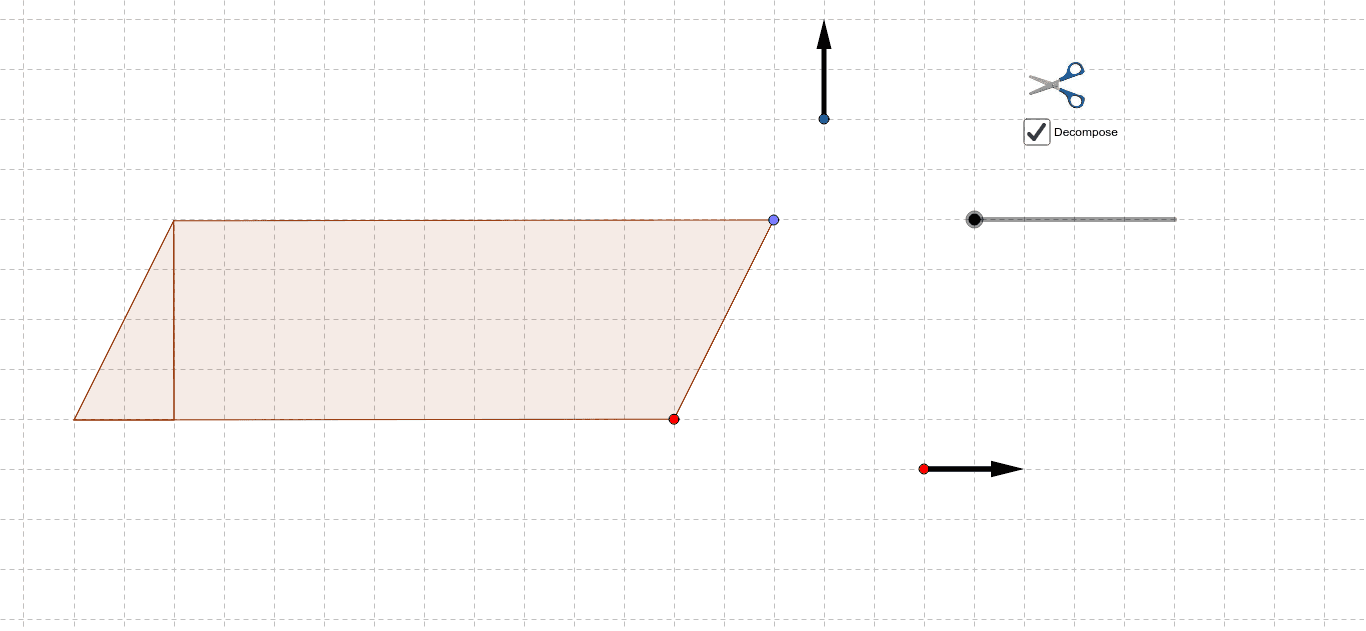
This example demonstrates how to calculate the area of a parallelogram using vector cross product. It involves core mathematical concepts like vectors, vector cross product, and geometric construction. The construction utilizes commands and objects such as Point, Segment, OrthogonalLine, Line, Intersect, Polygon, and Vector. It is suitable for high school mathematics teaching, helping students understand and apply vectors in geometric problems.
GeoGebra Commands & Parameters
Point(yAxis) → ASegment(A, B) → aPoint(a) → COrthogonalLine(C, a) → bPoint(b) → DPoint(a) → ESegment(D, E) → cOrthogonalLine(D, b) → dLine(A, c) → eIntersect(d, e) → FOrthogonalLine(F, a) → fIntersect(f, a) → GPolygon(H_1, H_3, H_2) → poly1, h_2, h_1, h_3Polygon(A, F, D, E) → poly2, a_1, f_1, d_1, e_1Polygon(G, F, D, E) → poly3, g_1, f_2, d_2, e_2Vector(H, I) → uVector(J, K) → v
AI Drawing Prompt Reference
Draw a parallelogram to calculate its area using vector cross product. Start by drawing a line segment, then take a point on it, and draw a perpendicular line through this point. Find the intersection of this perpendicular line with another line parallel to the original segment. Construct the parallelogram using these points and segments, labeling the base and height, and represent the base and height as vectors to demonstrate the geometric meaning of the vector cross product.
The prompt above was compiled from the original drawing commands and is for reference only.