
Area of a Rhombus by hope0019
Loading the math board and drawing, please wait…
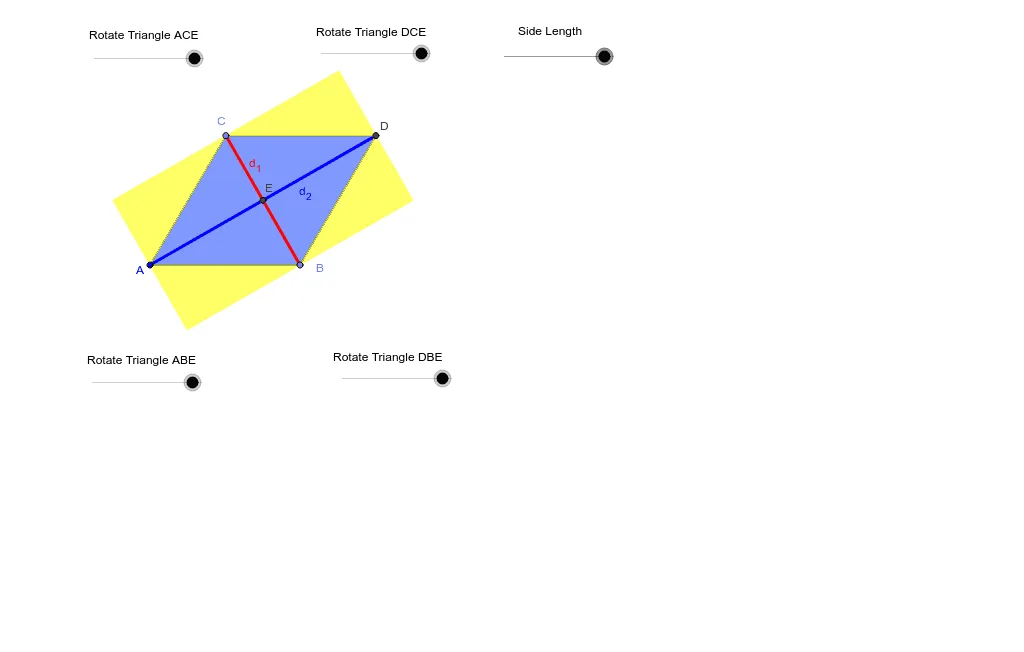
This example demonstrates the calculation of the area of a rhombus. Key mathematical concepts include the properties of a rhombus and the midline theorem. By constructing the midlines of the rhombus and using the area formula, one can intuitively understand the calculation of the rhombus area. GeoGebra commands used include point, segment, circle, line, intersect, polygon, midpoint, mirror, and rotate. Suitable for middle school and above students to learn geometric construction and area calculation.
GeoGebra Commands & Parameters
Point(Circle[A, a]) → BSegment(A, B) → bCircle(A, a) → cPoint(c) → CSegment(A, C) → dCircle(C, a) → eLine(C, b) → fIntersect(e, f, 2) → DSegment(C, D) → gSegment(D, B) → hSegment(A, D) → mSegment(C, B) → nIntersect(m, n) → EPolygon(C, E, D) → P, d_1, c_1, e_1Polygon(C, E, A) → Q, a_1, c_2, e_2Polygon(A, E, B) → R, b_1, a_2, e_3Polygon(B, D, E) → S, e_4, b_2, d_2Midpoint(D, C) → FMidpoint(D, B) → GMidpoint(A, B) → HMidpoint(A, C) → IMirror(C, I) → C'Mirror(E, I) → E'Mirror(A, I) → A'Mirror(C, F) → C'_1Mirror(E, F) → E'_1Mirror(D, F) → D'Mirror(B, G) → B'Mirror(D, G) → D'_1Mirror(E, G) → E'_2Mirror(A, H) → A'_1Mirror(E, H) → E'_3Mirror(B, H) → B'_1Rotate(C, α, I) → C'_2Rotate(E, α, I) → E'_4Rotate(A, α, I) → A'_2Polygon(C'_2, E'_4, A'_2) → Q', a'_2, c'_2, e'_4Rotate(C, (-β), F) → C'_3Rotate(E, (-β), F) → E'_5Rotate(D, (-β), F) → D'_2Polygon(C'_3, E'_5, D'_2) → P', d'_2, c'_3, e'_5Rotate(A, γ, H) → A'_3Rotate(E, γ, H) → E'_6Rotate(B, γ, H) → B'_2Polygon(A'_3, E'_6, B'_2) → R', b'_2, a'_3, e'_6Rotate(B, (-δ), G) → B'_3Rotate(D, (-δ), G) → D'_3Rotate(E, (-δ), G) → E'_7Polygon(B'_3, D'_3, E'_7) → S', e'_7, b'_3, d'_3
AI Drawing Prompt Reference
Draw a rhombus by constructing its diagonals and midlines to calculate the area. Start by drawing circles with centers at points A and C and the same radius to find intersection points B and D. Connect AB, BC, CD, and DA to form the rhombus. Then, find the midpoints F, G, H, and I of the diagonals and sides. Use mirroring and rotation to construct the diagonals and midlines, and finally use these lines to calculate the area of the rhombus.
The prompt above was compiled from the original drawing commands and is for reference only.