
Area of a Kite by Math Teachers' Adventure of ICT Integration
Loading the math board and drawing, please wait…
In collections
Area of a Kite (Deltoid)
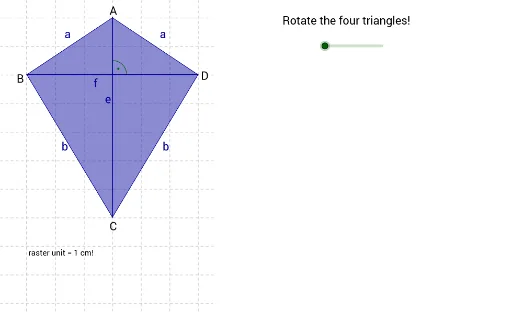
This example demonstrates the derivation of the area formula for a kite. Key mathematical concepts include geometric construction, angles, segments, and polygons. Using GeoGebra commands such as Line, Segment, Polygon, and Intersect, the construction process of a kite is clearly illustrated. Suitable for students in middle school and above who are learning geometry and area calculation.
GeoGebra Commands & Parameters
Line(A, B) → aSegment(C, D) → bPolygon(B, D, A, C) → Vieleck1, b_1, d, a_1, cSegment(A, B) → eIntersect(b, e) → EPolygon(A, E, D) → Vieleck2, d_1, a_2, e_1Polygon(A, E, C) → Vieleck3, c_1, a_3, e_2Polygon(C, E, B) → Vieleck4, b_2, c_2, e_3Polygon(E, B, D) → Vieleck5, d_2, e_4, b_3Midpoint(D, A) → FMidpoint(A, C) → GMidpoint(C, B) → HMidpoint(B, D) → IRotate(A, α, F) → A'_1Rotate(E, α, F) → E'_1Rotate(D, α, F) → D'_1Polygon(A'_1, E'_1, D'_1) → Vieleck2', d', a', e'Rotate(E, α, I) → E'_2Rotate(B, α, I) → B'_1Rotate(D, α, I) → D'Polygon(E'_2, B'_1, D') → Vieleck5', d'_1, e'_1, b'Rotate(A, α, G) → A'Rotate(E, α, G) → E'_3Rotate(C, α, G) → C'_1Polygon(A', E'_3, C'_1) → Vieleck3', c', a'_1, e'_2Rotate(C, α, H) → C'Rotate(E, α, H) → E'Rotate(B, α, H) → B'Polygon(C', E', B') → Vieleck4', b'_1, c'_1, e'_3Angle(D, E, A) → βSegment(J, K) → fTextfield(Text21) → Textfeld1Textfield(Text23) → Textfeld2Textfield(Text26) → Textfeld3Textfield(Text28) → Textfeld4Textfield(Text29) → Textfeld5Polygon(L, M, N, O) → Vieleck6, l, m, n, o
AI Drawing Prompt Reference
Draw a kite-shaped quadrilateral with diagonals intersecting at a point, dividing the kite into four triangles. Rotate each of these four triangles outward around the intersection point by a certain angle, creating four rotated triangles. Mark the midpoints of the kite's sides and connect them to form an inner quadrilateral. Add an angle label near the intersection and several text fields beside the figure, along with an auxiliary quadrilateral formed by four points, to illustrate the derivation of the area formula.
The prompt above was compiled from the original drawing commands and is for reference only.