
Area Models for Improper Fractions by EDC Interactive Math
Loading the math board and drawing, please wait…
In collections
fifth grade fractions
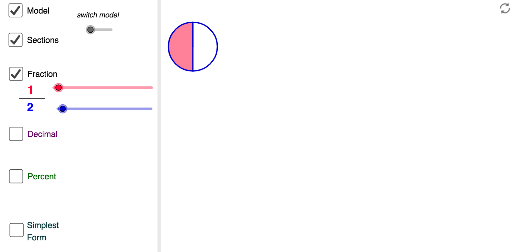
This example demonstrates two area models for improper fractions using circles and rectangles. Users can adjust the fraction numerator and denominator using sliders to observe the corresponding shape changes. The core mathematical concepts involved include fractions, geometric construction, and slider animation. Using GeoGebra commands such as Point, Rotate, CircleSector, and Polygon, users can visually understand the concept of improper fractions. Suitable for high-grade elementary to junior high school students to deepen their understanding of fractions.
GeoGebra Commands & Parameters
Point(Circle[M, 1]) → QPoint(Circle[N, 1]) → RPoint(Circle[L_1, 0.02]) → U_1Point(Circle[U_1, 0.5]) → V_1Rotate(C_2, angle, Center1) → D_2CircleSector(Center1, C_2, D_2) → circle1sectorRotate(C_2, (360 / denom1)°, Center1) → B_2Polygon((x(Center1) - 0.09, y(Center1) - 0.07), (x(Center1) - 0.09 + (0.18 * (val1 - floor(val1))), y(Center1) - 0.07), (x(Center1) - 0.09 + (0.18 * (val1 - floor(val1))), y(Center1) + 0.07), (x(Center1) - 0.09, y(Center1) + 0.07)) → rect1shadePartial, g, h, i, jPolygon((Element[Position, 1], 0) + (-0.09, yRow1 - 0.07), (Element[Position, 1], 0) + (0.09, yRow1 - 0.07), (Element[Position, 1], 0) + (0.09, yRow1 + 0.07), (Element[Position, 1], 0) + (-0.09, yRow1 + 0.07)) → rect1outline1, c, d, e, fSequence(Sequence[Segment[Rotate[(k, 0.525), ((360 / denom1 * i))°, (k, 0.525)], Rotate[(k, 0.525) + (0, CircleDiameters), ((360 * i / denom1))°, (k, 0.525)]], i, 0, denom1], k, 0.1, If[val1 ≥ 5, 0.9, Element[Position, ceil(val1)]], 0.2) → circle1div1If(val1 ≤ 5, Sequence[Circle[(i, yRow1), CircleDiameters], i, 0.1, Element[Position, If[val1 ≠ round(val1), floor(val1), ceil(val1)]], 0.2], Sequence[Circle[(i, yRow1), CircleDiameters], i, 0.1, Element[Position, 5], 0.2]) → circle1fill1If(val1 ≤ 5, Sequence[Circle[(i, yRow1), CircleDiameters], i, 0.1, Element[Position, ceil(val1)], 0.2], Sequence[Circle[(i, yRow1), CircleDiameters], i, 0.1, Element[Position, 5], 0.2]) → circle1outline1If(val1 ≤ 10, Sequence[Circle[(i, yRow2), CircleDiameters], i, 0.1, Element[Position, floor(val1)], 0.2], Sequence[Circle[(i, yRow2), CircleDiameters], i, 0.1, Element[Position, 5], 0.2]) → circle1fill2Sequence(Sequence[Segment[Rotate[(k, yRow2), ((360 / denom1 * i))°, (k, yRow2)], Rotate[(k, yRow2) + (0, CircleDiameters), ((360 * i / denom1))°, (k, yRow2)]], i, 0, denom1], k, 0.1, Element[Position, ceil(val1)], 0.2) → circle1div2If(val1 ≤ 10, Sequence[Circle[(i, yRow2), CircleDiameters], i, 0.1, Element[Position, ceil(val1)], 0.2], Sequence[Circle[(i, yRow2), CircleDiameters], i, 0.1, Element[Position, 10], 0.2]) → circle1outline2If(val1 ≤ 15, Sequence[Circle[(i, yRow3), CircleDiameters], i, 0.1, Element[Position, If[val1 ≠ round(val1), floor(val1), ceil(val1)]], 0.2], Sequence[Circle[(i, yRow3), CircleDiameters], i, 0.1, Element[Position, 15], 0.2]) → circle1fill3If(val1 ≤ 15, Sequence[Circle[(i, yRow3), CircleDiameters], i, 0.1, Element[Position, ceil(val1)], 0.2], Sequence[Circle[(i, yRow3), CircleDiameters], i, 0.1, Element[Position, 15], 0.2]) → circle1outline3If(val1 ≤ 20, Sequence[Circle[(i, yRow4), CircleDiameters], i, 0.1, Element[Position, ceil(val1)], 0.2], Sequence[Circle[(i, yRow4), CircleDiameters], i, 0.1, Element[Position, 20], 0.2]) → circle1outline4If(val1 ≤ 20, Sequence[Circle[(i, yRow4), CircleDiameters], i, 0.1, Element[Position, If[val1 ≠ round(val1), floor(val1), ceil(val1)]], 0.2], Sequence[Circle[(i, yRow4), CircleDiameters], i, 0.1, Element[Position, 20], 0.2]) → circle1fill4Sequence(Polygon[Translate[(Element[Position, 1], 0) + (-0.09, yRow1 - 0.07), Vector[(0, 0), (i, 0)]], Translate[(Element[Position, 1], 0) + (0.09, yRow1 - 0.07), Vector[(0, 0), (i, 0)]], Translate[(Element[Position, 1], 0) + (0.09, yRow1 + 0.07), Vector[(0, 0), (i, 0)]], Translate[(Element[Position, 1], 0) + (-0.09, yRow1 + 0.07), Vector[(0, 0), (i, 0)]]], i, 0, Element[Position, If[val1 ≤ 5, ceil(val1), 5]], 0.2) → rect1outline1SeqSequence(Polygon[Translate[(Element[Position, 1], 0) + (-0.09, yRow3 - 0.07), Vector[(0, 0), (i, 0)]], Translate[(Element[Position, 1], 0) + (0.09, yRow3 - 0.07), Vector[(0, 0), (i, 0)]], Translate[(Element[Position, 1], 0) + (0.09, yRow3 + 0.07), Vector[(0, 0), (i, 0)]], Translate[(Element[Position, 1], 0) + (-0.09, yRow3 + 0.07), Vector[(0, 0), (i, 0)]]], i, 0, Element[Position, If[val1 ≤ 15, ceil(val1), 15]], 0.2) → rect1outline3SeqSequence(Polygon[Translate[(Element[Position, 1], 0) + (-0.09, yRow4 - 0.07), Vector[(0, 0), (i, 0)]], Translate[(Element[Position, 1], 0) + (0.09, yRow4 - 0.07), Vector[(0, 0), (i, 0)]], Translate[(Element[Position, 1], 0) + (0.09, yRow4 + 0.07), Vector[(0, 0), (i, 0)]], Translate[(Element[Position, 1], 0) + (-0.09, yRow4 + 0.07), Vector[(0, 0), (i, 0)]]], i, 0, Element[Position, If[val1 ≤ 20, ceil(val1), 20]], 0.2) → rect1outline4SeqSequence(Sequence[Segment[(k - 0.09 + (0.18 / denom1 * i), yRow1 - 0.07), (k - 0.09 + (0.18 / denom1 * i), yRow1 + 0.07)], i, 1, denom1 - 1], k, 0.1, If[val1 ≥ 5, 0.9, Element[Position, ceil(val1)]], 0.2) → rect1div1Sequence(Sequence[Segment[(k - 0.09 + (0.18 / denom1 * i), yRow2 - 0.07), (k - 0.09 + (0.18 / denom1 * i), yRow2 + 0.07)], i, 1, denom1 - 1], k, 0.1, If[val1 ≥ 10, 0.9, Element[Position, ceil(val1)]], 0.2) → rect1div2Sequence(Polygon[Translate[(Element[Position, 1], 0) + (-0.09, yRow1 - 0.07), Vector[(0, 0), (i, 0)]], Translate[(Element[Position, 1], 0) + (0.09, yRow1 - 0.07), Vector[(0, 0), (i, 0)]], Translate[(Element[Position, 1], 0) + (0.09, yRow1 + 0.07), Vector[(0, 0), (i, 0)]], Translate[(Element[Position, 1], 0) + (-0.09, yRow1 + 0.07), Vector[(0, 0), (i, 0)]]], i, 0, Element[Position, If[val1 ≤ 5, floor(val1), 5]], 0.2) → rect1shade1SeqSequence(Polygon[Translate[(Element[Position, 1], 0) + (-0.09, yRow2 - 0.07), Vector[(0, 0), (i, 0)]], Translate[(Element[Position, 1], 0) + (0.09, yRow2 - 0.07), Vector[(0, 0), (i, 0)]], Translate[(Element[Position, 1], 0) + (0.09, yRow2 + 0.07), Vector[(0, 0), (i, 0)]], Translate[(Element[Position, 1], 0) + (-0.09, yRow2 + 0.07), Vector[(0, 0), (i, 0)]]], i, 0, Element[Position, If[val1 < 10, floor(val1), 10]], 0.2) → rect1shade2SeqSequence(Polygon[Translate[(Element[Position, 1], 0) + (-0.09, yRow2 - 0.07), Vector[(0, 0), (i, 0)]], Translate[(Element[Position, 1], 0) + (0.09, yRow2 - 0.07), Vector[(0, 0), (i, 0)]], Translate[(Element[Position, 1], 0) + (0.09, yRow2 + 0.07), Vector[(0, 0), (i, 0)]], Translate[(Element[Position, 1], 0) + (-0.09, yRow2 + 0.07), Vector[(0, 0), (i, 0)]]], i, 0, Element[Position, If[val1 < 10, ceil(val1), 10]], 0.2) → rect1outline2SeqSequence(Polygon[Translate[(Element[Position, 1], 0) + (-0.09, yRow3 - 0.07), Vector[(0, 0), (i, 0)]], Translate[(Element[Position, 1], 0) + (0.09, yRow3 - 0.07), Vector[(0, 0), (i, 0)]], Translate[(Element[Position, 1], 0) + (0.09, yRow3 + 0.07), Vector[(0, 0), (i, 0)]], Translate[(Element[Position, 1], 0) + (-0.09, yRow3 + 0.07), Vector[(0, 0), (i, 0)]]], i, 0, Element[Position, If[val1 ≤ 15, floor(val1), 15]], 0.2) → rect1shade3SeqSequence(Polygon[Translate[(Element[Position, 1], 0) + (-0.09, yRow4 - 0.07), Vector[(0, 0), (i, 0)]], Translate[(Element[Position, 1], 0) + (0.09, yRow4 - 0.07), Vector[(0, 0), (i, 0)]], Translate[(Element[Position, 1], 0) + (0.09, yRow4 + 0.07), Vector[(0, 0), (i, 0)]], Translate[(Element[Position, 1], 0) + (-0.09, yRow4 + 0.07), Vector[(0, 0), (i, 0)]]], i, 0, Element[Position, If[val1 ≤ 20, floor(val1), 20]], 0.2) → rect1shade4SeqFractionText(num1 / denom1 - floor(num1 / denom1)) → MixNumFracFractionText(num1 / denom1) → FracSimplist