
Area Model for Multiplying 2-Digit by 2-Digit Numbers (GeoGebra Example)
Loading the math board and drawing, please wait…
In collections
Multiplication with Area Models
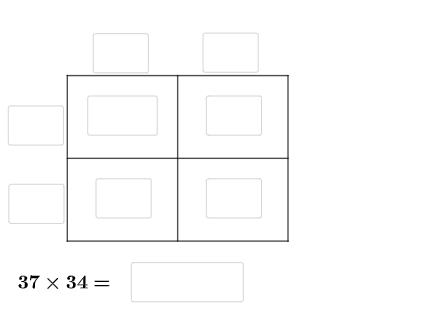
This GeoGebra example demonstrates how to use an area model to break down a multiplication of two 2-digit numbers into smaller regions, showing how each sub-area corresponds to a partial product and how the total area yields the final product. It focuses on key concepts such as place-value decomposition (tens and ones), distributive property for multiplication over addition, and the correspondence between geometric area and numerical products. Construction highlights drawn from the provided build summary include using Intersect to find boundary intersections, Point to define critical vertices, Polygon to form the partitioned shapes, and Segment to draw the dividing lines that create the area regions. Textfield is used to annotate variables or partial products on the diagram, and If supports conditional behavior (e.g., different configurations or displays). The construction references many point/label objects (e.g., A, D, E, F, G, H, J, K, L; and symbolic parameters such as q1, q2, q5, q6, a_{2}, e, f_{2}, g_{1}, g_{2}, h_{3}, h_{4}, l_{1}, l_{2}, etc.) to parameterize the model and keep the visual consistent with the chosen digits. Suitable for late primary through early secondary education, or for interactive lessons reinforcing place value and the distributive law in multiplication.
GeoGebra Commands & Parameters
Intersect(xAxis, yAxis) → APoint(yAxis) → DPoint(xAxis) → EPoint(xAxis) → FPoint(yAxis) → LPolygon(A, E, G, L) → q1, a_{2}, e, g_{4}, l_{2}Polygon(E, F, H, G) → q2, e_1, f_{2}, h_{4}, g_1Polygon(G, H, K, J) → q5, g_2, h_3, k_1, j_{2}Polygon(L, G, J, D) → q6, l_1, g_3, j_1, d_{2}Segment(D, A) → qSegment(J, E) → sSegment(K, F) → tRandom(1, 9) → oRandom(1, 9) → uRandom(1, 9) → vRandom(1, 9) → wRandom(1, 9) → a_1Random(1, 9) → b_1Textfield(d_1) → aTextfield(m_1) → bTextfield(t_1) → dTextfield(u_1) → fTextfield(o_1) → gTextfield(p_1) → hTextfield(r_1) → kTextfield(s_1) → lTextfield(ansguess) → nIf(n_1 ≟ v, "√", "X") → text3If(t_1 ≟ (10 * w), "√", "X") → text4If(u_1 ≟ a_1, "√", "X") → text5If(ansguess ≟ produc, "☺", "☹ ") → text7Segment(L, H) → rSegment(A, F) → m_{2}Segment(D, K) → pIf(d_1 ≟ (10 * u), "√", "X") → text1If(m_1 ≟ v, "√", "X") → text2
AI Drawing Prompt Reference
Draw an area model to demonstrate the multiplication of two two-digit numbers. Start by drawing a rectangle, then divide it into four smaller rectangles using horizontal and vertical lines, each representing a partial product. Label the length and width of each smaller rectangle and their products. Finally, use text to label each partial product and the final product.
The prompt above was compiled from the original drawing commands and is for reference only.