
Archimedes Pi: Approximating π with Inscribed and Circumscribed Polygons
Loading the math board and drawing, please wait…
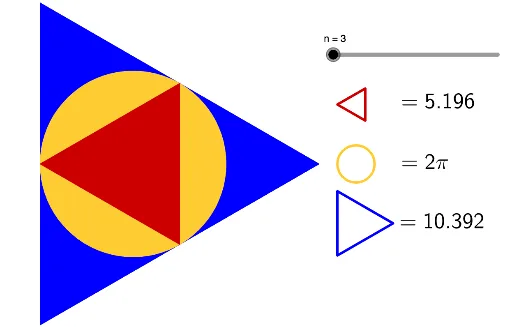
① This example dynamically demonstrates Archimedes' classical method of approximating π by constructing inscribed and circumscribed regular polygons around a circle. ② Core mathematical concepts include π, regular polygons, inscribed/circumscribed figures, limits, and the relationship between perimeter and circumference. As the number of sides n increases, the polygon perimeters converge to the circle's circumference, yielding increasingly accurate approximations of π. ③ Construction details: using GeoGebra commands such as Circle, Polygon, Intersect, Rotate, Dilate, Area, and Perimeter, with a slider n controlling the number of sides to animate the convergence. ④ Suitable for high school and early college students to explore limit concepts and the historical derivation of π, integrating geometry, trigonometry, and mathematical history.
GeoGebra Commands & Parameters
Circle((0, 0), 1) → cPolygon(A, B, n) → p_1, a, c_1, e_1, g_1, i_1, k_1, m_1, p_3, r_1, t_1, b_2, b, d_2, f_2, h_2, j_2, l_2, n_2, r_2, t_2, a_3, d_3, d, f_3, p, i_3, k_3, m_3, q_3, s_3, a_4, c_4, e_4, h, g_4, h_4, k_4, m_4, p_4, q_4, r_4, b_5, d_5, f_5, j, h_5, C, E, G, I, K, M, O, Q, S, l, U, W, C_1, E_1, G_1, I_1, K_1, M_1, O_1, Q_1, q, S_1, U_1, W_1, A_2, C_2, E_2, F_2, I_2, K_2, P_2, s, R_2, T_2, V_2, Z_2, B_3, D_3, F_3, H_3, J_3, K_3, a_1, N_3, P_3, R_3, S_3, T_3, Z_3, B_4, D_4, F_4Intersect(Tangent[A, c], Tangent[B, c]) → A_1Rotate(A_1, (2 * π / n)) → B_1Polygon(A_1, B_1, n) → p_2, e, d_1, f_1, h_1, j_1, l_1, n_1, q_1, s_1, a_2, c_2, f, e_2, g_2, i_2, k_2, m_2, q_2, s_2, b_3, c_3, e_3, g, g_3, h_3, j_3, l_3, n_3, r_3, t_3, b_4, d_4, f_4, i, i_4, j_4, l_4, n_4, s_4, t_4, a_5, c_5, e_5, g_5, k, i_5, D, F, H, J, L, N, P, R, T, m, V, Z, D_1, F_1, H_1, J_1, L_1, N_1, P_1, R_1, r, T_1, V_1, Z_1, B_2, D_2, G_2, H_2, J_2, L_2, Q_2, t, S_2, U_2, W_2, A_3, C_3, E_3, G_3, I_3, L_3, M_3, b_1, O_3, Q_3, U_3, V_3, W_3, A_4, C_4, E_4, G_4Dilate(p_1, fa, M_2) → mini1Dilate(p_2, fa, O_2) → mini3Dilate(c, fa, N_2) → mini2Area(c) → areacPerimeter(p_2) → perimeterp2Perimeter(p_1) → perimeterp1