
Archimedes Insight = GoGeometry Action 150!
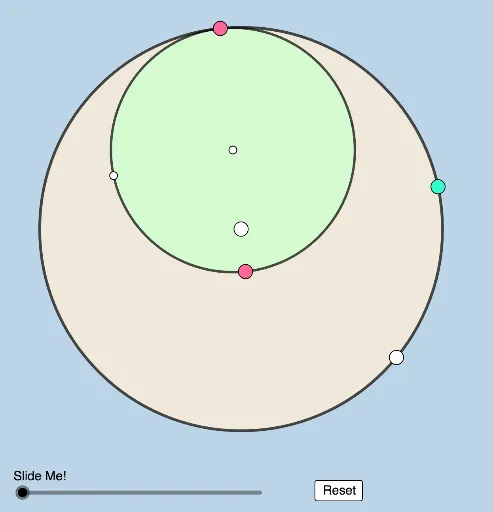
Loading the math board and drawing, please wait…
① This interactive GeoGebra example dynamically illustrates a geometry problem posted by Antonio Gutierrez, showcasing an Archimedean insight through a modifiable figure. ② Core mathematical concepts include circles, isosceles triangles, vectors, fractions, symmetry, and angle relationships, emphasizing proportional and structural connections among geometric elements. ③ Construction highlights: based on the summary, commands such as Circle, Point, Line, Intersect, Segment, Midpoint, Angle, Ray, Dilate, Rotate, CircleSector, Vector, and Translate are used to build a complex arrangement of circles, segments, vectors, and rotated objects, with sliders or draggable points enabling dynamic exploration. ④ Suitable for high school to early college geometry instruction, math competition training, or exploratory activities, helping learners grasp intuitive proofs and dynamic verification of geometric theorems.
GeoGebra Commands & Parameters
Circle(A, B) → cPoint(c) → CLine(C, A) → fIntersect(c, f) → D, ESegment(C, E) → gPoint(g) → FMidpoint(C, F) → GCircle(G, F) → dPoint(c) → HLine(H, A) → hIntersect(c, h, 2) → ILine(G, h) → iIntersect(d, i) → J, KLine(K, I) → jCircle(I, (0.3 * Min[Distance[K, I], Distance[K, G]])) → eIntersect(e, j, 2) → LAngle(L, I, H) → αRay(I, L) → kDilate(H, If[0 < a ≤ 1, 1 - a, 0], I) → H'Segment(H, H') → lDilate(K, If[1 < a ≤ 2, 2 - a, 0], G) → K'Segment(K, K') → mDilate(K, If[1 < a ≤ 2, 2 - a, 0], I) → I'Segment(K, I') → nRotate(L, If[2 < a ≤ 3, ((a - 2) * α), α], I) → L'CircleSector(I, L, L') → pDilate(I, If[3.5 < a ≤ 4.5, 4.5 - a, 0], K) → I'_1Vector(I, I'_1) → uTranslate(p, u) → p'Rotate(L, If[2 < a ≤ 3, ((-(a - 2)) * ((2 * π) - α)), α - (2 * π)], I) → L'_1CircleSector(I, L'_1, L) → qTranslate(q, u) → q'Dilate(G, If[3.5 < a ≤ 4.5, 4.5 - a, 0], J) → G'Segment(G, G') → rDilate(C, If[5.5 < a ≤ 6.5, 6.5 - a, 0], J) → C'Segment(C, C') → sDilate(J, If[6.5 < a ≤ 7.5, 7.5 - a, 0], H) → J'Segment(J, J) → tSegment(J, J') → b