
Arc Length Formula S=Rθ
Loading the math board and drawing, please wait…
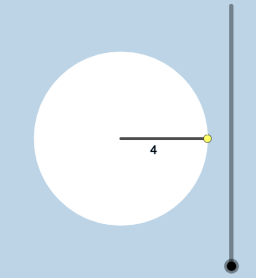
This example demonstrates constructing the arc length formula S=Rθ using GeoGebra. Key mathematical concepts include circles, angles, arc length, and radius relationships. Construction involves commands like Rotate, CircleArc, OrthogonalLine, and objects such as Point, Vector. Suitable for high school students learning geometry and trigonometry, or for math teaching demonstrations.
GeoGebra Commands & Parameters
Rotate((r, 0), 4, (0, 0)) → DRotate(D, If[11.5 < a ≤ 12.5, a - 11.5, 1], M) → D'Line(M, D') → g_2OrthogonalLine(D', g_2) → h_2CircleArc(M, D, D') → c_2Circle(D', r - c_2) → d_2Intersect(d_2, h_2) → J_1, K_1If(x(J_1) > x(K_1), J_1, K_1) → L_1Segment((0, 0), (r, 0)) → fRotate((r, 0), 1, (0, 0)) → ARotate((r, 0), 2, (0, 0)) → BRotate((r, 0), 3, (0, 0)) → CRotate((r, 0), 5, (0, 0)) → ERotate((r, 0), -1, (0, 0)) → FRotate(f, If[0 < a ≤ 1, ((-a) * pi / 2), ((-pi)) / 2], (r, 0)) → f'Rotate(G, If[1.5 < a ≤ 2.5, a - 1.5, 1], (0, 0)) → G'CircleArc((0, 0), G, G') → cCircle(G', r - c) → dLine((0, 0), G') → gOrthogonalLine(G', g) → hIntersect(d, h, 2) → HSegment(G', H) → iDilate(G, If[3 < a ≤ 4, 4 - a, 0], A) → G'_{1}Vector(G, G'_{1}) → uTranslate(f, u) → f'_{1}Line((0, 0), A) → jOrthogonalLine(A, j) → kPoint(p) → IPoint(k) → JAngle(J, A, I) → αRotate(f'_{1}, If[3 < a ≤ 4, ((-(a - 3)) * α), (-α)], G'_{1}) → lRotate(A, If[4 < a ≤ 5, a - 4, 1], (0, 0)) → A'CircleArc((0, 0), A, A') → eCircle(A', r - e) → qLine((0, 0), A') → mOrthogonalLine(A', m) → nIntersect(q, n, 2) → KSegment(A', K) → sDilate((0, 0), If[5.5 < a ≤ 6.5, 6.5 - a, 0], B) → LVector(M, L) → vTranslate(f, v) → f'_{2}Line(M, B) → bOrthogonalLine(B, b) → f_1Point(t) → NPoint(f_1) → OAngle(O, B, N) → βRotate(f'_{2}, If[5.5 < a ≤ 6.5, ((-(a - 5.5)) * β), (-β)], L) → g_1Rotate(B, If[6.5 < a ≤ 7.5, a - 6.5, 1], (0, 0)) → B'CircleArc(M, B, B') → c_1Line(M, B') → h_1OrthogonalLine(B', h_1) → i_1Circle(B', r - c_1) → d_1Intersect(d_1, i_1, 2) → PDilate(M, If[8 < a ≤ 9, 9 - a, 0], C) → M'Vector(M, M') → wTranslate(f, w) → f'_{3}Line(M, C) → k_1OrthogonalLine(C, k_1) → l_1Point(p_1) → QPoint(l_1) → RAngle(R, C, Q) → γRotate(f'_{3}, If[8 < a ≤ 9, ((-(a - 8)) * γ), (-γ)], M') → m_1Rotate(C, If[9 < a ≤ 10, a - 9, 1], M) → C'CircleArc(M, C, C') → e_1Line(M, C') → n_1OrthogonalLine(C', n_1) → q_1Circle(C', r - e_1) → r_1Intersect(r_1, q_1) → S, B_1Intersect(d_1, i_1, 1) → TDilate(M, If[10.5 < a ≤ 11.5, 11.5 - a, 0], D) → M'_{1}Vector(M, M'_{1}) → u_1Translate(f, u_1) → f'_{4}Line(M, D) → a_1OrthogonalLine(D, a_1) → b_1Point(b_1) → UPoint(t_1) → VAngle(U, D, V) → δRotate(f'_{4}, If[10.5 < a ≤ 11.5, ((-(a - 10.5)) * δ), (-δ)], M'_{1}) → f_2Intersect(d_2, h_2, 1) → WRotate(M, If[13 < a ≤ 14, ((a - 13) * pi / 2), pi / 2], G) → M'_{2}Segment(G, M'_{2}) → j_2If(x(P) ≤ x(T), P, T) → A_1Segment(B', A_1) → j_1If(y(B_1) < y(S), B_1, S) → C_1Segment(C', C_1) → s_1Rotate(G, If[14 < a ≤ 15, (-(a - 14)), -1], M) → G'_{2}CircleArc(M, G'_{2}, G) → e_2Line(M, G'_{2}) → k_2Circle(G'_{2}, r - e_2) → p_2OrthogonalLine(G'_{2}, k_2) → l_2Intersect(p_2, l_2) → D_1, E_1If(y(D_1) ≤ y(E_1), D_1, E_1) → F_1Segment(G'_{2}, F_1) → m_2Rotate(D, 1, M) → D'_{1}Rotate(G, 0.5) → G'_{3}Rotate(G, 1.5) → G'_{4}Rotate(G, 2.5) → G'_{5}Rotate(G, 3.5) → G'_{6}Rotate(G, 4.5) → G'_{7}Rotate(G, -0.5) → G'_{8}If(0 < a < 14, G, G'_{2}) → H_1If(0 < a ≤ 4, G', D'_{1}, 4 ≤ a ≤ 6.5, A', 6.5 < a ≤ 9, B', 9 < a ≤ 11.5, C', 11.5 < a ≤ 14, D') → I_1Segment(G_1, I_1) → n_2Angle(H_1, G_1, I_1) → θSegment(G_1, H_1) → q_2Segment(D', Z) → i_2CircleArc(G_1, H_1, I_1) → r_2
AI Drawing Prompt Reference
Draw a circle with a marked radius. Rotate the radius from the center to the circumference at specific angles, drawing arcs and connecting the endpoints to form angles. Draw perpendicular lines to the radius at the intersection points. Connect the center to these points to create new arcs. Repeat the rotation and arc drawing process to show the relationship between arc length and radius at different angles. The final image should include multiple arcs, angle markings, and connecting lines, clearly demonstrating the geometric meaning of the arc length formula S=Rθ.
The prompt above was compiled from the original drawing commands and is for reference only.