
Approximating π via Summation and Definite-Integral Ideas
Loading the math board and drawing, please wait…
In collections
Pi Approximations
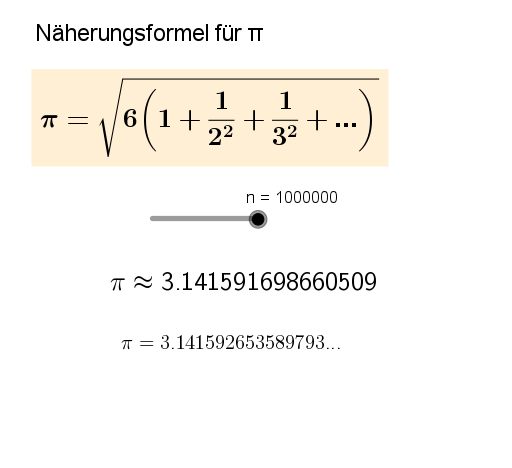
This GeoGebra example demonstrates how to approximate the constant π by partitioning a circular-related region and accumulating contributions through numerical summation. The central concepts are real numbers, the definite-integral viewpoint (area/accumulation as a limit of sums), and a construction that uses rotation/turning of plane figures to build a circle-like aggregate from simpler pieces. From the construction summary, the key implementation uses the Sum command to compute a running total from parameters such as n (number of subparts/steps) and the accumulated quantity S, with p serving as an additional parameter controlling the terms; Text1–Text4 are used to display intermediate/final labels and results. The example is well suited for advanced high-school and early university learners studying calculus, numerical approximation, and visualization of how sum-based methods converge toward π.
GeoGebra Commands & Parameters
Sum(1 / k^(2), k, 1, n) → S
AI Drawing Prompt Reference
Create a mathematical illustration showing the approximation of pi through summation. Draw a large circle in the center, divided into many thin wedge-shaped slices radiating from the center, each labeled with a small number representing a term in the sum. As the slices increase in number, the total accumulated value is displayed below the circle, approaching the value of pi. Use clean lines and subtle colors to emphasize the geometric and numerical relationship.
The prompt above was compiled from the original drawing commands and is for reference only.