
Approximate Calculation of Volume of Solids of Revolution by Andreas Lindner
Loading the math board and drawing, please wait…
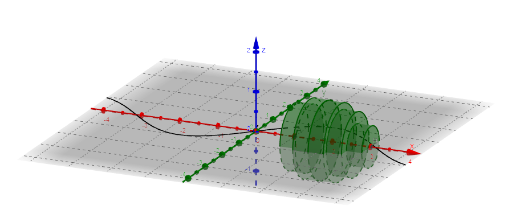
This example demonstrates the approximate calculation of the volume of a solid of revolution by rotating a graph around the x-axis. Key mathematical concepts include integral calculus and solid geometry. GeoGebra commands used include Sequence, Textfield, Surface, Sum, and Integral. Suitable for high school mathematics education and learning.
GeoGebra Commands & Parameters
Sequence(Cylinder[(a + (k * Δx), 0, 0), (a + ((k + 1) * Δx), 0, 0), f(a + (k * Δx))], k, 0, n - 1) → Liste1Textfield(a) → Textfeld1Textfield(b) → Textfeld2Surface(u, (f(u) * cos(w)), (f(u) * sin(w)), u, a, b, w, 0, 6.283185307179586) → cTextfield(f) → Textfeld3Sum(Liste1) → V_KIntegral((π * f(x)^(2)), a, b) → V
AI Drawing Prompt Reference
Draw the volume approximation of a solid of revolution formed by rotating a function f(x) around the x-axis. First, draw a sequence of cylinders with height f(x) from x=a to x=b, then calculate the sum of their volumes, and finally compute the integral of f(x)^2 from a to b to get the exact volume of the solid.
The prompt above was compiled from the original drawing commands and is for reference only.