
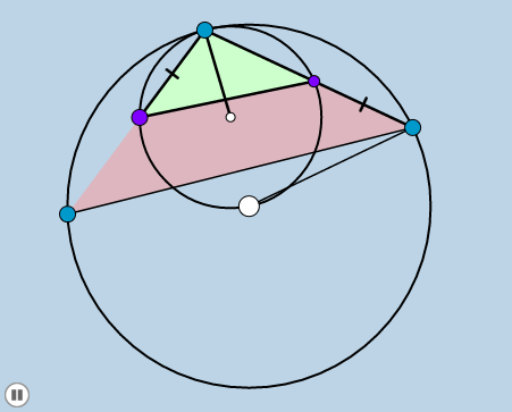
Animation of the Circumcircle of an Isosceles Triangle
Loading the math board and drawing, please wait…
This example demonstrates the animation of the circumcircle of an isosceles triangle. Key mathematical concepts include the properties of isosceles triangles, circumcircle, and symmetry. Construction highlights include using the Circle command to draw a circle, Intersect command to find intersection points, Dilate and Rotate commands for transformations, and Segment command to draw line segments. Suitable for middle school and above students to learn geometric construction and transformations.
GeoGebra Commands & Parameters
Circle(A, B_1) → cIntersect(c, q) → O, P_1CircleArc(A, O, P_1) → dPoint(d) → CLineBisector(C, A) → i_1Segment(A, C) → bPoint(b) → QLineBisector(A, Q) → n_1Segment(A, Q) → nCircleArc(A, C, P_1) → ePoint(e) → BLineBisector(A, B) → h_1Intersect(h_1, i_1) → UCircle(B, n) → tSegment(B, A) → gIntersect(t, g) → P,LineBisector(A, P) → r_1Intersect(r_1, n_1) → VAngle(A, V, U) → δDilate(V, If[12 < j ≤ 13, 13 - j, 0], A) → V'Dilate(A, If[0 < j ≤ 1, 1 - j, 0], C) → A'Segment(A, A') → aAngle(C, A, B) → αRotate(A, If[1 < j ≤ 2, ((j - 1) * α), α], A) → A'_1Rotate(A', If[1 < j ≤ 2, ((j - 1) * α), α], A) → A''Segment(A'_1, A'') → a'Segment(C, B) → fMidpoint(f) → ESegment(A, E) → hMidpoint(h) → FSegment(A, F) → iSegment(F, E) → kCircle(A, (0.35 * i)) → pCircle(E, (0.15 * Distance[B, E])) → rIntersect(r, f, 2) → GIntersect(r, h, 1) → HIntersect(r, f, 1) → IIntersect(p, b, 1) → JIntersect(p, h, 1) → KIntersect(p, g, 1) → LCircle(A, B_1) → c_1Dilate(C, If[2 < j ≤ 3, 3 - j, 0], B) → C'Segment(C, C') → lPolygon(C, B, A) → poly1, a_1, c_2, d_1Circle(C, (0.2 * Distance[B, E])) → e_1Intersect(e_1, b) → M,Intersect(e_1, f) → N,Dilate(A, If[3 < j ≤ 4, 4 - j, 0], F) → A'_2Dilate(F, If[5 < j ≤ 6, 6 - j, 0], E) → F'Dilate(E, If[6 < j ≤ 7, 7 - j, 0], B) → E'Rotate(E, If[7 < j ≤ 8, ((j - 7) * π), 3.141592653589793], E) → E'_1Rotate(E', If[7 < j ≤ 8, ((j - 7) * π), 3.141592653589793], E) → E''Dilate(C, If[9 < j ≤ 10, 10 - j, 0], B) → C'_1Vector(C, C'_1) → uAngle(E, C, A) → βSegment(C, B) → mIntersect(t, c, 1) → RDilate(A, If[4 < j ≤ 5, 5 - j, 0], Q) → A'_3Segment(A, A'_3) → sDilate(A, If[5 < j ≤ 6, 6 - j, 0], B) → A'_4Vector(A, A'_4) → vTranslate(A, v) → A'_5Translate(A'_3, v) → DSegment(A'_5, D) → s'Line(C, A) → f_1Line(B, f_1) → g_1Point(g_1) → SAngle(A, B, S) → γRotate(A'_5, If[6 < j ≤ 7, ((-(j - 6)) * γ), (-γ)], B) → TRotate(D, If[6 < j ≤ 7, ((-(j - 6)) * γ), (-γ)], B) → D'Segment(T, D') → s''Dilate(U, If[7 < j ≤ 8, 8 - j, 0], B) → U'Segment(U, U') → j_1Rotate(B, If[8 < j ≤ 9, (((j - 8) * 2) * π), (2 * π)], U) → B'Rotate(U, If[8 < j ≤ 9, (((j - 8) * 2) * π), (2 * π)], U) → U'_1Rotate(U', If[8 < j ≤ 9, (((j - 8) * 2) * π), (2 * π)], U) → U''Segment(U'_1, U'') → k_1CircleArc(U, B, B') → p_1Polygon(Q, P, A) → poly2, a_2, q_1, p_2Polygon(C, B, P, Q) → poly3, c_3, b_1, p_3, q_2Dilate(Q, If[9 < j ≤ 10, 10 - j, 0], P) → Q'Segment(Q, Q') → l_1Dilate(P, If[10 < j ≤ 11, 11 - j, 0], A) → P'Segment(P, P') → m_1Segment(V, V') → s_1Rotate(A, If[13 < j ≤ 14, (((j - 13) * 2) * π), (2 * π)], V) → A'_6Rotate(V, If[13 < j ≤ 14, (((j - 13) * 2) * π), (2 * π)], V) → V'_1Rotate(V', If[13 < j ≤ 14, ((j - 13) * δ), δ], V) → V''Segment(V'_1, V'') → t_1Circle(U, B) → e_2Circle(V, P) → f_2CircleArc(V, A, V'') → d_2Rotate(U_3, If[14 < j ≤ 15, ((j - 14) * ((2 * π) - δ)), (2 * π) - δ], V) → WCircleArc(V, U_3, W) → g_2Rotate(V'_1, If[14 < j ≤ 15, ((j - 14) * ((2 * π) - δ)), (2 * π) - δ], V) → ZRotate(V'', If[14 < j ≤ 15, ((j - 14) * ((2 * π) - δ)), (2 * π) - δ], V) → V'''Segment(Z, V''') → h_2