
Dynamic Illustration of Two Internally Tangent Circles with an Inscribed Equilat
Loading the math board and drawing, please wait…
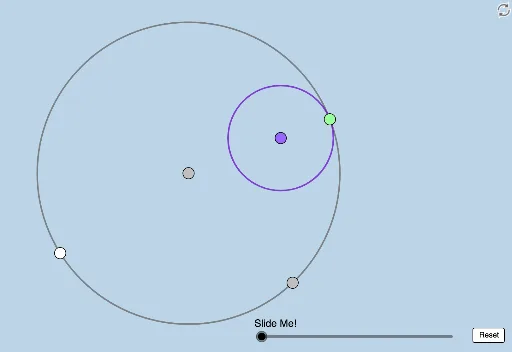
This example demonstrates the dynamic relationship between two internally tangent circles and an inscribed equilateral triangle. Key mathematical concepts include circles, equilateral triangles, and geometric transformations. Using GeoGebra commands such as Circle, Rotate, Intersect, etc., the size and position of the circles can be dynamically adjusted to observe the changes in the inscribed equilateral triangle. Suitable for students at the junior high school level and above to learn about geometric transformations and properties of circles.
GeoGebra Commands & Parameters
Circle(A, B) → cPoint(c) → DRotate(D, (2 * π / 3), A) → D'Rotate(D', (2 * π / 3), A) → D''CircleArc(A, D', D'') → sPoint(s) → CSegment(A, C) → gPoint(g) → FSemicircle(D'', F) → tSegment(F, C) → hCircle(F, h) → eIntersect(e, t, 1) → HSemicircle(D, F) → kIntersect(e, k, 1) → EDilate(D'', If[6 < b ≤ 7, 7 - b, 0], H) → D'''Segment(D'', D''') → k_1Line(E, k_1) → p_1Point(p_1) → LSemicircle(D', F) → pIntersect(e, p, 1) → GDilate(D', If[3 < b ≤ 4, 4 - b, 0], G) → D''_1Segment(D', D''_1) → f_1Line(D, f_1) → l_1Point(l_1) → SPolygon(D, D', D'') → t1, d'', d, d'Line(A, C) → fSegment(D, E) → iSegment(D', G) → jSemicircle(C, D'') → qSemicircle(D'', F) → rSegment(D'', H) → lCircle(D, j) → c_1Intersect(c_1, i) → I,Dilate(D, If[0 < b ≤ 1, 1 - b, 0], D') → D'_1Segment(D, D'_1) → mRotate(D, If[1 < b ≤ 2, ((b - 1) * π / 3), π / 3], D) → D'_2Rotate(D'_1, If[1 < b ≤ 2, ((b - 1) * π / 3), π / 3], D) → JSegment(D'_2, J) → m'Rotate(D'_2, If[2 < b ≤ 3, ((b - 2) * π / 3), π / 3], D'') → KRotate(J, If[2 < b ≤ 3, ((b - 2) * π / 3), π / 3], D'') → J'Segment(K, J') → m''Angle(D', G, F) → αAngle(D'', H, F) → βAngle(D, E, F) → γDilate(F, If[3 < b ≤ 4, 4 - b, 0], G) → F'Segment(F, F') → nDilate(D, If[4 < b ≤ 5, 5 - b, 0], I) → D'_3Segment(D, D'_3) → g_1Dilate(I, If[5 < b ≤ 6, 6 - b, 0], E) → I'Segment(I, I') → h_1Dilate(F, If[5 < b ≤ 6, 6 - b, 0], E) → F'_1Segment(F, F'_1) → i_1Dilate(F, If[6 < b ≤ 7, 7 - b, 0], H) → F'_2Segment(F, F'_2) → j_1Angle(S, D, E) → δDilate(G, If[8 < b ≤ 9, 9 - b, 0], D) → G'Vector(G, G') → uTranslate(D', u) → D''_2Translate(D''_1, u) → MSegment(D''_2, M) → m_1Rotate(D''_2, If[9 < b ≤ 10, ((b - 9) * δ), δ], D) → ORotate(M, If[9 < b ≤ 10, ((b - 9) * δ), δ], D) → M'Segment(O, M') → n_1Angle(L, E, D) → εDilate(H, If[10 < b ≤ 11, 11 - b, 0], E) → H'Vector(H, H') → vTranslate(D'', v) → D'''_1Translate(D''', v) → QSegment(D'''_1, Q) → q_1Rotate(D'''_1, If[11 < b ≤ 12, ((b - 11) * ε), ε], E) → RRotate(Q, If[11 < b ≤ 12, ((b - 11) * ε), ε], E) → Q'Segment(R, Q') → r_1