
Animation Demonstrating Rhombus and Special Points
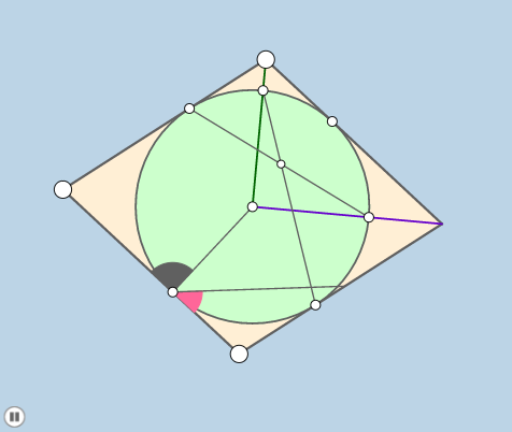
Loading the math board and drawing, please wait…
This example dynamically illustrates the properties of a rhombus and its special points (like intersection of diagonals, circumcenter) through animation. It covers core concepts including rhombus characteristics, special points, indefinite integral, cone, and boxplot. Construction uses commands like Line, Circle, Intersect, Rotate, Dilate. Suitable for high school mathematics students and educators for geometric visualization and statistical learning.
GeoGebra Commands & Parameters
Line(A, B) → bCircle(A, B) → cIntersect(c, b, 2) → CCircleArc(A, B, C) → dPoint(d) → DCircle(D, A) → eSegment(D, B) → sCircle(B, A) → fIntersect(e, f, 2) → EAngle(D, E, B) → βAngle(E, B, A) → αSegment(A, E) → nIntersect(n, s) → LRotate(L, If[13 < l ≤ 14, ((-(l - 13)) * π), -3.141592653589793], L) → L'_2Dilate(L, If[12 < l ≤ 13, 13 - l, 0], E) → L'_1Segment(L, L'_1) → j_1Dilate(L, If[10 < l ≤ 11, 11 - l, 0], B) → L'Rotate(L', If[13 < l ≤ 14, ((-(l - 13)) * π), -3.141592653589793], L) → L''Segment(L'_2, L'') → l_1Rotate(B, If[1 < l ≤ 2, ((-(l - 1)) * α), α], B) → B'_1Rotate(B'_1, If[2 < l ≤ 3, ((-(l - 2)) * β), (-β)], E) → JRotate(J, If[3 < l ≤ 4, ((-(l - 3)) * α), (-α)], D) → J'Dilate(B, If[0 < l ≤ 1, 1 - l, 0], A) → B'Rotate(B', If[1 < l ≤ 2, ((-(l - 1)) * α), (-α)], B) → B''Rotate(B'', If[2 < l ≤ 3, ((-(l - 2)) * β), (-β)], E) → B'''Rotate(B''', If[3 < l ≤ 4, ((-(l - 3)) * α), (-α)], D) → KSegment(J', K) → m'''Segment(J, B''') → m''OrthogonalLine(L, m'') → n_1Intersect(n_1, m'') → B_1Circle(L, B_1) → g_2Intersect(g_2, j_1) → I_1,Intersect(g_2, l_1) → H_1,Intersect(g_2, m''', 1) → C_1Segment(C_1, I_1) → a_2Segment(B'_1, B'') → m'Intersect(g_2, m', 1) → E_1Segment(H_1, E_1) → t_2Intersect(a_2, t_2) → Q_1Segment(A, B) → aSegment(A, D) → gSegment(D, E) → hSegment(E, B) → iMin(g, h) → jSegment(B, B') → mCircle(B, (0.2 * j)) → kCircle(E, (0.2 * j)) → pIntersect(p, m'', 1) → FIntersect(p, m', 1) → GIntersect(k, m', 1) → HIntersect(k, m, 1) → ICircleSector(B, H, I) → qCircleSector(E, F, G) → rPolygon(A, B, E, D) → poly1, a_1, b_1, e_1, d_1Dilate(B, If[5 < l ≤ 6, 6 - l, 0], D) → B'_2Vector(B, B'_2) → uTranslate(q, u) → q'Rotate(q', If[6 < l ≤ 7, ((l - 6) * π), 3.141592653589793], D) → q''Dilate(E, If[7 < l ≤ 8, 8 - l, 0], A) → E'Vector(E, E') → vTranslate(r, v) → r'Rotate(r', If[8 < l ≤ 9, ((-(l - 8)) * π), -3.141592653589793], A) → r''Dilate(D, If[9 < l ≤ 10, 10 - l, 0], L) → D'Vector(D, D') → wMin(n / 2, s / 2) → oCircle(L, (0.2 * o)) → tIntersect(t, s, 2) → MIntersect(t, n, 2) → NCircleSector(L, M, N) → c_1Segment(D, D') → f_1Circle(D, (0.2 * j)) → h_1Intersect(k, s) → P,Intersect(s, f_1) → QIntersect(h_1, s, 1) → OCircle(A, (0.2 * j)) → k_1Intersect(k_1, m, 1) → RIntersect(k_1, n, 1) → SIntersect(k_1, m''', 1) → TIntersect(h_1, m'', 1) → UCircleSector(D, O, U) → q_1Dilate(A, If[11 < l ≤ 12, 12 - l, 0], L) → A'Segment(A, A') → i_1Intersect(p, m'', 1) → VIntersect(p, n, 1) → WCircleSector(A, S, T) → s_1CircleSector(B, P, I) → p_1Intersect(p, m', 1) → ZCircleSector(E, W, Z) → r_1Segment(L, L') → g_1Rotate(L, If[14 < l ≤ 15, ((-(l - 14)) * π), 3.141592653589793], L) → L'_3Rotate(L'_1, If[14 < l ≤ 15, ((-(l - 14)) * π), 3.141592653589793], L) → A_1Segment(L'_3, A_1) → m_1Rotate(q_1, If[15 < l ≤ 16, ((-(l - 15)) * α / 2), ((-α)) / 2], D) → t_1Rotate(p_1, If[15 < l ≤ 16, ((-(l - 15)) * α / 2), ((-α)) / 2], B) → c_2Rotate(s_1, If[16 < l ≤ 17, ((-(l - 16)) * β / 2), ((-β)) / 2], A) → d_2Rotate(r_1, If[16 < l ≤ 17, ((-(l - 16)) * β / 2), ((-β)) / 2], E) → e_2Rotate(c_1, If[17 < l ≤ 18, ((l - 17) * π / 2), 1.5707963267948966], L) → f_2Intersect(g_2, m, 1) → D_1Segment(L, D_1) → h_2Dilate(L, If[20 < l ≤ 21, 21 - l, 0], D_1) → L'_4Segment(L, L'_4) → i_2Line(L, m) → j_2Point(j_2) → F_1Angle(D, L, F_1) → γDilate(L, If[21 < l ≤ 22, 22 - l, 0], D_1) → L'_5Vector(L, L'_5) → u_1Translate(f_2, u_1) → k_2Rotate(k_2, If[22 < l ≤ 23, ((l - 22) * γ), γ], D_1) → p_2Rotate(D_1, If[23 < l ≤ 24, (((l - 23) * 2) * π), (2 * π)], L) → G_1CircleArc(L, D_1, G_1) → q_2Angle(D_1, L, E_1) → δCircle(D_1, (0.2 * o)) → r_2Intersect(r_2, m) → J_1, K_1Rotate(B, 45°, D_1) → B'_3Angle(B, D_1, B'_3) → εRay(D_1, B'_3) → l_2Intersect(m', l_2) → M_1Intersect(r_2, l_2, 1) → N_1Dilate(D_1, If[24 < l ≤ 25, 25 - l, 0], M_1) → L_1Segment(D_1, L_1) → m_2Intersect(r_2, i_2) → O_1,CircleSector(D_1, N_1, O_1) → s_2Dilate(C_1, If[25 < l ≤ 26, 26 - l, 0], Q_1) → P_1Segment(C_1, P_1) → n_2Dilate(Q_1, If[26 < l ≤ 27, 27 - l, 0], I_1) → R_1Segment(Q_1, R_1) → b_2Dilate(E_1, If[27 < l ≤ 28, 28 - l, 0], Q_1) → S_1Segment(E_1, S_1) → f_3Dilate(Q_1, If[28 < l ≤ 29, 29 - l, 0], H_1) → T_1Segment(Q_1, T_1) → g_3Rotate(s_2, If[30.5 < l ≤ 31.5, ((-(l - 30.5)) * π / 4), ((-π)) / 4], D_1) → c_3Line(Q_1, m_2) → h_3Point(h_3) → U_1Angle(I_1, Q_1, U_1) → θDilate(D_1, If[32 < l ≤ 33, 33 - l, 0], Q_1) → V_1Vector(D_1, V_1) → v_1Translate(c_3, v_1) → d_3Rotate(d_3, If[33 < l ≤ 34, ((-(l - 33)) * θ), (-θ)], Q_1) → e_3