
Animation Demonstrating Geometric Transformations and Locus
Loading the math board and drawing, please wait…
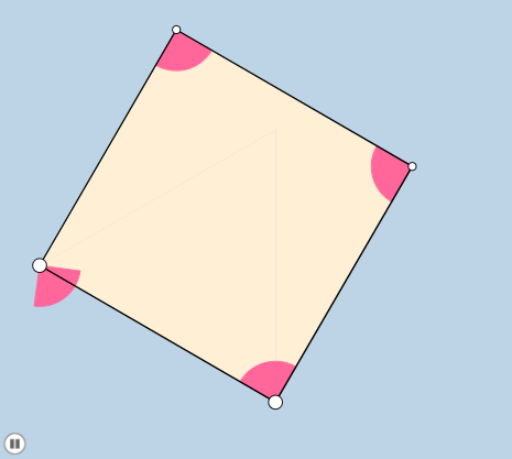
This example animates a square undergoing rotation in the plane, observing the locus formed by its vertices. Key math concepts include geometric transformations, similarity, locus, polygons, and vectors. Construction highlights the use of commands like Rotate, Dilate, Polygon, Midpoint, CircleArc, and Vector. Suitable for high school students to understand dynamic relationships between transformations and loci, and for teaching analytical geometry.
GeoGebra Commands & Parameters
Rotate(A, If[1 < e ≤ 2, ((-(e - 1)) * π / 2), -1.5707963267948966], B_2) → A'_1Dilate(A, If[0 < e ≤ 1, 1 - e, 0], B_2) → A'Rotate(A', If[1 < e ≤ 2, ((-(e - 1)) * π / 2), -1.5707963267948966], B_2) → A''Polygon(A, B_2, 4) → poly1, a, b, c, d, C, DMidpoint(A, C) → VCircleArc(V, C, D) → g_2Point(g_2) → BSegment(C, B) → j_1Segment(A, B) → nRotate(A'', If[2 < e ≤ 3, ((-(e - 2)) * π / 2), -1.5707963267948966], C) → A'''Rotate(A'_1, If[2 < e ≤ 3, ((-(e - 2)) * π / 2), -1.5707963267948966], C) → RSegment(R, A''') → f''Intersect(n, f'') → ZSegment(B, Z) → l_1Segment(A, A') → fSegment(A'_1, A'') → f'Segment(A, B_2) → gSegment(B_2, C) → hSegment(C, D) → iSegment(D, A) → jCircle(B_2, (0.15 * f)) → pCircle(C, Radius[p]) → kCircle(A, (0.1 * j)) → qCircle(D, (0.1 * j)) → rSegment(A, C) → lSegment(D, B_2) → mIntersect(r, j, 1) → FIntersect(r, m, 1) → GIntersect(r, i, 1) → HIntersect(k, i, 1) → IIntersect(k, l, 1) → JIntersect(k, h, 1) → KIntersect(p, h, 1) → LIntersect(p, m, 1) → MIntersect(p, g, 1) → NIntersect(q, g, 1) → OIntersect(q, l, 1) → PIntersect(q, j, 1) → QCircleSector(B_2, L, N) → sRotate(R, If[3 < e ≤ 4, ((-(e - 3)) * π / 2), -1.5707963267948966], D) → R'Rotate(A''', If[3 < e ≤ 4, ((-(e - 3)) * π / 2), -1.5707963267948966], D) → SSegment(R', S) → f'''Dilate(B_2, If[4 < e ≤ 5, 5 - e, 0], C) → B'Vector(B_2, B') → uTranslate(s, u) → s'Rotate(s', If[5 < e ≤ 6, ((e - 5) * π / 2), 1.5707963267948966], C) → s''Dilate(C, If[6 < e ≤ 7, 7 - e, 0], D) → C'Vector(C, C') → vTranslate(s'', v) → s'''Rotate(s''', If[7 < e ≤ 8, ((e - 7) * π / 2), 1.5707963267948966], D) → tDilate(D, If[8 < e ≤ 9, 9 - e, 0], A) → D'Vector(D, D') → wTranslate(t, w) → t'Rotate(t', If[9 < e ≤ 10, ((e - 9) * π / 2), 1.5707963267948966], A) → t''Dilate(B_2, If[18 < e ≤ 19, 19 - e, 0], C) → B'_1Dilate(B_2, If[18 < e ≤ 19, 19 - e, 0], A) → B'_2Dilate(B_2, If[18 < e ≤ 19, 19 - e, 0], D) → B'_3Vector(B_2, B'_1) → v_1Vector(B_2, B'_3) → w_1Vector(B_2, B'_2) → i_1Circle(A, n - j_1) → h_2Dilate(B, If[10 < e ≤ 11, 11 - e, 0], C) → W'Dilate(B_2, If[13 < e ≤ 14, 14 - e, 0], B) → B'_4Vector(B_2, B'_4) → u_1Translate(s, u_1) → s'_1Line(B, f') → a_1Point(a_1) → UAngle(U, B, C) → αRotate(B, If[14 < e ≤ 15, ((-(e - 14)) * π / 2), ((-π)) / 2], B) → W'_2Rotate(W', If[14 < e ≤ 15, ((-(e - 14)) * π / 2), ((-π)) / 2], B) → W''Line(A, B_2) → h_1Angle(B, A, D) → βDilate(D, If[19 < e ≤ 20, 20 - e, 0], B) → D'_1Mirror(C, D) → C'_1Rotate(C, ((-π)) / 3, B_2) → C'_2Segment(B_2, C'_2) → f_1Segment(C, C'_2) → g_1Intersect(k, g_1, 1) → EIntersect(k, h) → T,CircleSector(C, T, E) → d_1Rotate(D, 15°, C) → D'_2Angle(D, C, D'_2) → γRay(C, D'_2) → k_1Rotate(C, (-(15°)), D) → C'_3Angle(C'_3, D, C) → δRay(D, C'_3) → m_1Intersect(k_1, m_1) → WRotate(B_2, If[10 < e ≤ 11, (((-π)) / 3 * (e - 10)), ((-π)) / 3], B_2) → A_1Rotate(C, If[10 < e ≤ 11, (((-π)) / 3 * (e - 10)), ((-π)) / 3], B_2) → C'_4Rotate(B_2, If[11 < e ≤ 12, (π / 3 * (e - 11)), π / 3], C) → B_1Rotate(C, If[11 < e ≤ 12, (π / 3 * (e - 11)), π / 3], C) → C'_5Rotate(E, If[12 < e ≤ 13, (((-π)) / 6 * (e - 12)), ((-π)) / 6], C) → E'Polygon(A, B_2, W) → poly5, w_5, a_3, b_1Rotate(T, 15°, C) → T'Angle(T, C, T') → εRay(C, T') → q_1Dilate(C, If[21 < e ≤ 22, 22 - e, 0], D) → C'_8Vector(C, C'_8) → u_2Dilate(D, If[23 < e ≤ 24, 24 - e, 0], W) → D'_3Dilate(C, If[23 < e ≤ 24, 24 - e, 0], W) → C'_9Dilate(B_2, If[25 < e ≤ 26, 26 - e, 0], W) → G_1Dilate(A, If[25 < e ≤ 26, 26 - e, 0], W) → A'_2Rotate(B_2, If[26.75 < e ≤ 27.75, (π / 2 * (e - 26.75)), π / 2], B_2) → H_1Rotate(C'_2, If[26.75 < e ≤ 27.75, (π / 2 * (e - 26.75)), π / 2], B_2) → I_1Rotate(C, If[26.75 < e ≤ 27.75, (π / 2 * (e - 26.75)), π / 2], B_2) → C'_{10}Rotate(B_2, π / 3, A) → C_1Polygon(A, C_1, B_2, C, D) → poly2, a_2, c_1, b_2, c_2, d_2Rotate(A, If[10 < e ≤ 11, ((-(e - 10)) * π / 3), ((-π)) / 3], B_2) → A'_3Rotate(A', If[10 < e ≤ 11, ((-(e - 10)) * π / 3), ((-π)) / 3], B_2) → A''_1Segment(A'_3, A''_1) → f'_1Rotate(A, If[11 < e ≤ 12, ((e - 11) * π / 3), π / 3], A) → A'_4Rotate(A', If[11 < e ≤ 12, ((e - 11) * π / 3), π / 3], A) → A''_2Segment(A'_4, A''_2) → f'_2Polygon(A, B_2, A'_3) → poly3, a'_3, a_4, b_3Circle(A, A'_3, B_2) → e_1Rotate(B_2, If[12 < e ≤ 14, ((e - 12) * π), (2 * π)], Center[e_1]) → D_1Center(e_1) → E_1CircleArc(E_1, B_2, D_1) → p_1Midpoint(C, B_2) → F_1Segment(B_2, F_1) → r_1Segment(B_2, C) → s_1Intersect(e_1, s_1) → K_1, L_1Angle(B_2, E_1, L_1) → ζDilate(C, If[14 < e ≤ 15, 15 - e, 0], L_1) → C'_6Segment(C, C'_6) → t_1Rotate(C, If[15 < e ≤ 16, ((-(e - 15)) * π / 3), ((-π)) / 3], L_1) → C'_7Rotate(C'_6, If[15 < e ≤ 16, ((-(e - 15)) * π / 3), ((-π)) / 3], L_1) → J_1Segment(C'_7, J_1) → k_2Dilate(L_1, If[16 < e ≤ 17, 17 - e, 0], B_2) → M_1Vector(L_1, M_1) → v_2Translate(C'_7, v_2) → N_1Translate(J_1, v_2) → O_1Segment(N_1, O_1) → m_2Rotate(N_1, If[17 < e ≤ 18, ((e - 17) * π / 3), π / 3], B_2) → P_1Rotate(O_1, If[17 < e ≤ 18, ((e - 17) * π / 3), π / 3], B_2) → Q_1Segment(P_1, Q_1) → n_2Line(D, P_1) → n_1Intersect(f'_2, n_1) → R_1Circle(R_1, A'_3) → e_2Circle(R_1, (0.7 * Radius[e_2])) → p_2Intersect(p_2, n_1) → S_1, T_1Intersect(p_2, f'_2) → U_1, V_1Dilate(D, If[18 < e ≤ 19, 19 - e, 0], R_1) → D'_4Segment(D, D'_4) → q_2Dilate(R_1, If[19 < e ≤ 20, 20 - e, 0], P_1) → W_1Segment(R_1, W_1) → r_2Rotate(S_1, If[20 < e ≤ 21, ((e - 20) * π / 2), π / 2], R_1) → Z_1CircleSector(R_1, S_1, Z_1) → s_2Rotate(s_2, If[21.75 < e ≤ 22.75, ((e - 21.75) * π / 2), π / 2], R_1) → t_2
AI Drawing Prompt Reference
Draw a square rotating around a point, and observe the locus of its vertices. The square undergoes rotation, then scaling, and another rotation. Also, plot the locus of the vertices, marking midpoints and arcs. Finally, demonstrate the dynamic transformation of the square through rotation and scaling, and draw related segments and circles.
The prompt above was compiled from the original drawing commands and is for reference only.