
Animation 94: Equilateral Triangle Reflections and Rotations
Loading the math board and drawing, please wait…
In collections
CCSS High School: Geometry (Congruence) Volume 2
CCSS High School: Geometry (Congruence) Volume 2
CCSS High School: Geometry (Congruence) Volume 2
CCSS High School: Geometry (Congruence) Volume 2
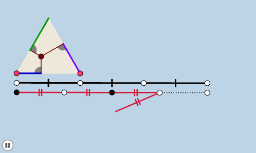
① This GeoGebra example demonstrates a dynamic animation involving equilateral triangles undergoing reflections, rotations, translations, and dilations, with circles, segments, sectors, and other geometric elements updating under button control. ② Core mathematical concepts include properties of equilateral triangles, reflection and rotational symmetry, vector translation, homothety (scaling), and the visualization of abstract ideas like standard deviation, set theory, and exponents within a geometric construction. ③ Construction highlights: from the summary, commands such as Polygon, Dilate, Segment, Circle, Intersect, Rotate, Vector, PointIn, OrthogonalLine, Angle, CircleSector, Line, Distance, and Translate are used, along with multiple points, lines, circles, and a button (button1) to drive the animation. ④ Suitable for upper secondary or early university students exploring geometric transformations and dynamic mathematics, and for teachers creating interactive geometry lessons.
GeoGebra Commands & Parameters
Polygon(A, B, 3) → poly1, a, b, c, CDilate(A, If[0 < d ≤ 1, 1 - d, 0], B) → A'Segment(A, A') → eDilate(B, If[1 < d ≤ 2, 2 - d, 0], C) → B'Segment(B, B') → fDilate(C, If[2 < d ≤ 3, 3 - d, 0], A) → C'Segment(C, C') → gSegment(A, B) → hSegment(A, C) → iSegment(B, C) → jCircle(A, (0.15 * h)) → kIntersect(k, i, 1) → DIntersect(k, h, 1) → ERotate(A, If[3.5 < d ≤ 4.5, ((d - 3.5) * π / 3), 1.0471975511965976], A) → A'_1Rotate(A', If[3.5 < d ≤ 4.5, ((d - 3.5) * π / 3), 1.0471975511965976], A) → A''Segment(A'_1, A'') → e'Rotate(A, If[4.5 < d ≤ 5.5, ((-(d - 4.5)) * π / 3), -1.0471975511965976], B) → A'_2Rotate(A', If[4.5 < d ≤ 5.5, ((-(d - 4.5)) * π / 3), -1.0471975511965976], B) → A''_1Segment(A'_2, A''_1) → e'_1Dilate(A, If[6 < d ≤ 7, 7 - d, 0], B) → A'_3Vector(A, A'_3) → uCircle(B, (0.15 * h)) → rIntersect(f, e'_1) → GIntersect(f, e'_1) → HIntersect(f, e'_1) → IIntersect(f, e'_1) → JIntersect(r, j, 1) → FIntersect(r, h, 1) → KDilate(B, If[8 < d ≤ 9, 9 - d, 0], C) → B'_1Vector(B, B'_1) → vIntersect(g, e') → LPolygon(A, B, C) → poly2, c_2, a_1, b_1PointIn(poly2) → TOrthogonalLine(T, h) → nOrthogonalLine(T, i) → g_1OrthogonalLine(T, j) → h_1Intersect(g_1, i) → UIntersect(n, h) → VIntersect(h_1, j) → WAngle(T, U, C) → αAngle(T, V, A) → βAngle(T, W, B) → γCircle(W, (0.1 * h)) → qCircle(V, (0.1 * h)) → sCircle(U, (0.1 * h)) → tIntersect(q, j, 2) → ZIntersect(q, h_1, 2) → A_1Intersect(s, h, 2) → B_1Intersect(s, n, 2) → C_1Intersect(t, i, 1) → D_1Intersect(t, g_1, 1) → E_1CircleSector(W, Z, A_1) → k_1CircleSector(V, B_1, C_1) → p_1CircleSector(U, D_1, E_1) → q_1Dilate(T, If[10 < d ≤ 11, 11 - d, 0], U) → T'Segment(T, T') → i_1Dilate(T, If[10 < d ≤ 11, 11 - d, 0], V) → T'_1Dilate(T, If[10 < d ≤ 11, 11 - d, 0], W) → T'_2Segment(T, T'_1) → a_2Segment(T, T'_2) → b_2Rotate(q_1, If[11.5 < d ≤ 12.5, ((d - 11.5) * π / 2), 1.5708], U) → r_1Rotate(p_1, If[11.5 < d ≤ 12.5, ((d - 11.5) * π / 2), 1.5708], V) → d_2Rotate(k_1, If[11.5 < d ≤ 12.5, ((d - 11.5) * π / 2), 1.5708], W) → e_2Rotate(B, π / 3, A) → B'_2Dilate(B'_2, If[7 < d ≤ 8, 8 - d, 0], U) → M_1Segment(B'_2, M_1) → k_2Dilate(A, If[8 < d ≤ 9, 9 - d, 0], V) → A'_4Segment(A, A'_4) → l_2Dilate(B, If[9 < d ≤ 10, 10 - d, 0], W) → B'_3Segment(B, B'_3) → m_2Line(A, B) → lDistance(A, B) → mCircle(A, (0.15 * m)) → pOrthogonalLine(A, l) → f_1Intersect(p, f_1, 1) → MLine(M, l) → j_1Circle(A, (0.3 * m)) → c_1Intersect(c_1, f_1, 1) → NLine(N, l) → l_1Circle(A, (0.45 * m)) → d_1Intersect(d_1, f_1, 1) → OLine(O, j_1) → m_1Dilate(A, If[3.5 < d ≤ 4.5, 4.5 - d, 0], M) → A'_5Vector(A, A'_5) → wTranslate(A, w) → A'_6Translate(A', w) → A''_2Segment(A'_6, A''_2) → e'_2Rotate(A'_6, If[4.5 < d ≤ 5.5, ((d - 4.5) * π), π], A''_2) → RRotate(A''_2, If[4.5 < d ≤ 5.5, ((d - 4.5) * π), π], A''_2) → SSegment(R, S) → n_1Rotate(R, If[5.5 < d ≤ 6.5, ((d - 5.5) * π), π], R) → R'Rotate(S, If[5.5 < d ≤ 6.5, ((d - 5.5) * π), π], R) → S'Segment(R', S') → s_1Dilate(M, If[12.5 < d ≤ 13.5, 13.5 - d, 0], N) → M'Vector(M, M') → u_1Segment(M, S') → t_1Translate(M, u_1) → M'_1Translate(S', u_1) → S''Segment(M'_1, S'') → e_1Circle(M', e_1 / 4) → f_2Intersect(f_2, e_1, 1) → F_1Circle(F_1, e_1 / 4) → g_2Intersect(g_2, e_1, 2) → G_1Circle(G_1, e_1 / 4) → h_2Intersect(h_2, e_1, 2) → H_1Dilate(M'_1, If[13.5 < d ≤ 14.5, 14.5 - d, 0], F_1) → I_1Segment(M', F_1) → i_2Segment(F_1, G_1) → j_2Segment(G_1, H_1) → n_2Segment(H_1, S'') → p_2Segment(M', I_1) → q_2Rotate(M', If[14.5 < d ≤ 15.5, ((d - 14.5) * π), π], F_1) → M''Rotate(I_1, If[14.5 < d ≤ 15.5, ((d - 14.5) * π), π], F_1) → J_1Segment(M'', J_1) → r_2Rotate(M'', If[15.5 < d ≤ 16.5, ((d - 15.5) * π), π], G_1) → M'''Rotate(J_1, If[15.5 < d ≤ 16.5, ((d - 15.5) * π), π], G_1) → PSegment(M''', P) → s_2Rotate(M''', If[16.5 < d ≤ 17.5, ((d - 16.5) * π), π], H_1) → QRotate(P, If[16.5 < d ≤ 17.5, ((d - 16.5) * π), π], H_1) → P'Segment(Q, P') → t_2Dilate(M', If[17.5 < d ≤ 18.5, 18.5 - d, 0], O) → M''_1Vector(M', M''_1) → v_1Translate(G_1, v_1) → K_1Line(M''_1, K_1) → f_3Circle(M''_1, l_2) → c_3Intersect(c_3, f_3, 2) → L_1Circle(L_1, k_2) → d_3Intersect(d_3, f_3, 2) → N_1Distance(N_1, K_1) → oSegment(M''_1, L_1) → g_3Segment(L_1, N_1) → h_3Segment(N_1, K_1) → i_3Dilate(A, If[19 < d ≤ 20, 20 - d, 0], M''_1) → A'_7Vector(A, A'_7) → w_1Translate(A, w_1) → A'_8Translate(A'_4, w_1) → O_1Segment(A'_8, O_1) → j_3Dilate(U, If[20 < d ≤ 21, 21 - d, 0], L_1) → U'Vector(U, U') → u_2Translate(B'_2, u_2) → P_1Translate(M_1, u_2) → Q_1Segment(P_1, Q_1) → k_3Rotate(P_1, If[21 < d ≤ 22, ((-(d - 21)) * π / 3), ((-π)) / 3], L_1) → R_1Rotate(Q_1, If[21 < d ≤ 22, ((-(d - 21)) * π / 3), ((-π)) / 3], L_1) → S_1Segment(R_1, S_1) → l_3Dilate(B, If[22 < d ≤ 23, 23 - d, 0], N_1) → B'_4Vector(B, B'_4) → v_2Translate(B, v_2) → B'_5Translate(B'_3, v_2) → T_1Segment(B'_5, T_1) → m_3Rotate(B'_5, If[23 < d ≤ 24, (((-(d - 23)) * 2) * π / 3), (-2 * π / 3)], N_1) → U_1Rotate(T_1, If[23 < d ≤ 24, (((-(d - 23)) * 2) * π / 3), (-2 * π / 3)], N_1) → V_1Segment(U_1, V_1) → n_3
AI Drawing Prompt Reference
Draw an equilateral triangle. Inside it, place a dynamic point. From one vertex, draw a segment along a side toward another vertex, with length varying by an animation parameter. Inside the triangle, draw a small circle centered at a vertex, intersecting two sides at two points. Rotate the triangle about its vertices to create new triangles, and connect corresponding vertices with segments. Choose an interior point, drop perpendiculars to the three sides, and mark the feet. Form three angles at the interior point with the feet. Draw three small circles centered at the feet, intersecting sides or perpendiculars. The whole figure includes multiple triangles, circles, segments, and angles, updating dynamically with the animation parameter.
The prompt above was compiled from the original drawing commands and is for reference only.