
Animation 48: Comprehensive Geometry Demo of Cone, Cuboid, and Pythagorean Theor
Loading the math board and drawing, please wait…
In collections
Congruence (CO) Cluster
Congruence (Vol 1)
Congruence (Vol 1) Over 80 Resources
CCSS High School: Geometry (Congruence) Volume 1 S N ATTAR
Geometry (Congruence) Volume 1
CCSS High School: Geometry (Congruence) Volume 1
CCSS High School: Geometry (Congruence) Volume 1
CCSS High School: Geometry (Congruence) Volume 1
CCSS High School: Geometry (Congruence) Volume 1
CCSS High School: Geometry (Congruence) Volume 1
CCSS High School: Geometry (Congruence) Volume 1
CCSS High School: Geometry (Congruence) Volume 1
CCSS High School: Geometry (Congruence) Volume 1
CCSS High School: Geometry (Congruence) Volume 1
CCSS High School: Geometry (Congruence) Volume 1
CCSS High School: Geometry (Congruence) Volume 1
CCSS High School: Geometry (Congruence) Volume 1
Congruence: Volume 1 - Chapter 1
Congruence: Volume 1 - Chapter 1
Congruence V1C1 Check
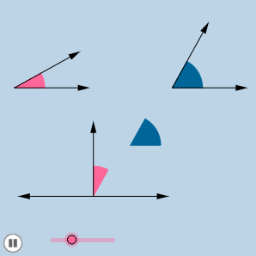
① This example presents a dynamic animation that integrates a cone, cuboid, hyperbola, and the Pythagorean theorem, visually demonstrating the connections between solid and plane geometry elements. ② Core mathematical concepts include the Pythagorean theorem, angles, difference and slope, cone, cuboid, and hyperbola, showcasing a multi-object geometric synthesis. ③ Construction highlights: Using GeoGebra commands such as Circle, Segment, Point, Ray, Midpoint, OrthogonalLine, Intersect, Rotate, Angle, Vector, CircleSector, Dilate, and Translate, the construction builds a rich object system including points A, B, C, D, E, F, G, H, I, J, K, L, M, N, O, P, Q, R and angles α, β, γ, with dynamic changes controlled by sliders or animation. ④ Suitable for high school and above students to explore the intersection of solid and plane geometry, and also serves as a reference for teachers creating interactive math lessons, helping to understand the extension of the Pythagorean theorem in 3D space and the intuitive effects of geometric transformations.
GeoGebra Commands & Parameters
Circle(A, B) → cSegment(A, B) → aPoint(b) → CRay(A, C) → dPoint(d) → DCircle(D, a) → eMidpoint(A, D) → EOrthogonalLine(E, b) → fPoint(f) → FRay(E, F) → gPoint(g) → GIntersect(c, b) → H, IIntersect(e, b) → J, KRotate(I, α, A) → I'Angle(I, A, I') → βRotate(K, π / 2 - β, D) → K'Angle(K, D, K') → γCircle(A, (0.4 * a)) → hCircle(D, (0.4 * a)) → kSegment(A, I') → iSegment(D, K') → jIntersect(h, b, 2) → LIntersect(h, i, 1) → MIntersect(k, b, 2) → NIntersect(k, j, 1) → OCircle(G, a) → pIntersect(p, l, 2) → PIntersect(p, l, 1) → QIntersect(p, g, 1) → RVector(G, P) → uVector(G, R) → vCircleSector(A, L, M) → qCircleSector(D, N, O) → rDilate(A, If[0 < m ≤ 1, 1 - m, 0], G) → A'Vector(A, A') → wTranslate(q, w) → q'Rotate(q', If[1 < m ≤ 2, ((m - 1) * (π / 2 - α)), π / 2 - α], G) → q''Dilate(D, If[2 < m ≤ 3, 3 - m, 0], G) → D'Vector(D, D') → nTranslate(r, n) → r'Vector(G, Q) → sAngle(R, G, Q) → δVector(A, I') → u_1Vector(A, I) → tVector(D, K) → v_1Vector(D, K') → w_1
AI Drawing Prompt Reference
Create a dynamic geometry illustration featuring a cone, a cuboid, and a hyperbola, demonstrating the Pythagorean theorem in 3D space. Start with a circle and a radius, place a point on the circle, draw a ray, and construct perpendicular lines to form multiple intersections. Use rotations and angles to create two circular sectors, then apply scaling and translation to move these sectors along vectors, creating animation. Include various points, segments, angles, and vectors, all controlled by sliders to show the relationship between solid and plane geometry.
The prompt above was compiled from the original drawing commands and is for reference only.