
Animation 42: Composite Geometric Transformations with Equilateral Triangles, Hy
Loading the math board and drawing, please wait…
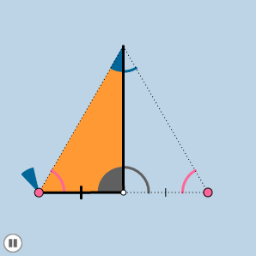
This GeoGebra example demonstrates a dynamic animation combining polygons, circles, circular sectors, vector translations, and rotations, featuring equilateral triangles, scalene triangles, a hyperbola, and integral-related elements. The core mathematical concepts include properties of equilateral triangles, graphs of quadratic functions and hyperbolas, and the application of integrals in area calculation. The construction uses GeoGebra commands such as Polygon, Dilate, Segment, Circle, Intersect, CircleSector, Rotate, Vector, Translate, CircleArc, and Midpoint, creating multiple points, segments, arcs, and transformed objects (e.g., A', B', C') with dynamic changes via sliders or animation. Suitable for high school and above students to explore the integration of geometry, conic sections, and calculus, and useful for teachers creating dynamic lesson demonstrations.
GeoGebra Commands & Parameters
Polygon(A, B, 3) → poly1, a, b, c, CDilate(A, If[0 < d ≤ 1, 1 - d, 0], B) → A'Segment(A, A') → eDilate(B, If[1 < d ≤ 2, 2 - d, 0], C) → B'Segment(B, B') → fDilate(C, If[2 < d ≤ 3, 3 - d, 0], A) → C'Segment(C, C') → gSegment(A, B) → hSegment(A, C) → iSegment(B, C) → jCircle(A, (0.15 * h)) → kIntersect(k, i, 1) → DIntersect(k, h, 1) → ECircleSector(A, E, D) → pRotate(A, If[3.5 < d ≤ 4.5, ((d - 3.5) * π / 3), 1.0471975511965976], A) → A'_1Rotate(A', If[3.5 < d ≤ 4.5, ((d - 3.5) * π / 3), 1.0471975511965976], A) → A''Segment(A'_1, A'') → e'Rotate(A, If[4.5 < d ≤ 5.5, ((-(d - 4.5)) * π / 3), -1.0471975511965976], B) → A'_2Rotate(A', If[4.5 < d ≤ 5.5, ((-(d - 4.5)) * π / 3), -1.0471975511965976], B) → A''_1Segment(A'_2, A''_1) → e'_1Dilate(A, If[6 < d ≤ 7, 7 - d, 0], B) → A'_3Vector(A, A'_3) → uTranslate(p, u) → p'CircleArc(A, E, D) → qRotate(p', If[7 < d ≤ 8, (((d - 7) * 2) * π / 3), 2.0943951023931953], B) → p''Circle(B, (0.15 * h)) → rIntersect(f, e'_1) → GIntersect(f, e'_1) → HIntersect(f, e'_1) → IIntersect(f, e'_1) → JIntersect(r, j, 1) → FIntersect(r, h, 1) → KCircleArc(B, F, K) → sDilate(B, If[8 < d ≤ 9, 9 - d, 0], C) → B'_1Vector(B, B'_1) → vTranslate(p'', v) → p'''Rotate(p''', If[9 < d ≤ 10, (((d - 9) * 2) * π / 3), 2.0943951023931953], C) → tCircle(C, (0.15 * h)) → c_1Intersect(g, e') → LIntersect(c_1, i) → M,Intersect(c_1, j) → N,Midpoint(h) → ODilate(C, If[10 < d ≤ 11, 11 - d, 0], O) → C'_1Segment(C, C'_1) → lCircle(O, (0.15 * h)) → d_1Segment(C, O) → mIntersect(d_1, m, 1) → PIntersect(d_1, h) → Q, RPolygon(A, O, C) → poly2, c_2, a_1, oIntersect(c_1, m) → S,CircleSector(C, S, N) → e_1CircleSector(O, R, P) → f_1Segment(O, B) → nRotate(f_1, If[11.25 < d ≤ 12.25, ((d - 11.25) * π / 2), 1.5708], O) → g_1Rotate(e_1, If[12.25 < d ≤ 13.25, ((-(d - 12.25)) * π / 6), -0.5236], C) → h_1CircleArc(C, S, N) → k_1CircleArc(O, R, P) → p_1Rotate(O, If[13.25 < d ≤ 14.25, ((-(d - 13.25)) * π), -3.141592653589793], O) → O'Rotate(B, If[13.25 < d ≤ 14.25, ((d - 13.25) * π), 3.14159], O) → B'_2Segment(O', B'_2) → n'Segment(O, B) → b_1Dilate(C, If[14.25 < d ≤ 15.25, 15.25 - d, 0], A) → C'_2Vector(C, C'_2) → wTranslate(h_1, w) → q_1Rotate(q_1, If[15.25 < d ≤ 16.25, (((-(d - 15.25)) * 4) * π / 3), -4.1887902047863905], A) → r_1Dilate(C, If[16.25 < d ≤ 17.25, 17.25 - d, 0], A) → C'_3Vector(C, C'_3) → u_1Translate(h_1, u_1) → s_1Rotate(s_1, If[17.25 < d ≤ 18.25, (((-(d - 17.25)) * 7) * π / 6), -3.665191429188092], A) → t_1Midpoint(g) → TRotate(O', If[18.25 < d ≤ 19.25, ((d - 18.25) * π / 3), 1.0471975511965976], A) → O''Rotate(B'_2, If[18.25 < d ≤ 19.25, ((d - 18.25) * π / 3), 1.0471975511965976], A) → USegment(O'', U) → n''Dilate(A, If[19.25 < d ≤ 20.25, 20.25 - d, 0], T) → A'_4Vector(A, A'_4) → v_1Translate(O', v_1) → O''_1Translate(B'_2, v_1) → VSegment(O''_1, V) → n''_1Rotate(O''_1, If[20.25 < d ≤ 21.25, ((d - 20.25) * π / 3), 1.0471975511965976], T) → WRotate(V, If[20.25 < d ≤ 21.25, ((d - 20.25) * π / 3), 1.0471975511965976], T) → V'Segment(W, V') → i_1