
Animation 231: Isosceles Right Triangles, Reflection, and Polynomial Functions
Loading the math board and drawing, please wait…
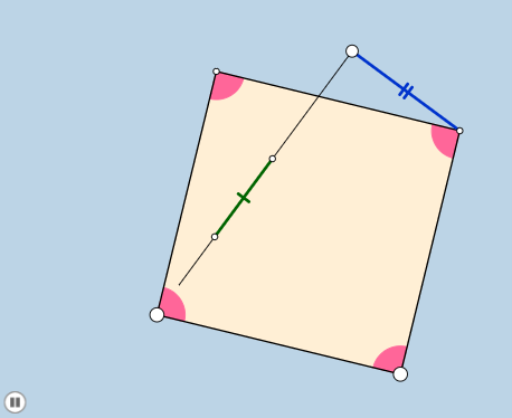
This GeoGebra example demonstrates a dynamic animation combining isosceles right triangles, reflection transformations, and polynomial function curves. The core mathematical concepts include isosceles triangles, right triangles, reflection (mirror) symmetry, line segments, circular arcs, circles, sectors, and polynomial functions. The construction uses GeoGebra commands such as Rotate, Dilate, Mirror, Polygon, Midpoint, CircleArc, Circle, CircleSector, Point, Segment, Intersect, Ray, Line, Angle, Vector, and Translate to build a rich geometric scene. The animation likely involves sliders or dynamic parameters to show continuous transformations. It is suitable for middle or high school geometry classes, dynamic geometry exploration, or math labs, helping students visualize how reflection symmetry and triangle properties interact with function graphs.
GeoGebra Commands & Parameters
Rotate(A, If[1 < e ≤ 2, ((-(e - 1)) * π / 2), -1.5707963267948966], B_2) → A'_1Dilate(A, If[0 < e ≤ 1, 1 - e, 0], B_2) → A'Rotate(A', If[1 < e ≤ 2, ((-(e - 1)) * π / 2), -1.5707963267948966], B_2) → A''Polygon(A, B_2, 4) → poly1, a, b, c, d, C, DMidpoint(A, C) → VCircleArc(V, C, D) → g_2Point(g_2) → BSegment(C, B) → j_1Segment(A, B) → nRotate(A'', If[2 < e ≤ 3, ((-(e - 2)) * π / 2), -1.5707963267948966], C) → A'''Rotate(A'_1, If[2 < e ≤ 3, ((-(e - 2)) * π / 2), -1.5707963267948966], C) → RSegment(R, A''') → f''Intersect(n, f'') → ZSegment(B, Z) → l_1Segment(A, A') → fSegment(A'_1, A'') → f'Segment(A, B_2) → gSegment(B_2, C) → hSegment(C, D) → iSegment(D, A) → jCircle(B_2, (0.5 * Min[j_1, l_1])) → pCircle(C, (0.1 * j)) → kCircle(A, (0.1 * j)) → qCircle(D, (0.1 * j)) → rSegment(A, C) → lSegment(D, B_2) → mIntersect(r, j, 1) → FIntersect(r, m, 1) → GIntersect(r, i, 1) → HIntersect(k, i, 1) → IIntersect(k, l, 1) → JIntersect(k, h, 1) → KIntersect(p, h, 1) → LIntersect(p, m, 1) → MIntersect(p, g, 1) → NIntersect(q, g, 1) → OIntersect(q, l, 1) → PIntersect(q, j, 1) → QCircleSector(B_2, L, N) → sRotate(R, If[3 < e ≤ 4, ((-(e - 3)) * π / 2), -1.5707963267948966], D) → R'Rotate(A''', If[3 < e ≤ 4, ((-(e - 3)) * π / 2), -1.5707963267948966], D) → SSegment(R', S) → f'''Dilate(B_2, If[4 < e ≤ 5, 5 - e, 0], C) → B'Vector(B_2, B') → uTranslate(s, u) → s'Rotate(s', If[5 < e ≤ 6, ((e - 5) * π / 2), 1.5707963267948966], C) → s''Dilate(C, If[6 < e ≤ 7, 7 - e, 0], D) → C'Vector(C, C') → vTranslate(s'', v) → s'''Rotate(s''', If[7 < e ≤ 8, ((e - 7) * π / 2), 1.5707963267948966], D) → tDilate(D, If[8 < e ≤ 9, 9 - e, 0], A) → D'Vector(D, D') → wTranslate(t, w) → t'Rotate(t', If[9 < e ≤ 10, ((e - 9) * π / 2), 1.5707963267948966], A) → t''Dilate(B_2, If[18 < e ≤ 19, 19 - e, 0], C) → B'_1Dilate(B_2, If[18 < e ≤ 19, 19 - e, 0], A) → B'_2Dilate(B_2, If[18 < e ≤ 19, 19 - e, 0], D) → B'_3Vector(B_2, B'_1) → v_1Vector(B_2, B'_3) → w_1Vector(B_2, B'_2) → i_1Circle(A, n - j_1) → h_2Intersect(h_2, n, 1) → A_1Midpoint(A, A_1) → B_1Dilate(B, If[10 < e ≤ 11, 11 - e, 0], C) → W'Dilate(B, If[10 < e ≤ 11, 11 - e, 0], A_1) → W'_1Segment(B, W') → m_1Segment(B, W'_1) → n_1Dilate(A_1, If[11 < e ≤ 12, 12 - e, 0], B_1) → ESegment(A_1, E) → f_1Dilate(B_1, If[12 < e ≤ 13, 13 - e, 0], A) → TSegment(B_1, T) → g_1Dilate(B_2, If[13 < e ≤ 14, 14 - e, 0], B) → B'_4Vector(B_2, B'_4) → u_1Translate(s, u_1) → s'_1Line(B, f') → a_1Point(a_1) → UAngle(U, B, C) → αRotate(s'_1, If[13 < e ≤ 14, ((e - 13) * (α - π / 2)), α - π / 2], B'_4) → c_1Rotate(B, If[14 < e ≤ 15, ((-(e - 14)) * π / 2), ((-π)) / 2], B) → W'_2Rotate(W', If[14 < e ≤ 15, ((-(e - 14)) * π / 2), ((-π)) / 2], B) → W''Segment(W'_2, W'') → b_1Rotate(A_1, If[15 < e ≤ 16, ((-(e - 15)) * π), (-π)], B_1) → C_1Rotate(E, If[15 < e ≤ 16, ((-(e - 15)) * π), (-π)], B_1) → E'Segment(C_1, E') → d_1Circle(A, B_1) → e_1Line(A, B_2) → h_1Intersect(e_1, h_1, 1) → D_1Intersect(e_1, f''', 1) → E_1Ray(A, D_1) → k_1Angle(B, A, D) → βRotate(C_1, If[16 < e ≤ 17, ((e - 16) * β), β], A) → F_1Rotate(E', If[16 < e ≤ 17, ((e - 16) * β), β], A) → E''Segment(F_1, E'') → p_1Circle(D_1, 1) → q_1Intersect(q_1, k_1, 2) → G_1Ray(D_1, G_1) → r_1Segment(A, D_1) → s_1Rotate(F_1, If[17 < e ≤ 18, ((e - 17) * π / 2), π / 2], A) → H_1Rotate(E'', If[17 < e ≤ 18, ((e - 17) * π / 2), π / 2], A) → E'''Segment(H_1, E''') → t_1Dilate(D, If[19 < e ≤ 20, 20 - e, 0], B) → D'_1Segment(D, D'_1) → f_2Rotate(t'', If[18 < e ≤ 19, ((e - 18) * π / 2), π / 2], A) → t'''Dilate(D, If[20 < e ≤ 21, 21 - e, 0], E'') → D'_2Vector(D, D'_2) → u_2Translate(D, u_2) → D'_3Translate(D'_1, u_2) → I_1Segment(D'_3, I_1) → i_2Mirror(C, D) → C'_1Line(E'', f_2) → j_2Point(j_2) → J_1Angle(J_1, E'', E''') → γRotate(D'_3, If[21 < e ≤ 22, ((e - 21) * γ), γ], E'') → K_1Rotate(I_1, If[21 < e ≤ 22, ((e - 21) * γ), γ], E'') → L_1Segment(K_1, L_1) → k_2Polygon(E''', A, E'') → poly2, e'', e''', a_2