
Animation 175: Dynamic Construction of Multiple Geometric Elements
Loading the math board and drawing, please wait…
In collections
Congruence (CO) Cluster
Congruence (Vol 2)
CCSS High School: Geometry (Congruence) Volume 2
CCSS High School: Geometry (Congruence) Volume 2
CCSS High School: Geometry (Congruence) Volume 2
Geometry (Congruence) Volume 2
CCSS High School: Geometry (Congruence) Volume 2
CCSS High School: Geometry (Congruence) Volume 2
CCSS High School: Geometry (Congruence) Volume 2
CCSS High School: Geometry (Congruence) Volume 2
CCSS High School: Geometry (Congruence) Volume 2
CCSS High School: Geometry (Congruence) Volume 2
CCSS High School: Geometry (Congruence) Volume 2
Gail LeBlancCCSS High School: Geometry (Congruence) Volume 2
Area, Surface Area, Volume, Cross Section, 3D
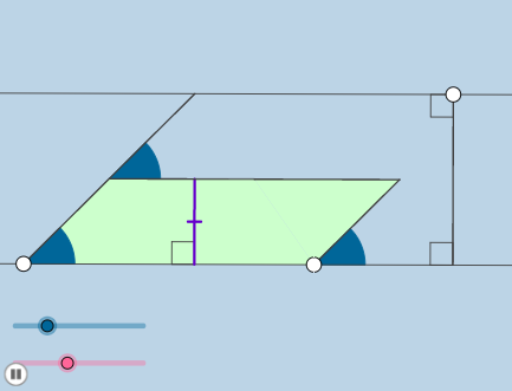
① This example demonstrates a composite geometric animation involving rotations, translations, and dilations, where sliders control parameters such as angles to dynamically show the changing positional relationships among points, lines, circles, polygons, and vectors. ② Core mathematical concepts include planar geometry transformations (rotation and translation), vector operations, properties of parallelograms, intersections of lines and circles, midpoints and perpendicular lines, with additional elements of complex numbers and solid geometry (cylinder), as well as an application context of interest calculation. ③ Construction highlights: Based on the construction summary, the GeoGebra commands used include Rotate, Angle, Ray, Segment, Intersect, Midpoint, Line, OrthogonalLine, Polygon, Point, Circle, Dilate, Min, CircleSector, Vector, and Translate. Numerous objects such as A, B, α, β, A', γ, f, B', δ, g, h, C, i, j, D, E, l, m, F, n, poly1, c, d, e, G, p, poly2, b, d_1, e_1, a, q, r, H, t, I, k, s, c_1, f_1 are created, with sliders driving angle parameters for dynamic effects. ④ Suitable for high school and above, this example is useful for teaching geometric transformations, vectors, and complex numbers, and can serve as a reference for mathematical modeling or dynamic demonstrations.
GeoGebra Commands & Parameters
Rotate(A, α, B) → A'Angle(A, B, A') → γRay(B, A') → fRotate(B, (-β), A) → B'Angle(B', A, B) → δRay(A, B') → gSegment(B, A) → hIntersect(f, g) → CSegment(B, C) → iSegment(A, C) → jMidpoint(i) → DMidpoint(j) → ELine(B, A) → lOrthogonalLine(C, l) → mIntersect(l, m) → FSegment(C, F) → nPolygon(D, E, C) → poly1, c, d, eMidpoint(n) → GLine(C, l) → pPolygon(B, D, E, A) → poly2, b, d_1, e_1, aSegment(D, C) → qSegment(B, A) → rPoint(p) → HOrthogonalLine(H, p) → tIntersect(l, t) → ISegment(H, I) → sCircle(I, 3) → c_1Circle(H, 3) → f_1Intersect(f_1, p, 1) → JIntersect(f_1, p, 2) → KIntersect(c_1, l, 2) → LIntersect(c_1, s, 1) → MIntersect(c_1, l, 1) → NAngle(J, H, I) → εAngle(M, I, N) → ζDilate(H, If[0 < k ≤ 1, 1 - k, 0], I) → H'Segment(H, H') → g_1Angle(C, F, B) → ηDilate(C, If[1 < k ≤ 2, 2 - k, 0], G) → C'Segment(C, C') → h_1Dilate(G, If[2 < k ≤ 3, 3 - k, 0], F) → G'Segment(G, G') → i_1Rotate(C, If[3 < k ≤ 4, ((-(k - 3)) * π), (-π)], G) → C'_1Rotate(C', If[3 < k ≤ 4, ((-(k - 3)) * π), (-π)], G) → C''Segment(C'_1, C'') → j_1Dilate(G, If[4 < k ≤ 5, 5 - k, 0], D) → G'_1Dilate(G, If[4 < k ≤ 5, 5 - k, 0], E) → G'_2Segment(G, G'_1) → k_1Segment(G, G'_2) → l_1Segment(B, F) → m_1Segment(B, D) → n_1Segment(D, G) → p_1Segment(D, C) → q_1Min({m_1, n_1, p_1, q_1}) → oCircle(B, (0.6 * o)) → r_1Intersect(r_1, l) → O, PSegment(B, C) → s_1Intersect(r_1, s_1, 1) → QCircleSector(B, P, Q) → t_1Rotate(D, If[6 < k ≤ 7, ((-(k - 6)) * π), (-π)], E) → D'Rotate(E, If[6 < k ≤ 7, ((-(k - 6)) * π), (-π)], E) → E'Rotate(C, If[6 < k ≤ 7, ((-(k - 6)) * π), (-π)], E) → C'_2Polygon(D', E', C'_2) → poly1', c'_2, d', e'Segment(D, C) → a_1Segment(D, B) → b_1Segment(C, E) → f_2Segment(E, A) → g_2Segment(E, C'_2) → h_2Segment(C'_2, D') → i_2Segment(D', E) → j_2Dilate(D, If[7 < k ≤ 8, 8 - k, 0], C) → D'_1Segment(D, D'_1) → k_2Dilate(B, If[8 < k ≤ 9, 9 - k, 0], D) → B'_1Vector(B, B'_1) → uTranslate(t_1, u) → c_2Dilate(B, If[9 < k ≤ 10, 10 - k, 0], A) → B'_2Vector(B, B'_2) → vTranslate(t_1, v) → d_2Circle(A, Radius[r_1]) → e_2Intersect(e_2, l, 1) → RIntersect(e_2, g_2, 1) → SSegment(B, A) → l_2Segment(A, C) → m_2Min({l_2, m_2}) → wCircle(A, (0.25 * w)) → p_2Intersect(g_2, m_2) → TIntersect(g_2, m_2) → UIntersect(p_2, m_2) → V,Intersect(p_2, l_2) → W,CircleSector(A, V, W) → q_2