
Animation 135: Dynamic Geometry and Function Visualization
Loading the math board and drawing, please wait…
In collections
Congruence (CO) Cluster
Congruence (Vol 2)
CCSS High School: Geometry (Congruence) Volume 2
CCSS High School: Geometry (Congruence) Volume 2
CCSS High School: Geometry (Congruence) Volume 2
Geometry (Congruence) Volume 2
CCSS High School: Geometry (Congruence) Volume 2
CCSS High School: Geometry (Congruence) Volume 2
CCSS High School: Geometry (Congruence) Volume 2
CCSS High School: Geometry (Congruence) Volume 2
CCSS High School: Geometry (Congruence) Volume 2
CCSS High School: Geometry (Congruence) Volume 2
CCSS High School: Geometry (Congruence) Volume 2
Gail LeBlancCCSS High School: Geometry (Congruence) Volume 2
CCSS High School: Geometry (Congruence) Volume 2
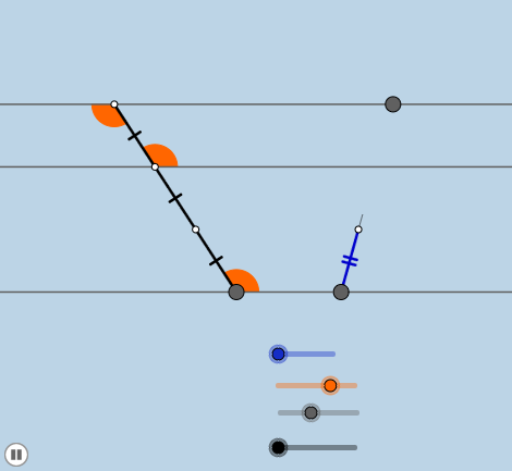
①This example demonstrates a dynamic animation that integrates geometric figures with function graphs, showcasing complex interactions among lines, circles, angles, vectors, polynomial functions, and derivatives. ②Core mathematical concepts include angles, straight lines, complex numbers, polynomial functions, derivatives, and secant lines, with transformations such as rotation, translation, and dilation creating rich geometric relationships. ③Construction highlights: Based on the construction summary, GeoGebra commands such as Point, Line, Rotate, Angle, Ray, Circle, OrthogonalLine, Intersect, Segment, CircleSector, Dilate, Vector, and Translate are used, generating numerous objects (A, B, f, α, B', β, g, γ, B'', δ, h, a, c, i, C, d, D, e, E, j, k, l, F, G, H, m, p, I, J, n, K, L, M, N, q, b, A', r, F', s) to illustrate dynamic changes via sliders or animation. ④Suitable for high school and above, this example helps explore relationships between geometric transformations, function derivatives, and secant slopes, and serves as a visual teaching tool or enrichment material for mathematical competitions.
GeoGebra Commands & Parameters
Point(y = 0) → ALine(A, B) → fRotate(B, α, A) → B'Angle(B, A, B') → βLine(A, B') → gRotate(B', γ, A) → B''Angle(B', A, B'') → δRay(A, B'') → hCircle(A, a) → cOrthogonalLine(A, g) → iIntersect(c, i, 2) → CCircle(C, a) → dIntersect(d, i, 2) → DCircle(D, a) → eIntersect(e, i, 2) → ELine(C, g) → jLine(D, g) → kLine(E, g) → lIntersect(h, j) → FIntersect(k, h) → GIntersect(l, h) → HSegment(A, F) → mCircle(A, (0.3 * m)) → pPoint(l) → IPoint(g) → JSegment(I, J) → nIntersect(k, n) → KIntersect(j, n) → LIntersect(p, g, 2) → MIntersect(p, h, 1) → NCircleSector(A, M, N) → qDilate(A, If[0 < b ≤ 1, 1 - b, 0], F) → A'Segment(A, A') → rDilate(F, If[1 < b ≤ 2, 2 - b, 0], G) → F'Segment(F, F') → sDilate(G, If[2 < b ≤ 3, 3 - b, 0], H) → G'Segment(G, G') → tDilate(A, If[3 < b ≤ 4, 4 - b, 0], F) → A'_1Vector(A, A'_1) → uTranslate(q, u) → q'Dilate(F, If[4 < b ≤ 5, 5 - b, 0], G) → F'_1Vector(F, F'_1) → vTranslate(q', v) → q''Dilate(G, If[5 < b ≤ 6, 6 - b, 0], H) → G'_1Vector(G, G'_1) → wTranslate(q'', w) → q'''Rotate(q''', If[6 < b ≤ 7, ((-(b - 6)) * π), (-π)], H) → c_1Rotate(A, If[7 < b ≤ 8, ((b - 7) * π), π], F) → A'_2Rotate(A', If[7 < b ≤ 8, ((b - 7) * π), π], F) → A''Segment(A'_2, A'') → r'Rotate(A'_2, If[8 < b ≤ 9, ((b - 8) * π), π], G) → ORotate(A'', If[8 < b ≤ 9, ((b - 8) * π), π], G) → A'''Segment(O, A''') → r''Dilate(L, If[12.5 < b ≤ 13.5, 13.5 - b, 0], K) → K'Dilate(J, If[11.5 < b ≤ 12.5, 12.5 - b, 0], L) → L'Rotate(I, If[14.5 < b ≤ 15.5, ((-(b - 15.5)) * π), (-π)], K) → I'_1Rotate(I, If[14.5 < b ≤ 15.5, ((-(b - 14.5)) * π), (-π)], K) → I'_2Rotate(I'_2, If[15.5 < b ≤ 16.5, ((-(b - 15.5)) * π), (-π)], L) → PCircle(E, a) → d_1Intersect(d_1, i, 2) → RLine(R, g) → k_1Intersect(k_1, h) → SCircle(R, a) → e_1Intersect(e_1, i, 2) → ULine(U, g) → m_1Intersect(m_1, h) → VPoint(k_1) → TPoint(m_1) → WSegment(J, T) → l_1Segment(J, L') → j_1Segment(L, K') → q_1Dilate(K, If[13.5 < b ≤ 14.5, 14.5 - b, 0], I) → K'_1Segment(K, K'_1) → f_1Rotate(J, If[14.5 < b ≤ 15.5, ((b - 14.5) * π), π], L) → J'Rotate(L', If[14.5 < b ≤ 15.5, ((b - 14.5) * π), π], L) → L''Segment(J', L'') → g_1Rotate(J', If[15.5 < b ≤ 16.5, ((b - 15.5) * π), π], K) → J''Rotate(L'', If[15.5 < b ≤ 16.5, ((b - 15.5) * π), π], K) → L'''Segment(J'', L''') → h_1Intersect(l, l_1) → QCircle(T, Q) → r_1Circle(Q, Radius[r_1]) → s_1Intersect(s_1, l_1, 1) → ZCircle(Z, Radius[r_1]) → t_1Intersect(t_1, l_1, 1) → A_1Dilate(H, If[6 < b ≤ 7, 7 - b, 0], S) → H'Vector(H, H') → u_1Translate(q''', u_1) → c_2Rotate(c_2, If[7 < b ≤ 8, ((b - 7) * π), π], S) → d_2Segment(H, H') → i_1Rotate(O, If[9 < b ≤ 10, ((b - 9) * π), π], H) → O'Rotate(A''', If[9 < b ≤ 10, ((b - 9) * π), π], H) → B_1Segment(O', B_1) → r'''Dilate(J, If[10 < b ≤ 11, 11 - b, 0], A_1) → J'_1Segment(J, J'_1) → p_1Dilate(A_1, If[11 < b ≤ 12, 12 - b, 0], Z) → C_1Segment(A_1, C_1) → a_1Dilate(Z, If[12 < b ≤ 13, 13 - b, 0], Q) → Z'Segment(Z, Z') → b_1Dilate(Q, If[13 < b ≤ 14, 14 - b, 0], T) → Q'Segment(Q, Q') → g_2Rotate(J, If[14 < b ≤ 15, ((b - 14) * π), π], A_1) → J'_2Rotate(J'_1, If[14 < b ≤ 15, ((b - 14) * π), π], A_1) → D_1Segment(J'_2, D_1) → h_2Rotate(J'_2, If[15 < b ≤ 16, ((b - 15) * π), π], Z) → E_1Rotate(D_1, If[15 < b ≤ 16, ((b - 15) * π), π], Z) → F_1Segment(E_1, F_1) → i_2Rotate(E_1, If[16 < b ≤ 17, ((b - 16) * π), π], Q) → G_1Rotate(F_1, If[16 < b ≤ 17, ((b - 16) * π), π], Q) → H_1Segment(G_1, H_1) → j_2
AI Drawing Prompt Reference
Create a dynamic geometric animation combining shapes and function graphs. Start with a point on a horizontal line, then rotate it to form rays and angles. Construct a series of equal circles along a perpendicular line, intersecting with parallel lines to generate key points. Connect these points to form segments and a circular sector. Then, translate and rotate the sector along a path while using dilation to create moving segments between points, simulating function changes. The scene includes lines, circles, angles, sectors, vectors, and dynamic segments, controlled by a slider to show different transformation stages.
The prompt above was compiled from the original drawing commands and is for reference only.