
Animation 115: Circle, Orthocenter, Rectangle, and Coordinate Geometry
Loading the math board and drawing, please wait…
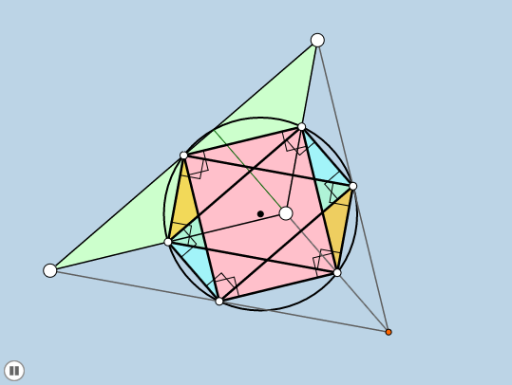
This example demonstrates the dynamic relationship between a triangle's orthocenter, circumcircle, rectangle, and linear equations through animation. Key math concepts include circle, orthocenter, rectangle, linear equations, and coordinate geometry. Construction involves commands like Segment, Midpoint, Circle, Intersect, Dilate, Rotate, etc. Suitable for high school mathematics education, emphasizing the integration of analytical geometry and geometric transformations.
GeoGebra Commands & Parameters
Segment(A, B) → fSegment(B, C_1) → gSegment(C_1, A) → hMidpoint(f) → DMidpoint(h) → EMidpoint(g) → FMin(list1) → aCircle(D, (0.1 * a)) → cCircle(E, (0.1 * a)) → dCircle(F, (0.1 * a)) → eIntersect(c, f, 2) → HIntersect(d, h, 2) → KIntersect(e, g, 2) → MDilate(A, If[0 < b ≤ 1, 1 - b, 0], D) → A'Dilate(B, If[2 < b ≤ 3, 3 - b, 0], F) → B'Dilate(C_1, If[4 < b ≤ 5, 5 - b, 0], E) → C'Segment(A, A') → lSegment(B, B') → mSegment(C_1, C') → nRotate(A, If[1 < b ≤ 2, ((b - 1) * π), π], D) → A'_1Rotate(A', If[1 < b ≤ 2, ((b - 1) * π), π], D) → A''Segment(A'_1, A'') → l'Rotate(B, If[3 < b ≤ 4, ((b - 3) * π), π], F) → B'_1Rotate(B', If[3 < b ≤ 4, ((b - 3) * π), π], F) → B''Segment(B'_1, B'') → m'Rotate(C_1, If[5 < b ≤ 6, ((b - 5) * π), π], E) → C'_1Rotate(C', If[5 < b ≤ 6, ((b - 5) * π), π], E) → C''Segment(C'_1, C'') → n'Polygon(A, B, C_1) → poly1, c_1, a_1, b_1Line(A, B) → iPoint(i) → CPoint(i) → GOrthogonalLine(C_1, i) → jIntersect(i, j) → IRay(A, G) → kRay(B, C) → pPoint(k) → JPoint(p) → LRay(A, J) → qRay(B, L) → rCircle(I, (0.1 * a)) → sIntersect(s, i, 2) → NIntersect(s, j, 2) → OCircleSector(I, N, O) → tAngle(C_1, B, A) → αAngle(B, A, C_1) → βAngle(A, C_1, B) → γLine(A, C_1) → f_1Point(f_1) → PPoint(f_1) → QRay(A, P) → g_1Ray(C_1, Q) → h_1Point(g_1) → RRay(A, R) → i_1Point(h_1) → SRay(C_1, S) → j_1OrthogonalLine(B, f_1) → k_1Intersect(f_1, k_1) → TCircle(T, (0.1 * a)) → d_1Intersect(d_1, f_1, 1) → UIntersect(d_1, k_1, 1) → VCircleSector(T, U, V) → e_1Line(C_1, B) → l_1OrthogonalLine(A, l_1) → m_1Intersect(l_1, m_1) → WCircle(W, (0.1 * a)) → p_1Intersect(p_1, l_1, 1) → ZIntersect(p_1, m_1, 1) → A_1Point(l_1) → B_1Point(l_1) → D_1CircleSector(W, Z, A_1) → q_1Ray(C_1, B_1) → n_1Ray(B, D_1) → r_1Point(n_1) → E_1Point(r_1) → F_1Ray(C_1, E_1) → s_1Ray(B, F_1) → t_1Dilate(C_1, If[6 < b ≤ 7, 7 - b, 0], I) → G_1Segment(C_1, G_1) → f_2Dilate(B, If[7 < b ≤ 8, 8 - b, 0], T) → B'_2Segment(B, B'_2) → g_2Dilate(A, If[8 < b ≤ 9, 9 - b, 0], W) → A'_2Segment(A, A'_2) → h_2Intersect(k_1, m_1) → H_1Rotate(t, If[9 < b ≤ 10, ((b - 9) * π / 2), π / 2], I) → t'Rotate(e_1, If[10 < b ≤ 11, ((b - 10) * π / 2), π / 2], T) → c_2Rotate(q_1, If[11 < b ≤ 12, ((b - 11) * π / 2), π / 2], W) → d_2Dilate(I, If[12 < b ≤ 13, 13 - b, 0], H_1) → I'Dilate(A, If[12 < b ≤ 13, 13 - b, 0], H_1) → A'_3Dilate(T, If[12 < b ≤ 13, 13 - b, 0], H_1) → T'Segment(I, I') → i_2Segment(A, A'_3) → j_2Segment(T, T') → k_2Dilate(C_1, If[12 < b ≤ 13, 13 - b, 0], H_1) → I_1Dilate(W, If[12 < b ≤ 13, 13 - b, 0], H_1) → W'Dilate(T, If[12 < b ≤ 13, 13 - b, 0], H_1) → T'_1Segment(W, W') → l_2Segment(C_1, I_1) → m_2Segment(T, T'_1) → n_2Dilate(I, If[12 < b ≤ 13, 13 - b, 0], H_1) → I'_1Dilate(B, If[12 < b ≤ 13, 13 - b, 0], H_1) → B'_3Dilate(W, If[12 < b ≤ 13, 13 - b, 0], H_1) → W'_1Segment(B, B'_3) → p_2Segment(W, W'_1) → q_2Segment(I, I'_1) → r_2Midpoint(H_1, C_1) → J_1Midpoint(H_1, A) → K_1Midpoint(H_1, B) → L_1Dilate(H_1, If[14 < b ≤ 15, 15 - b, 0], J_1) → M_1Segment(H_1, M_1) → s_2Dilate(J_1, If[15 < b ≤ 16, 16 - b, 0], C_1) → N_1Segment(J_1, N_1) → t_2Rotate(H_1, If[16 < b ≤ 17, ((b - 16) * π), π], J_1) → O_1Rotate(M_1, If[16 < b ≤ 17, ((b - 16) * π), π], J_1) → P_1Segment(O_1, P_1) → a_2Dilate(H_1, If[17 < b ≤ 18, 18 - b, 0], L_1) → Q_1Segment(H_1, Q_1) → b_2Dilate(L_1, If[18 < b ≤ 19, 19 - b, 0], B) → R_1Segment(L_1, R_1) → e_2Rotate(H_1, If[19 < b ≤ 20, ((b - 19) * π), π], L_1) → S_1Rotate(Q_1, If[19 < b ≤ 20, ((b - 19) * π), π], L_1) → T_1Segment(S_1, T_1) → f_3Dilate(H_1, If[20 < b ≤ 21, 21 - b, 0], K_1) → U_1Segment(H_1, U_1) → g_3Dilate(K_1, If[21 < b ≤ 22, 22 - b, 0], A) → V_1Segment(K_1, V_1) → h_3Rotate(H_1, If[22 < b ≤ 23, ((b - 22) * π), π], K_1) → W_1Rotate(U_1, If[22 < b ≤ 23, ((b - 22) * π), π], K_1) → Z_1Segment(W_1, Z_1) → i_3Intersect(e, l_1) → A_2, B_2OrthogonalLine(F, l_1) → j_3Intersect(e, j_3) → C_2, D_2CircleSector(F, A_2, C_2) → c_3OrthogonalLine(E, f_1) → k_3Circle(E, (0.1 * a)) → d_3Intersect(d_3, k_3) → E_2, F_2Intersect(d_3, f_1) → G_2, H_2CircleSector(E, G_2, E_2) → e_3Rotate(c_3, If[25 < b ≤ 26, ((b - 25) * π / 2), π / 2], F) → p_3Rotate(e_3, If[26 < b ≤ 27, ((b - 26) * π / 2), π / 2], E) → q_3Intersect(k_3, j_3) → I_2Midpoint(H_1, I_2) → J_2Dilate(H_1, If[28 < b ≤ 29, 29 - b, 0], J_2) → K_2Segment(H_1, K_2) → l_3Dilate(J_2, If[29 < b ≤ 30, 30 - b, 0], I_2) → L_2Segment(J_2, L_2) → m_3Rotate(H_1, If[30 < b ≤ 31, ((b - 30) * π), π], J_2) → M_2Rotate(K_2, If[30 < b ≤ 31, ((b - 30) * π), π], J_2) → N_2Segment(M_2, N_2) → n_3Dilate(J_2, If[31 < b ≤ 32, 32 - b, 0], D) → O_2Segment(J_2, O_2) → r_3Rotate(J_2, If[32 < b ≤ 34, ((b - 32) * π), (2 * π)], J_2) → P_2Rotate(O_2, If[32 < b ≤ 34, ((b - 32) * π), (2 * π)], J_2) → Q_2Segment(P_2, Q_2) → s_3CircleArc(J_2, D, Q_2) → t_3Circle(J_2, D) → c_4Segment(B, T) → a_3Segment(I, C_1) → b_3Segment(A, W) → f_4Segment(H_1, I) → g_4Segment(H_1, T) → h_4Segment(H_1, W) → i_4Polygon(L_1, D, E, J_1) → poly2, l_4, d_4, e_4, j_4Angle(J_1, L_1, D) → δAngle(L_1, D, E) → εAngle(D, E, J_1) → ζAngle(E, J_1, L_1) → ηDilate(D, If[37 < b ≤ 38, 38 - b, 0], L_1) → D'Segment(D, D') → k_4Dilate(L_1, If[38 < b ≤ 39, 39 - b, 0], J_1) → R_2Segment(L_1, R_2) → m_4Dilate(J_1, If[39 < b ≤ 40, 40 - b, 0], E) → S_2Segment(J_1, S_2) → n_4Dilate(E, If[40 < b ≤ 41, 41 - b, 0], D) → E'Segment(E, E') → p_4Polygon(D, F, J_1, K_1) → poly3, d_5, f_5, j_5, k_5Angle(J_1, F, D) → θAngle(F, D, K_1) → ιAngle(D, K_1, J_1) → κAngle(K_1, J_1, F) → λDilate(F, If[42 < b ≤ 43, 43 - b, 0], D) → F'Segment(F, F') → q_4Dilate(D, If[43 < b ≤ 44, 44 - b, 0], K_1) → D'_1Segment(D, D'_1) → r_4Dilate(K_1, If[44 < b ≤ 45, 45 - b, 0], J_1) → T_2Segment(K_1, T_2) → s_4Dilate(J_1, If[45 < b ≤ 46, 46 - b, 0], F) → U_2Segment(J_1, U_2) → t_4Polygon(E, F, L_1, K_1) → poly4, e_5, f_6, l_5, k_6Dilate(L_1, If[47 < b ≤ 48, 48 - b, 0], F) → V_2Segment(L_1, V_2) → a_4Dilate(F, If[48 < b ≤ 49, 49 - b, 0], E) → F'_1Segment(F, F'_1) → b_4Dilate(E, If[49 < b ≤ 50, 50 - b, 0], K_1) → E'_1Segment(E, E'_1) → g_5Dilate(K_1, If[50 < b ≤ 51, 51 - b, 0], L_1) → W_2Segment(K_1, W_2) → h_5Angle(E, F, L_1) → μAngle(F, L_1, K_1) → νAngle(L_1, K_1, E) → ξAngle(K_1, E, F) → ο
AI Drawing Prompt Reference
Draw a triangle and label its orthocenter, circumcircle, and rectangle, showing the dynamic relationship between them through animation. Also, draw relevant lines and equations to illustrate the integration of coordinate geometry and geometric transformations. Start by drawing the three sides of the triangle, then find the midpoints of each side to draw the circumcircle. Next, locate the orthocenter of the triangle and use it as the center to draw a rectangle. Animate the rectangle rotating around the orthocenter, demonstrating the dynamic relationship between the circumcircle and the rectangle. Finally, draw lines from the orthocenter to the vertices of the triangle and label the angles and equations involved.
The prompt above was compiled from the original drawing commands and is for reference only.