
Animation 114: Conic Sections and Geometric Transformations
Loading the math board and drawing, please wait…
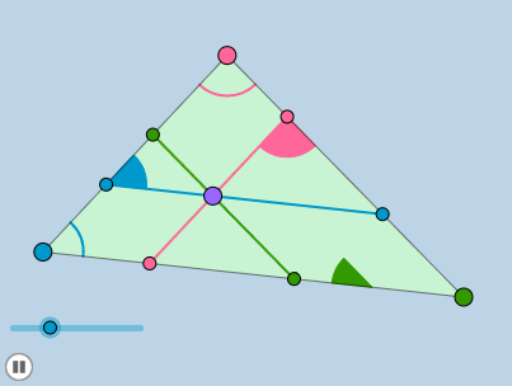
① This example demonstrates a dynamic animation showing the relationships among ellipses, hyperbolas, parabolas, straight lines, circles, and polygons, creating a comprehensive geometric construction scene. ② Core mathematical concepts include conic sections (ellipse, hyperbola, parabola), the Pythagorean theorem, geometric transformations (rotation, translation, scaling), frequency distribution, and correlation, integrating multiple areas of mathematics. ③ Construction highlights: Based on the construction summary, the example uses GeoGebra commands such as Line, Rotate, Angle, Ray, Point, Segment, Polygon, Intersect, Conic, Focus, Vertex, Circle, CircleSector, Dilate, Vector, Translate, and CircleArc, creating numerous objects (A, B, f, α, B', β, g, C, h, poly1, c, a, b, D, i, j, k, E, F, G, H, I, J, d, K, L, M, N, O, P, l, m, e, p, q, r, Q, R, S, T). Sliders or animation controls vary parameters to dynamically display geometric relationships. ④ Suitable for high school and above students to explore properties of conic sections and geometric transformations, and also useful for teachers creating dynamic geometry lessons to visualize abstract mathematical concepts.
GeoGebra Commands & Parameters
Line(A, B) → fRotate(B, α, A) → B'Angle(B, A, B') → βRay(A, B') → gPoint(g) → CSegment(C, B) → hPolygon(A, B, C) → poly1, c, a, bPointIn(poly1) → DLine(D, f) → iLine(D, h) → jLine(D, g) → kIntersect(k, h) → EIntersect(f, k) → FIntersect(i, g) → GIntersect(j, g) → HIntersect(h, i) → IIntersect(f, j) → JConic(F, J, I, E, H) → dFocus(d) → K, LVertex(d) → M, N, O, PSegment(A, B) → lSegment(C, A) → mMin({l, m, h}) → eCircle(A, (0.15 * e)) → pCircle(C, (0.15 * e)) → qCircle(B, (0.15 * e)) → rIntersect(q, m, 1) → QIntersect(q, h, 1) → RIntersect(p, l, 1) → SIntersect(p, m, 1) → TIntersect(r, l, 1) → UIntersect(r, h, 1) → VCircleSector(C, Q, R) → sCircleSector(A, S, T) → tCircleSector(B, V, U) → c_1Dilate(D, If[0 < n ≤ 1, 1 - n, 0], I) → D'Dilate(D, If[0 < n ≤ 1, 1 - n, 0], G) → D'_1Segment(D, D') → f_1Segment(D, D'_1) → g_1Dilate(A, If[1 < n ≤ 2, 2 - n, 0], G) → A'Vector(A, A') → uTranslate(t, u) → t'CircleArc(A, S, T) → d_1Dilate(D, If[2 < n ≤ 3, 3 - n, 0], E) → D'_2Dilate(D, If[2 < n ≤ 3, 3 - n, 0], F) → D'_3Segment(D, D'_2) → h_1Segment(D, D'_3) → i_1Dilate(C, If[3 < n ≤ 4, 4 - n, 0], E) → C'Vector(C, C') → vTranslate(s, v) → s'CircleArc(C, Q, R) → e_1Dilate(D, If[4 < n ≤ 5, 5 - n, 0], J) → D'_4Dilate(D, If[4 < n ≤ 5, 5 - n, 0], H) → D'_5Segment(D, D'_4) → j_1Segment(D, D'_5) → k_1Dilate(B, If[5 < n ≤ 6, 6 - n, 0], J) → B'_1Vector(B, B'_1) → wTranslate(c_1, w) → p_1CircleArc(B, V, U) → q_1
AI Drawing Prompt Reference
Create a dynamic animation showing the relationships among ellipses, hyperbolas, parabolas, straight lines, circles, and polygons, forming a comprehensive geometric construction. Use rotations, translations, and scalings to dynamically display how these shapes interact and transform, incorporating concepts like the Pythagorean theorem and geometric properties.
The prompt above was compiled from the original drawing commands and is for reference only.