
Angles on Two Lines
Loading the math board and drawing, please wait…
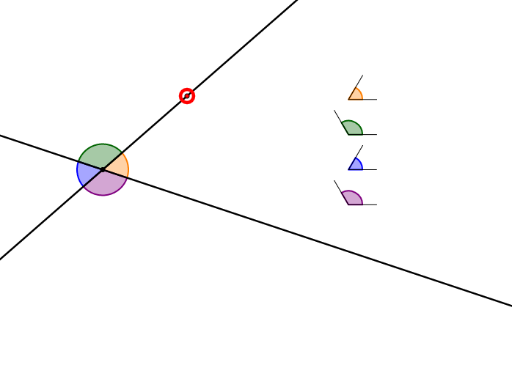
This example demonstrates angles on two lines. Key mathematical concepts include the properties of angles. Using GeoGebra commands such as Line, Point, Angle, Segment, etc., you can construct two lines and their angles. Suitable for middle school and above students to learn geometric construction.
GeoGebra Commands & Parameters
Line(A, B) → fPoint(f) → DLine(C, D) → gAngle(B, D, C) → αAngle(C, D, A) → βPoint(g) → EAngle(A, D, E) → γAngle(E, D, B) → δSegment(F, G) → hSegment(H, I) → iSegment(J, K) → jSegment(L, M) → kRotate(F, α, G) → F'Angle(F, G, F') → εRotate(H, β, I) → H'Angle(H, I, H') → ζRotate(J, γ, K) → J'Angle(J, K, J') → ηRotate(L, δ, M) → L'Angle(L, M, L') → θSegment(F', G) → lSegment(H', I) → mSegment(J', K) → nSegment(L', M) → pOrthogonalLine(D, f) → qOrthogonalLine(C, q) → r
AI Drawing Prompt Reference
Draw two intersecting lines, one passing through two fixed points and the other through a third fixed point and a moving point on the first line. Mark four angles at the intersection with arcs. Then pick two points on each line, connect them with segments, and rotate one endpoint of each segment by the corresponding angle to create new angles. Finally, draw a perpendicular from the intersection to the first line, and then a perpendicular to that perpendicular through the third fixed point, forming a parallel line.
The prompt above was compiled from the original drawing commands and is for reference only.