
Angles on a Line
Loading the math board and drawing, please wait…
In collections
Introduction to Angles
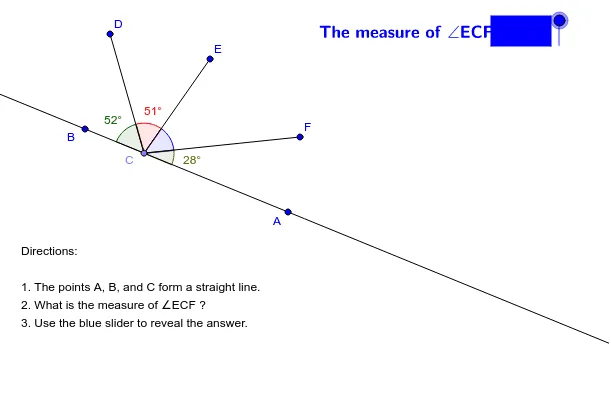
This example demonstrates finding missing angles on a line. Key mathematical concepts include angle properties and calculations. It uses GeoGebra commands such as Line, Point, Ray, Angle, etc., for geometric construction. Suitable for middle school and above students learning geometry and trigonometry.
GeoGebra Commands & Parameters
Line(A, B) → aPoint(a) → CRay(C, D) → bRay(C, E) → cRay(C, F) → dAngle(D, C, B) → αAngle(E, C, D) → βAngle(F, C, E) → γAngle(A, C, F) → δSegment(C, D) → eSegment(C, E) → fSegment(C, F) → gPolygon(G, H, I, J) → P, g_1, h, i, jVector((0, k - 1)) → uTranslate(G, u) → G'Translate(H, u) → H'Translate(I, u) → I'Translate(J, u) → J'Polygon(G', H', I', J') → P', g', h', i', j'
AI Drawing Prompt Reference
Draw a straight line and mark three points on it. From the first point, draw three rays extending outwards, each forming a different angle with the line. Measure the angles between each pair of adjacent rays and draw a quadrilateral above the line. Then, translate the quadrilateral to show the angle relationships.
The prompt above was compiled from the original drawing commands and is for reference only.