
Angles at a Point: Exploring Adjacent Angles Around a Common Vertex
Loading the math board and drawing, please wait…
In collections
Introduction to Angles
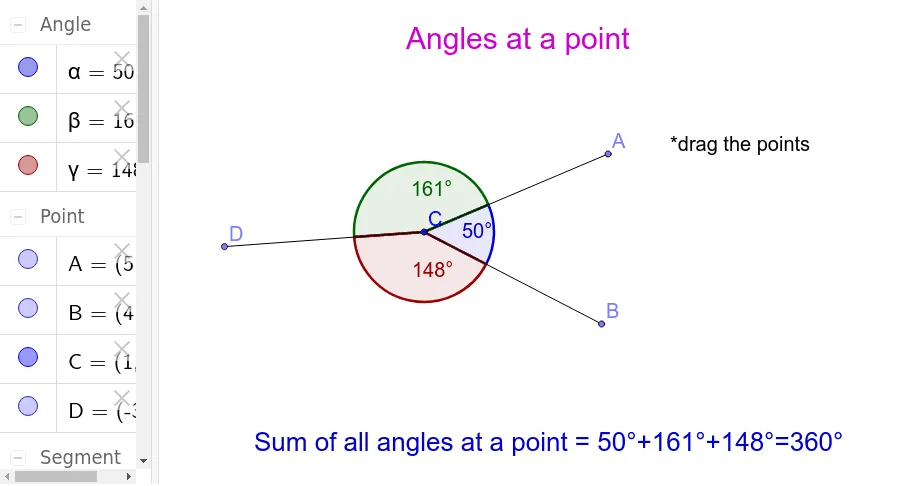
This GeoGebra example dynamically illustrates the concept of angles at a point, showing how multiple adjacent angles (α, β, γ) share a common vertex (point A) and together form a full revolution of 360°. It demonstrates the fundamental geometric principle that the sum of angles around a point equals 360°, and visually reinforces the relationships between adjacent angles. Core mathematical concepts include angle definition, angle measurement, the full-turn property, and angle addition. The construction uses GeoGebra commands such as Point (creating points C, B, A, D), Segment (drawing rays or segments from the common vertex), and Angle (marking and measuring each angle), along with text objects for labels. This resource is ideal for middle school geometry lessons, helping students grasp angle composition and decomposition, and can also serve as an interactive demonstration for teachers to show how dragging vertices changes angle measures while the total remains constant. Suitable for grades 6-9 or introductory geometry courses.
GeoGebra Commands & Parameters
Point(Circle[C, 4]) → BSegment(C, B) → aPoint(Circle[C, 4]) → ASegment(C, A) → bPoint(Circle[C, 4]) → DSegment(C, D) → cAngle(B, C, A) → αAngle(A, C, D) → βAngle(D, C, B) → γ