
Angles of a Trapezoid and Parallelogram
Loading the math board and drawing, please wait…
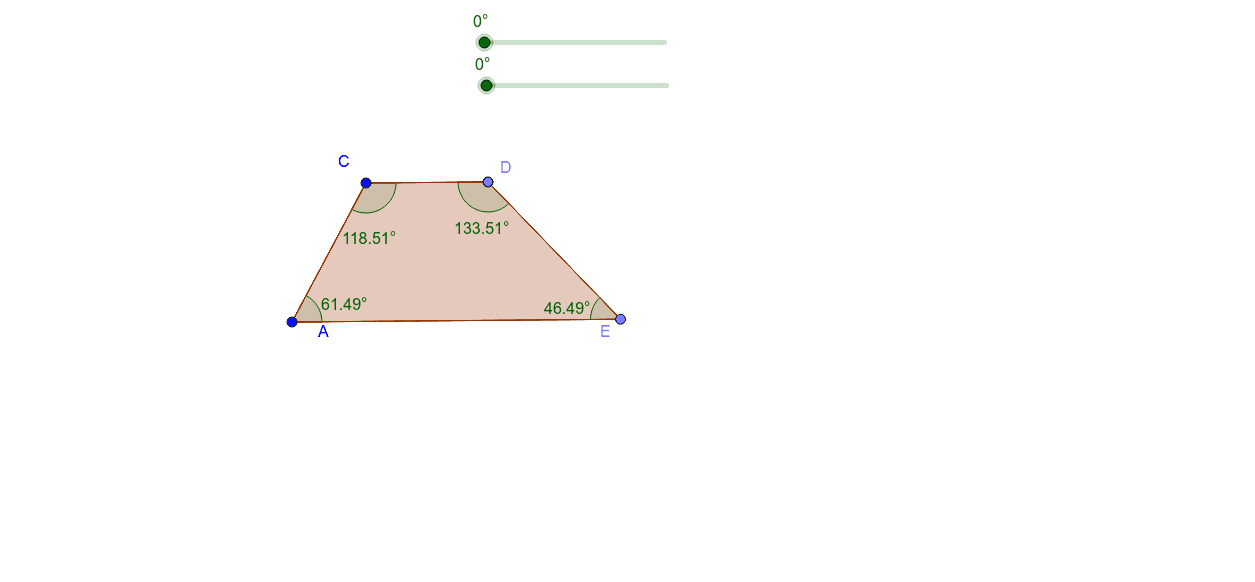
This GeoGebra example dynamically illustrates the angle relationships within a trapezoid and a parallelogram, showing how the interior angles of these two quadrilaterals are interconnected. It demonstrates key mathematical concepts such as the sum of interior angles in polygons, properties of parallel lines (supplementary consecutive interior angles), and specific angle properties of parallelograms (opposite angles equal, adjacent angles supplementary). The construction uses commands like Line, Segment, Point, Angle, Midpoint, Polygon, and Rotate to build the shapes and their rotated copies, with angles labeled (α, β, γ, δ, ε, ζ) for clear visualization. It also references tangent functions and quadratic equations, suggesting possible extensions. Suitable for middle school to high school students learning geometry, angle properties, and quadrilateral classifications, and useful for interactive classroom demonstrations or self-study, allowing users to drag vertices and observe angle changes dynamically.
GeoGebra Commands & Parameters
Line(A, B) → fLine(C, f) → gSegment(A, C) → hPoint(g) → DPoint(f) → ESegment(D, E) → iAngle(E, A, C) → βAngle(D, E, A) → δMidpoint(A, C) → FMidpoint(D, E) → GPolygon(A, C, D, E) → poly1, a, c, d, eRotate(A, ε, F) → A'Rotate(C, ε, F) → C'Rotate(D, ε, F) → D'Rotate(E, ε, F) → E'Polygon(A', C', D', E') → poly1', a', c', d', e'Angle(A', C', D') → αRotate(A, (-ζ), G) → A'_1Rotate(C, (-ζ), G) → C'_1Rotate(D, (-ζ), G) → D'_1Rotate(E, (-ζ), G) → E'_1Polygon(A'_1, C'_1, D'_1, E'_1) → poly1'_1, a'_1, c'_1, d'_1, e'_1Angle(C'_1, D'_1, E'_1) → γ