
Angles in Parallelograms
Loading the math board and drawing, please wait…
In collections
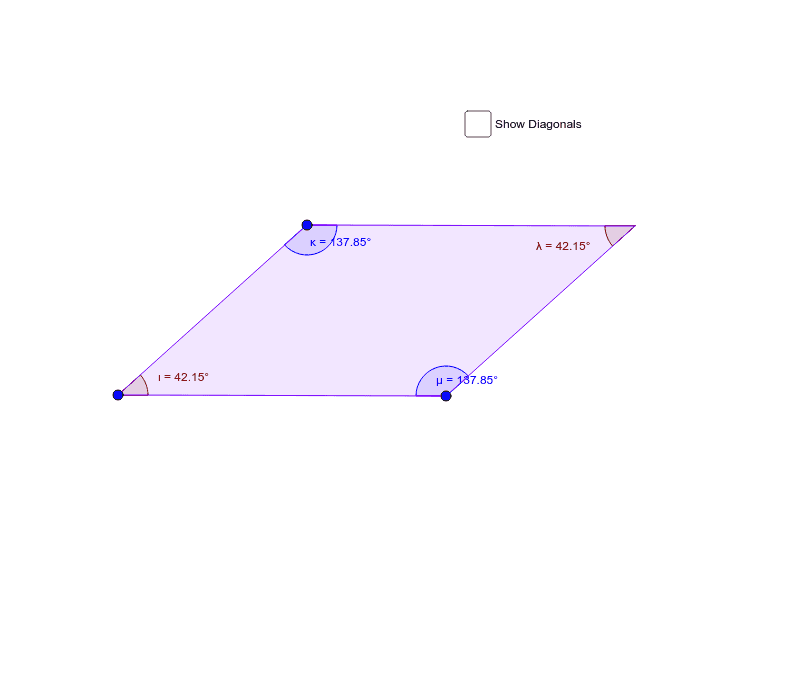
Investigating Parallelogram Sides and Angles
This example explores the relationship of angles in a parallelogram, helping students understand the properties of angles in geometric figures. Key mathematical concepts include the angle properties of parallelograms. GeoGebra commands used include Segment, Line, Intersect, Polygon, and Angle. Suitable for middle school and above students learning geometric construction.
GeoGebra Commands & Parameters
Segment(A, B) → aSegment(A, C) → bLine(C, a) → cLine(B, b) → dIntersect(d, c) → DPolygon(A, C, D, B) → poly1, a_1, c_1, d_1, b_1Segment(C, B) → eSegment(D, A) → fAngle(B, C, D) → αAngle(C, B, A) → βAngle(D, A, C) → γAngle(C, D, A) → δAngle(A, D, B) → εAngle(D, B, C) → ζAngle(A, C, B) → ηAngle(B, A, D) → θAngle(poly1) → ι, κ, λ, μIntersect(e, f) → EAngle(C, E, A) → νAngle(B, E, D) → ξAngle(D, E, C) → οAngle(A, E, B) → ρ
AI Drawing Prompt Reference
Draw a parallelogram ABCD, connect its diagonals AC and BD, mark and measure all interior angles, including ∠A, ∠B, ∠C, ∠D and their adjacent angles.
The prompt above was compiled from the original drawing commands and is for reference only.