
Angles in Parallel Lines by Ooi Soo Huat
Loading the math board and drawing, please wait…
In collections
Mathematics Form 1
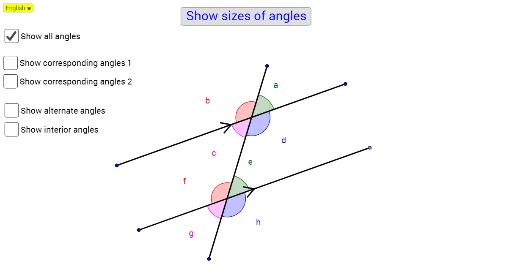
This example demonstrates the relationships between alternate interior angles, corresponding angles, and consecutive interior angles formed by parallel lines. Key math concepts include properties of parallel lines, angle equality, and angle supplementation. Construction involves commands like Segment, Line, Point, Midpoint, Circle, Intersect, Rotate, Angle, If, SelectedIndex to create parallel lines and measure angles, visually showing their relationships. Suitable for middle school mathematics education to intuitively understand parallel line properties and their applications.
GeoGebra Commands & Parameters
Segment(A, B) → g_1Line(C, g_1) → b_1Point(b_1) → DSegment(E, F) → g_2Segment(C, D) → g_3Midpoint(A, B) → GMidpoint(C, D) → HCircle(G, 0.5) → e_1Circle(H, 0.5) → f_1Intersect(e_1, g_1, 1) → IIntersect(f_1, g_3, 1) → JRotate(I, 30°, G) → I'Rotate(I, (-(30°)), G) → I'_1Rotate(J, 30°, H) → J'Rotate(J, (-(30°)), H) → J'_1Segment(I'_1, G) → g_0Segment(I', G) → g_4Segment(J'_1, H) → g_5Segment(H, J) → g_6Segment(J', H) → g_7Intersect(g_1, g_2) → KIntersect(g_2, g_3) → LAngle(F, L, D) → hAngle(C, L, F) → gAngle(B, K, E) → aAngle(E, K, A) → bAngle(D, L, E) → eAngle(E, L, C) → fAngle(F, K, B) → dAngle(A, K, F) → cIf(Label ≟ true, 0, 2) → IndexSelectedIndex(Bahasa) → nn