
Angles in a Regular Polygon
Loading the math board and drawing, please wait…
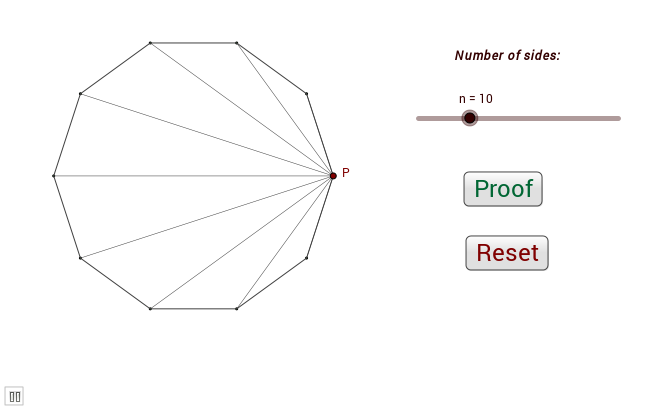
This example demonstrates the angles between diagonals in a regular polygon. It involves core math concepts like polygons, angle calculations, and geometric constructions. GeoGebra commands/objects used include Intersect, Circle, Sequence, Polygon, Sector, CircleArc, and Angle. Suitable for high school students learning geometry to understand symmetry and angle relationships in regular polygons.
GeoGebra Commands & Parameters
Intersect(xAxis, yAxis) → OCircle(O, 1) → cSequence((cos(((k * 2) * π / n)), sin(((k * 2) * π / n))), k, 1, n) → list1Polygon(list1) → poly1Sequence(Segment[P, Element[list1, i]], i, 1, n) → list2Sector(c, Element[list1, i], Element[list1, i + 1]) → dCircleArc(O, Element[list1, i], Element[list1, i + 1]) → eAngle(Element[list1, i], O, Element[list1, i + 1]) → αAngle(Element[list1, i], P, Element[list1, i + 1]) → βCircleArc(O, Element[list1, i], Element[list1, i + 1]) → fSector(c, Element[list1, 1], Element[list1, 2]) → kPolygon(P, Element[list1, 1], Element[list1, 2]) → poly3, j, p, lPolygon(P, Element[list1, i], Element[list1, i + 1]) → poly2, a, p_1, bAngle(Element[list1, 1], O, Element[list1, 2]) → γAngle(Element[list1, 1], P, Element[list1, 2]) → δSequence(Segment[Element[list1, k], O], k, 1, n) → list3CircleArc(O, Element[list1, 1], Element[list1, 2]) → gSequence(Angle[Element[list1, k], P, Element[list1, k + 1]], k, 1, i) → list4