
Angles and Coterminal Angles Demo
Loading the math board and drawing, please wait…
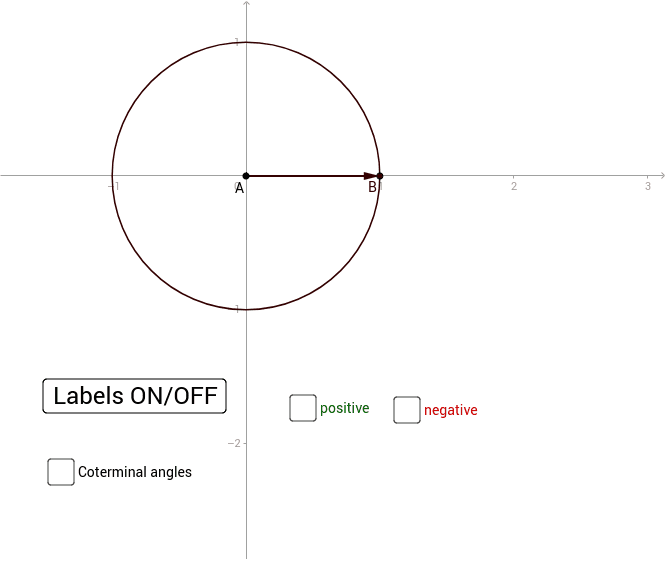
This example demonstrates the relationship between angles and coterminal angles with geometric representations. It involves core concepts like angle measurement, coterminal angle definition, vector rotation, and complex number representation. GeoGebra commands used include Point, Circle, Vector, CircleArc, Angle, Rotate, and CurveCartesian. Suitable for high school mathematics teaching to understand trigonometric functions and geometric transformations.
GeoGebra Commands & Parameters
Point(yAxis) → APoint(xAxis) → BCircle(A, B) → cPoint(c) → CVector(A, B) → uVector(A, C) → vCircleArc(A, B, C) → dAngle(B, A, C) → αPoint(c) → DVector(A, D) → wAngle(D, A, B) → βCircleArc(A, D, B) → eRotate(B, -(β / 2), A) → B'Angle(B', A, B) → γPoint(A, Vector[A, B'] / 2.8) → MPoint(A, Vector[A, B'] / 0.9) → NVector(A, P) → zCurveCartesian(r1 / h * (t + 6 * π) * cos(t + 6 * π), r1 / h * (t + 6 * π) * sin(t + 6 * π), t, 0, θ) → fCurveCartesian(r1 / h * (t + 6 * π) * cos(t + 6 * π), (-r1) / h * (t + 6 * π) * sin(t + 6 * π), t, 0, θn) → gVector(A, Q) → i
AI Drawing Prompt Reference
Draw a geometric representation showing the relationship between angles and coterminal angles. Start by plotting points and a circle on the coordinate axes, then mark vectors and represent angles with arcs. Next, obtain new points and vectors through rotation and calculation, and finally draw two curves using parametric equations to illustrate the relationship between coterminal angles and the angle.
The prompt above was compiled from the original drawing commands and is for reference only.