
Angle MAX on the Diagonal of a Cube
Loading the math board and drawing, please wait…
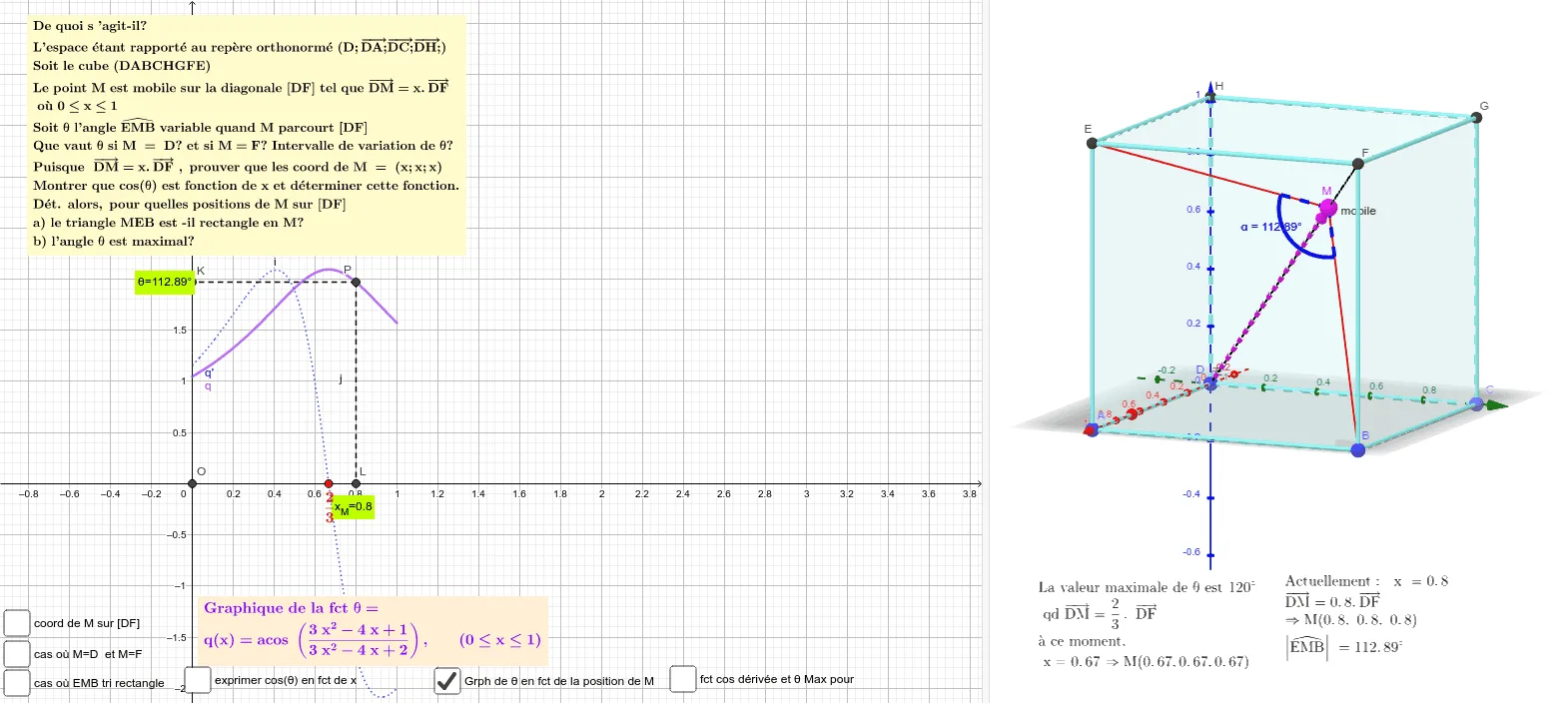
This example demonstrates the angle MAX on the diagonal of a cube. Key mathematical concepts include solid geometry angles. Using GeoGebra commands such as Derivative, Intersect, Point, etc., as listed in the construction summary, a cube and its diagonal can be constructed. Suitable for high school mathematics education or students learning solid geometry.
GeoGebra Commands & Parameters
Derivative(q) → q'Intersect(q', xAxis, (0.666666666374032, 4.561722849665948E-9)) → NPoint(Circle[B, Distance[A, B], Segment[A, B]]) → CCube(A, B, C) → a, E_1, faceCEIH, faceFGHI, arêteAE, arêteAB, arêteBC, arêteCE, arêteAF, arêteEI, arêteFI, arêteFG, E, arêteBG, arêteGH, arêteCH, arêteHI, F, G, H, faceABCE, faceAEIF, faceABGF, faceBCHGSegment(D, F) → fPoint(f) → MVector(D, M) → uSegment(E, M) → gSegment(M, B) → hAngle(E, M, B) → αVector(D, F) → vIntersect(yAxis, xAxis) → OPoint(yAxis) → IPoint(xAxis) → JOutil1(I, O, P) → iOutil1(J, O, P) → jIntersect(i, yAxis) → KIntersect(j, xAxis) → LIntersect(q, yAxis, (0, 1.0471975511965979)) → QDerivative(cx) → cx'