
Angle Formed by Two Tangents
Loading the math board and drawing, please wait…
In collections
Circles (Theorems)
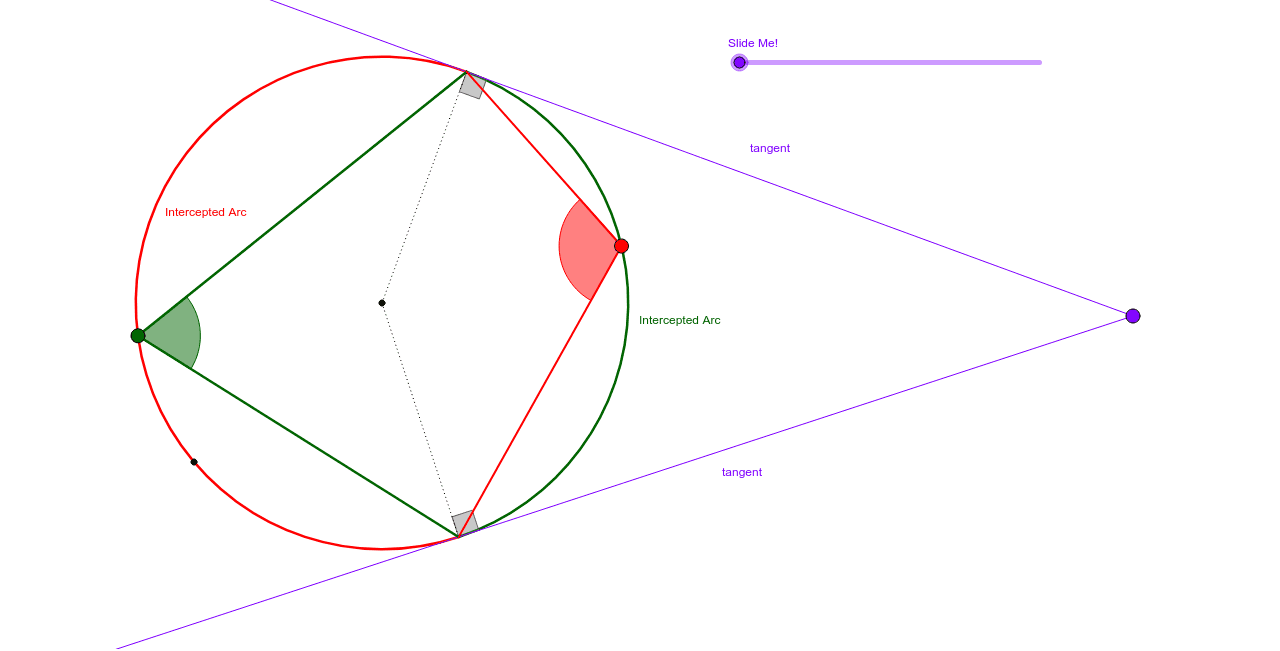
This example demonstrates the measurement of the angle formed by two tangents drawn from an external point to a circle. Key math concepts include circles, tangent lines, angles, and vectors. It utilizes GeoGebra commands like Circle, Tangent, Intersect, Ray, CircleArc, Point, Segment, CircleSector, Angle, Vector, Translate, Line, Rotate, and Dilate. Suitable for high school mathematics education to help students visually understand tangent properties and angle calculations.
GeoGebra Commands & Parameters
Circle(A, B) → cTangent(C, c) → a, bIntersect(c, a) → DIntersect(c, b) → ERay(C, D) → dRay(C, E) → eCircleArc(A, D, E) → fCircleArc(A, E, D) → gPoint(f) → FPoint(g) → GSegment(F, D) → hSegment(F, E) → iSegment(G, D) → jSegment(G, E) → kCircle(F, 1.5) → pCircle(G, 1.5) → qIntersect(p, h, 1) → HIntersect(p, i, 1) → IIntersect(q, j, 1) → JIntersect(q, k, 1) → KCircleSector(F, I, H) → rCircleSector(G, J, K) → sSegment(A, E) → lAngle(C, E, A) → αAngle(A, D, C) → βSegment(A, D) → mVector(F, G) → uSegment(F, G) → tIntersect(p, t) → L,Translate(r, u) → r'Line(F, k) → a_1Intersect(p, a_1) → M, NAngle(H, F, N) → γRotate(r', γ, G) → r''Dilate(F, If[0 < n < 1, 1 - n, 0], G) → F'Vector(F, F') → vTranslate(r, v) → r'_1Rotate(r'_1, If[0 < n < 1, (n * γ), 0], F') → c_1Angle(I, F, H) → δRotate(K, (-δ), G) → K'Angle(K', G, K) → εCircleSector(G, J, K') → d_1Vector(G, C) → wLine(G, d) → b_1Translate(d_1, w) → e_1Dilate(G, If[1.5 < n < 2.5, 2.5 - n, 0], C) → G'Vector(G, G') → u_1Translate(d_1, u_1) → f_1Translate(K', u_1) → K''Point(e) → OLine(G, e) → g_1Intersect(q, g_1) → P, QAngle(K', G, Q) → ζRotate(e_1, ζ, C) → h_1Rotate(f_1, If[1.5 < n < 2.5, ((n - 1.5) * ζ), 0], G') → k_1Angle(E, F, D) → ηAngle(D, G, E) → θ
AI Drawing Prompt Reference
Draw a circle with two tangent lines from an external point, showing the intersection points of the tangents with the circle. Connect the tangent points with arcs and label the key points and segments. Then, draw smaller circles centered at the tangent points, intersect them to get new points, and form corresponding line segments and sectors. Finally, use rotation and scaling to demonstrate the relationship between the tangent angle and the sector, completing the geometric construction.
The prompt above was compiled from the original drawing commands and is for reference only.