
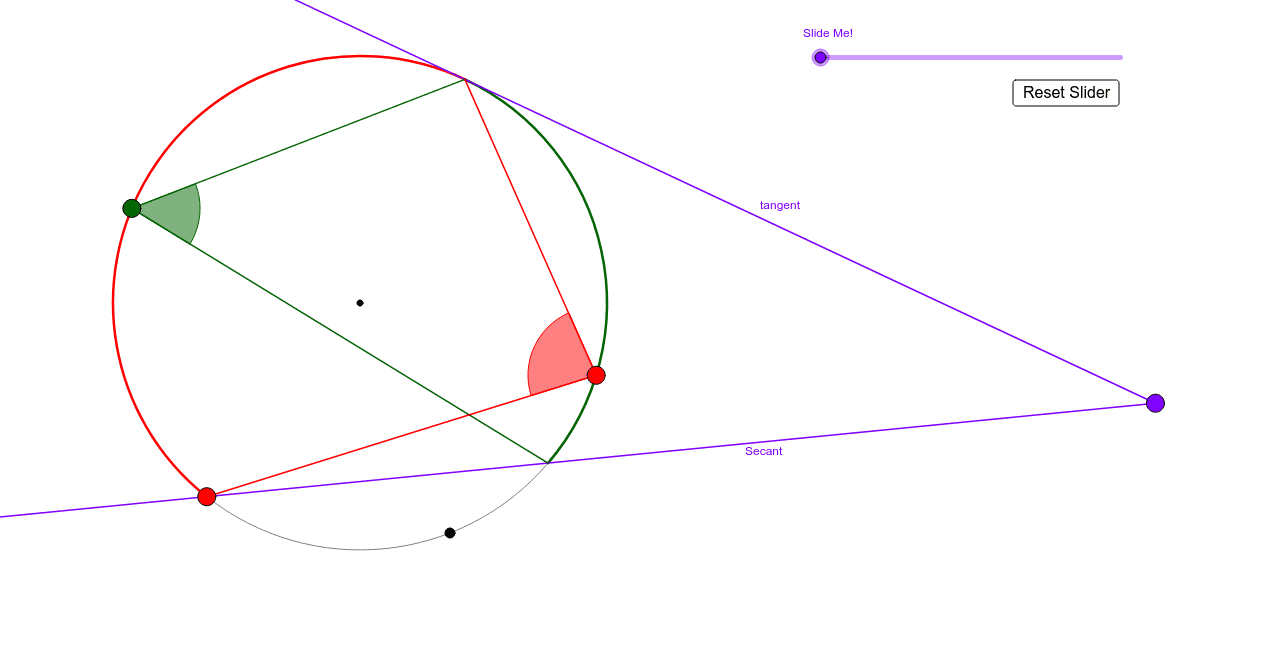
Angle Formed by a Secant & Tangent: What Do You See?
Loading the math board and drawing, please wait…
This example demonstrates the angle formed by a secant and a tangent. Key mathematical concepts include the properties of circles, isosceles triangles, and angle relationships. Using GeoGebra commands such as Circle, Point, Segment, Tangent, etc., dynamic exploration of these geometric elements is possible. Suitable for middle school and above students or teachers to understand circle properties and geometric construction techniques.
GeoGebra Commands & Parameters
Circle(A, B) → cPoint(c) → CSegment(C, A) → aOrthogonalLine(C, a) → bPoint(b) → ETangent(E, c) → l, mIntersect(c, m) → KCircleArc(A, C, K) → tPoint(t) → DRay(E, D) → dRay(E, C) → eSegment(A, D) → fAngle(C, A, D) → αRotate(C, α / 2, A) → C'Angle(C, A, C') → βCircle(A, 1.5) → hIntersect(h, a, 1) → HIntersect(h, f, 1) → IAngle(I, A, H) → γCircleArc(A, K, C) → sRay(E, D) → nIntersect(s, n, 1) → FSegment(A, F) → qIntersect(h, q, 1) → LCircleArc(A, F, C) → rCircleArc(A, D, F) → c_1CircleArc(A, C, D) → d_1Angle(F, A, C) → δRotate(F, δ / 2, A) → F'Angle(F, A, F') → εVector(A, E) → uTranslate(H, u) → H'Dilate(A, If[1.5 < j < 2.5, 2.5 - j, 0], E) → A'Vector(A, A') → vLine(A, n) → a_1Intersect(h, a_1) → M, NAngle(a, e) → λRay(E, K) → b_1Angle(E, D, A) → μCircleArc(A, C, K) → t_1Point(t_1) → OCircleArc(A, K, C) → c_2Point(c_2) → PSegment(O, C) → i_1Segment(O, F) → j_1Segment(P, D) → l_1Segment(P, C) → m_1Circle(O, 1.5) → gCircle(P, 1.5) → kIntersect(g, j_1, 1) → GIntersect(g, i_1, 1) → JIntersect(k, l_1, 1) → QIntersect(k, m_1, 1) → RCircleSector(O, G, J) → pCircleSector(P, R, Q) → e_1Dilate(O, If[0 < j < 1, 1 - j, 0], P) → O'Vector(O, O') → wTranslate(p, w) → p'Line(O, l_1) → iIntersect(g, i, 2) → SAngle(J, O, S) → ζRotate(p', If[0 < j < 1, (j * ζ), 0], O') → p''Vector(O, P) → u_1Translate(p, u_1) → p'_1Rotate(p'_1, ζ, P) → f_1Translate(G, u_1) → G'Rotate(G', ζ, P) → G''CircleSector(P, R, G'') → g_1Dilate(P, If[1.5 < j < 2.5, 2.5 - j, 0], E) → P'Vector(P, P') → v_1Translate(g_1, v_1) → h_1Vector(P, E) → w_1Translate(G'', w_1) → G'''Circle(E, 1.5) → k_1Intersect(k_1, n, 1) → TAngle(G''', E, T) → ηTranslate(g_1, w_1) → p_1Rotate(p_1, η, E) → q_1Rotate(h_1, If[1.5 < j < 2.5, ((j - 1.5) * η), 0], P') → r_1