
Angle Bisector Theorem Exploration
Loading the math board and drawing, please wait…
In collections
Congruence (CO) Cluster
Congruence (Vol 2)
CCSS High School: Geometry (Congruence) Volume 2
CCSS High School: Geometry (Congruence) Volume 2
CCSS High School: Geometry (Congruence) Volume 2
Geometry (Congruence) Volume 2
CCSS High School: Geometry (Congruence) Volume 2
CCSS High School: Geometry (Congruence) Volume 2
CCSS High School: Geometry (Congruence) Volume 2
CCSS High School: Geometry (Congruence) Volume 2
CCSS High School: Geometry (Congruence) Volume 2
CCSS High School: Geometry (Congruence) Volume 2
CCSS High School: Geometry (Congruence) Volume 2
Gail LeBlancCCSS High School: Geometry (Congruence) Volume 2
CCSS High School: Geometry (Congruence) Volume 2
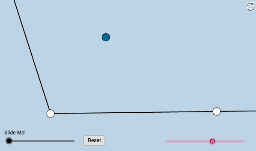
This example demonstrates the exploration of the Angle Bisector Theorem through dynamic geometry. It shows the property of a point lying on the angle bisector when it is equidistant from the sides of the angle. Key mathematical concepts include angle bisectors, distances, and geometric proofs. The construction utilizes GeoGebra commands such as Rotate, Angle, Point, OrthogonalLine, Intersect, Distance, Min, Circle, Dilate, Segment, and CircleSector. Suitable for high school mathematics education to understand geometric theorem proofs and properties.
GeoGebra Commands & Parameters
Rotate(A, α, B) → A'Angle(A, B, A') → βRay(B, A) → fRay(B, A') → gRotate(A, β / 2, B) → A'_1Angle(A, B, A'_1) → γRay(B, A'_1) → hPoint(h) → COrthogonalLine(C, f) → iOrthogonalLine(C, g) → jIntersect(j, g) → DIntersect(i, f) → EDistance(E, B) → aDistance(E, C) → bMin(a, b) → cCircle(E, (0.2 * c)) → dCircle(D, (0.2 * c)) → eIntersect(e, j, 1) → FIntersect(d, i, 2) → HIntersect(d, f, 2) → GIntersect(e, g, 2) → IDilate(C, If[0 < l ≤ 1, 1 - l, 0], D) → C'_1Dilate(C, If[1 < l ≤ 2, 2 - l, 0], E) → C'Segment(C, C'_1) → mSegment(C, C') → nAngle(D, C, E) → δRotate(C, If[2 < l ≤ 3, ((l - 2) * δ), δ], C) → C'_2Rotate(C'_1, If[2 < l ≤ 3, ((l - 2) * δ), δ], C) → JSegment(C'_2, J) → m'Circle(B, (0.3 * c)) → qIntersect(q, f, 1) → LIntersect(q, h, 1) → MCircleSector(B, L, M) → rAngle(C, E, B) → εAngle(B, D, C) → ζRotate(r, If[3.75 < l ≤ 4.75, ((l - 3.75) * α / 2), α / 2], B) → r'
AI Drawing Prompt Reference
Draw an angle and its bisector. Place a point on the bisector and prove it is equidistant from the angle's sides. Use rotations and perpendicular lines to explore the properties of the angle bisector in dynamic geometry. The final image should include the angle, bisector, distances to the sides, auxiliary lines from rotations, and dynamically changing arcs, demonstrating the geometric proof.
The prompt above was compiled from the original drawing commands and is for reference only.