
Angle Between Two Planes by Nadezhda Konstantinova
Loading the math board and drawing, please wait…
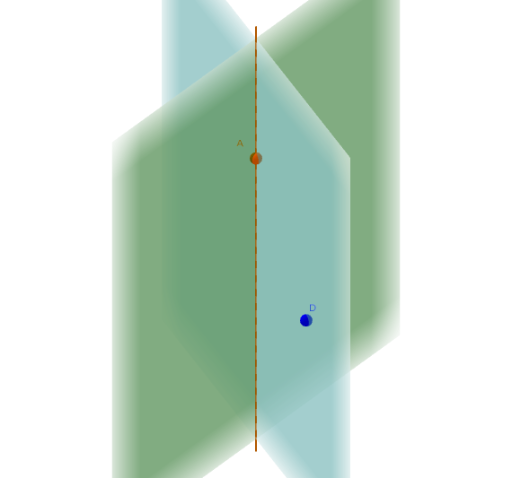
This example demonstrates how to calculate the angle between two planes. It involves core mathematical concepts like plane equations, vector dot product, and angle calculation. Construction highlights include using commands/objects such as Point, Plane, Intersect, IntersectPath, OrthogonalPlane, Angle, PointIn, Line in GeoGebra. Suitable for high school solid geometry teaching and geometric construction practice.
GeoGebra Commands & Parameters
Point(zAxis) → APoint(yAxis) → BPoint(yAxis) → CPlane(A, B, C) → aIntersect(zAxis, xAxis) → EPlane(A, E, D) → bIntersectPath(b, xOyPlane) → fIntersectPath(xOyPlane, a) → gIntersectPath(a, b) → hOrthogonalPlane(A, h) → cIntersectPath(c, a) → iIntersectPath(c, b) → jAngle(h, i) → αAngle(j, h) → βAngle(i, j) → γPointIn(a) → FPointIn(b) → GLine(A, F) → kLine(A, G) → lAngle(l, k) → δ
AI Drawing Prompt Reference
Draw the angle between two planes. Start by taking point A on the z-axis, and points B and C on the y-axis to form plane a. Then take point E at the intersection of the z-axis and x-axis to form plane b. Find the intersection line f of plane b with the xOy plane, the intersection line g of plane a with the xOy plane, and the intersection line h of planes a and b. Construct plane c perpendicular to line h and passing through point A, and find the intersection lines i and j of plane c with planes a and b, respectively. Calculate the angles α between lines h and i, β between lines j and h, and γ between lines i and j. Finally, take points F and G on planes a and b, respectively, and draw lines k and l from point A to points F and G, respectively, and calculate the angle δ between lines k and l.
The prompt above was compiled from the original drawing commands and is for reference only.