
Angle Between Lines
Loading the math board and drawing, please wait…
In collections
Vector Applications
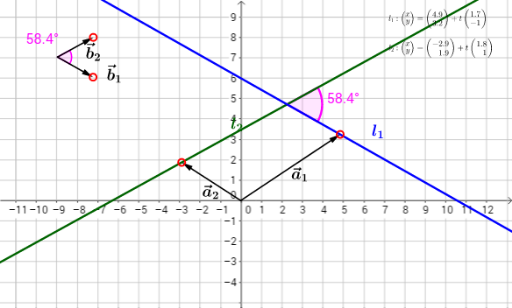
This example demonstrates how to calculate the angle between two lines using GeoGebra. It involves core concepts like vectors, points, lines, and angle measurement. Key GeoGebra commands used include Circle, Point, Vector, Intersect, Translate, Line, If, and Angle to construct geometric objects and compute the angle. Suitable for high school mathematics teaching, helping students understand vector-angle relationships and applications in analytical geometry.
GeoGebra Commands & Parameters
Circle(A, 2) → cPoint(c) → BPoint(c) → CVector(A, B) → b_2Vector(A, C) → b_1Intersect(xAxis, yAxis) → DVector(D, E) → a_2Vector(D, F) → a_1Translate(E, b_2) → E'Vector(E, E') → bLine(E', E) → dTranslate(F, b_1) → F'Vector(F, F') → eLine(F, F') → fIf(x(A) ≠ x(B), (1000, d(1000)), (x(E), -1000)) → EndDIf(x(A) ≠ x(C), (1000, f(1000)), (x(F), -1000)) → EndFIntersect(f, d) → IntIf(x(A) ≠ x(B), (-1000, d(-1000)), (x(E), 1000)) → EndD'Angle(EndD, Int, EndF) → αAngle(EndD', Int, EndF) → βAngle(C, A, B) → γ