
Angle Addition Formula Without Measures
Loading the math board and drawing, please wait…
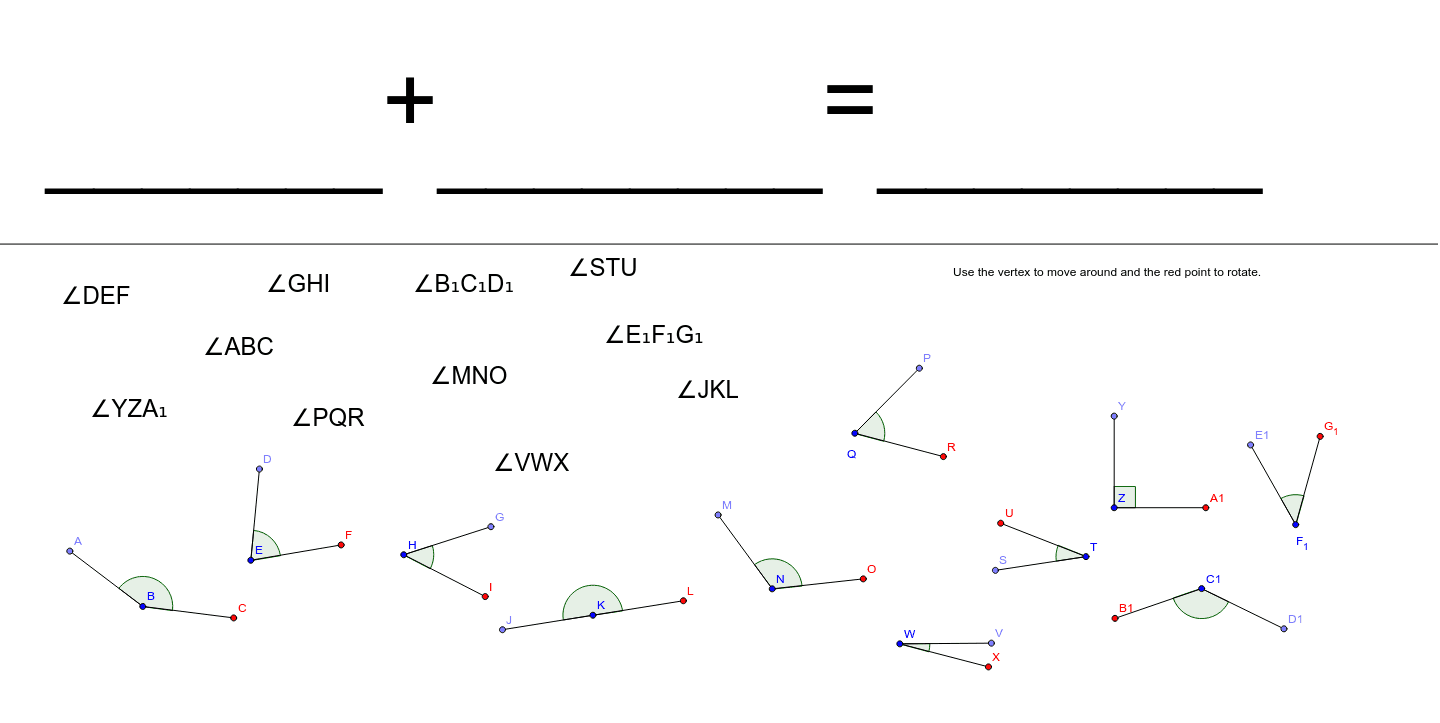
This example dynamically demonstrates the geometric meaning of the angle addition formula by combining two angles. It involves core math concepts like angle synthesis, vector addition, and geometric transformations. Constructed using GeoGebra commands such as Line, Point, Segment, Rotate, and Angle, it visually represents the dynamic synthesis of angles. Suitable for high school mathematics teaching to help students understand the angle addition formula and its applications.
GeoGebra Commands & Parameters
Line(C_1, E_1) → aPoint(Circle[F_1, 4]) → G_1Segment(F_1, G_1) → bRotate(G_1, 45*°, F_1) → E1Angle(G_1, F_1, E1) → αSegment(F_1, E1) → cPoint(Circle[Z, 4]) → A1Segment(Z, A1) → dPoint(Circle[C1, 4]) → B1Segment(C1, B1) → ePoint(Circle[K, 4]) → LSegment(K, L) → fPoint(Circle[Q, 4]) → RSegment(Q, R) → gPoint(Circle[H, 4]) → ISegment(H, I) → hPoint(Circle[W, 4]) → XSegment(W, X) → iPoint(Circle[T, 4]) → USegment(T, U) → jPoint(Circle[E, 4]) → FSegment(E, F) → kRotate(I, 45*°, H) → GAngle(I, H, G) → βRotate(A1, 90*°, Z) → YAngle(A1, Z, Y) → γRotate(B1, 135*°, C1) → D1Angle(B1, C1, D1) → δRotate(L, 180*°, K) → JAngle(L, K, J) → εRotate(U, 30*°, T) → SAngle(U, T, S) → ζRotate(X, 15*°, W) → VAngle(X, W, V) → ηRotate(R, 60*°, Q) → PAngle(R, Q, P) → θRotate(F, 75*°, E) → DAngle(F, E, D) → ιSegment(H, G) → lSegment(K, J) → mSegment(Z, Y) → nSegment(C1, D1) → pSegment(T, S) → qSegment(W, V) → rSegment(Q, P) → sSegment(E, D) → tPoint(Circle[N, 4]) → OSegment(N, O) → a_1Rotate(O, 120*°, N) → MAngle(O, N, M) → κSegment(N, M) → b_1Point(Circle[B, 4]) → CSegment(B, C) → c_1Rotate(C, 150*°, B) → AAngle(C, B, A) → λSegment(B, A) → d_1