
Alternate Interpretation of Slope
Loading the math board and drawing, please wait…
In collections
Slope
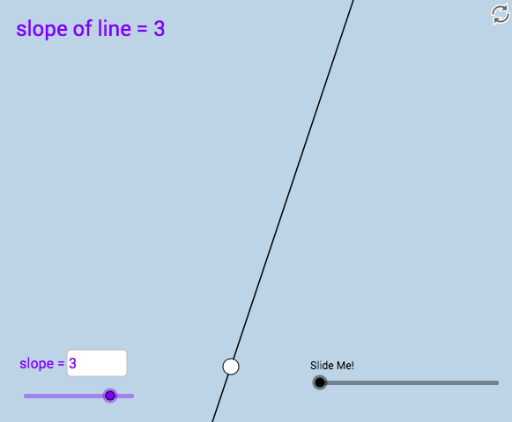
This example demonstrates the dynamic interpretation of the slope of a line and its geometric significance. It involves core mathematical concepts such as slope, vector, translation, dilation, integral, etc. Key construction elements include commands/objects like Vector, Translate, Polygon, Dilate, Segment, Line, IntegralBetween, Midpoint, Slope, Textfield, and Distance in GeoGebra. Suitable for high school coordinate geometry and calculus instruction to understand multiple representations of slope.
GeoGebra Commands & Parameters
Vector((0, 0), (1, 0)) → uTranslate(G, u) → G'Translate(B, u) → B'Translate(C, u) → C'Translate(D, u) → D'Translate(A, u) → A'Polygon(A, A', B) → poly1, b, a_1, a'Polygon(B, B', C) → poly2, c, b_1, b'Polygon(C, C', D) → poly3, d, c_1, c'Polygon(D, D', E) → poly4, e, d_1, d'Dilate(A, If[0 < o ≤ 1, 1 - o, 0], A') → A'_1Dilate(B, If[0 < o ≤ 1, 1 - o, 0], B') → B'_1Dilate(C, If[0 < o ≤ 1, 1 - o, 0], C') → C'_1Dilate(D, If[0 < o ≤ 1, 1 - o, 0], D') → D'_1Segment(A, A'_1) → pSegment(B, B'_1) → qSegment(C, C'_1) → rSegment(D, D'_1) → sDilate(A'_1, If[1 < o ≤ 2, 2 - o, 0], B) → HSegment(A'_1, H) → tDilate(A'_1, If[2 < o ≤ 3, 3 - o, 0], B'_1) → IVector(A'_1, I) → vTranslate(A'_1, v) → JTranslate(H, v) → H'Segment(J, H') → t'Dilate(B'_1, If[3 < o ≤ 4, 4 - o, 0], C'_1) → KVector(B'_1, K) → wTranslate(J, w) → J'Translate(H', w) → H''Segment(J', H'') → t''Dilate(C'_1, If[4 < o ≤ 5, 5 - o, 0], D'_1) → MVector(C'_1, M) → u_1Translate(J', u_1) → J''Translate(H'', u_1) → H'''Segment(J'', H''') → t'''Translate(L, u) → L'Translate(F, u) → F'Line(A, B) → f_1IntegralBetween(f, g, 0, 1) → e_1Translate(O, u) → O'IntegralBetween(f, g_1, 1, 2) → h_1IntegralBetween(f, h, 2, 3) → i_1Dilate(O, If[0 < p_1 ≤ 1, 1 - p_1, 0], O') → O'_1Dilate(L, If[0 < p_1 ≤ 1, 1 - p_1, 0], L') → L'_1Dilate(G, If[0 < p_1 ≤ 1, 1 - p_1, 0], G') → G'_1Segment(G, G'_1) → k_1Segment(O, O'_1) → l_1Segment(L, L'_1) → m_1Dilate(G'_1, If[1 < p_1 ≤ 2, 2 - p_1, 0], O) → PSegment(G'_1, P) → q_1Midpoint(O'_1, L) → QMidpoint(L'_1, F) → RDilate(G'_1, If[2 < p_1 ≤ 3, 3 - p_1, 0], O'_1) → SVector(G'_1, S) → v_1Translate(G'_1, v_1) → TTranslate(P, v_1) → P'Segment(T, P') → j_1Dilate(G'_1, If[3 < p_1 ≤ 4, 4 - p_1, 0], Q) → UVector(G'_1, U) → w_1Translate(G'_1, w_1) → VTranslate(P, w_1) → P'_1Segment(V, P'_1) → n_1Segment(O'_1, L) → r_1Dilate(O'_1, If[4 < p_1 ≤ 5, 5 - p_1, 0], L'_1) → WVector(O'_1, W) → s_1Translate(O'_1, s_1) → ZTranslate(L, s_1) → L'_2Segment(Z, L'_2) → t_1Dilate(O'_1, If[5 < p_1 ≤ 6, 6 - p_1, 0], R) → A_1Vector(O'_1, A_1) → u_2Translate(O'_1, u_2) → B_1Translate(L, u_2) → L'_3Segment(B_1, L'_3) → f_2Segment(C_1, A) → g_2Slope(f_1) → a_2Textfield(m) → InputBox1Distance(C_1, A) → distanceC1A