
Alternate Interior Angles Theorem Demo
Loading the math board and drawing, please wait…
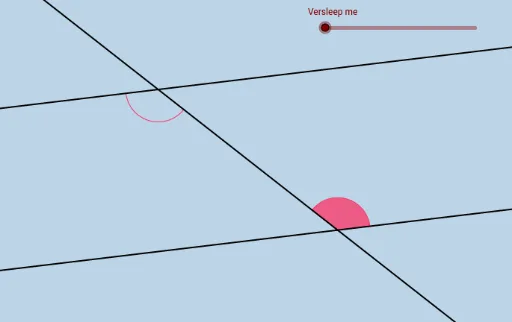
This example demonstrates the Alternate Interior Angles Theorem, showing that when two parallel lines are cut by a transversal, the alternate interior angles are equal. It involves core concepts like parallel lines, transversals, alternate interior angles, and angle measurement. The construction uses GeoGebra commands and objects such as Point, Rotate, Angle, Line, Circle, Intersect, CircleSector, Dilate, Vector, Translate, and CircleArc. It is suitable for high school students to learn and understand the relationship between parallel lines and angles, as well as for geometric constructions and theorem verification.
GeoGebra Commands & Parameters
Point(a) → BRotate(B, α, A) → B'Angle(B, A, B') → βLine(A, B') → bCircle(A, 1) → eIntersect(b, d) → CCircle(C, 1) → fIntersect(e, a) → D, EIntersect(e, b) → F, GIntersect(f, b) → H, IIntersect(f, d) → J, KCircleSector(C, J, H) → kCircleSector(C, H, K) → pCircleSector(A, E, G) → qCircleSector(A, G, D) → rCircleSector(A, F, E) → tDilate(A, If[0 < i < 1, 1 - i], C) → A'Vector(A, A') → uTranslate(q, u) → q'Translate(r, u) → r'Translate(t, u) → t'CircleArc(A, E, G) → c_1CircleArc(A, G, D) → f_1CircleArc(C, J, H) → h_1CircleArc(C, H, K) → p_1Vector(A, C) → vTranslate(q, v) → q'_1Rotate(q'_1, (((-(i - 1)) * 180))°, C) → gTranslate(r, v) → r'_1Rotate(r'_1, (((i - 1) * 180))°, C) → h
AI Drawing Prompt Reference
Draw a figure where two parallel lines are intersected by a transversal to demonstrate the equality of alternate interior angles. Start by creating point A and B, then rotate B to get B', and draw ∠BAB'. Draw line b through A. Draw circle e centered at A, intersecting lines b and d to get point C, and draw circle f centered at C, intersecting circle e to get points D and E. Draw points F and G, and points H and I, then points J and K. Draw sectors k, p, q, r, and t, and perform a series of translation and rotation operations to get sectors g, h, h_1, p_1, and q'_1.
The prompt above was compiled from the original drawing commands and is for reference only.