
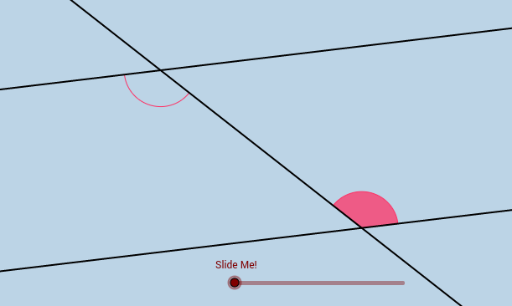
Alternate Interior Angles Theorem Demo (V3)
Loading the math board and drawing, please wait…
In collections
Congruence (CO) Cluster
Congruence (Vol 2)
CCSS High School: Geometry (Congruence) Volume 2
CCSS High School: Geometry (Congruence) Volume 2
CCSS High School: Geometry (Congruence) Volume 2
Geometry (Congruence) Volume 2
CCSS High School: Geometry (Congruence) Volume 2
CCSS High School: Geometry (Congruence) Volume 2
CCSS High School: Geometry (Congruence) Volume 2
CCSS High School: Geometry (Congruence) Volume 2
CCSS High School: Geometry (Congruence) Volume 2
CCSS High School: Geometry (Congruence) Volume 2
CCSS High School: Geometry (Congruence) Volume 2
Gail LeBlancCCSS High School: Geometry (Congruence) Volume 2
CCSS High School: Geometry (Congruence) Volume 2
Parallel Lines & Related Angles
Parallel Lines & Related Angles
Geometry: Parallel Lines & Related Angles
Angle Congruence Intros
① This example dynamically demonstrates the alternate interior angles theorem: when a transversal cuts two parallel lines, the alternate interior angles are congruent. ② Core mathematical concepts include the alternate interior angles theorem, parallel line criteria, angle measurement and congruence, and vector translation/rotation transformations. ③ Construction uses GeoGebra commands Point, Line, Rotate, Translate, Dilate, Vector, Angle, Circle, Intersect, CircleSector, and CircleArc, creating points A, B, C and applying rotations, translations, and dilations to generate the corresponding angles and auxiliary arcs. ④ Suitable for middle‑school geometry (grade 8 parallel lines and angles), high‑school analytic geometry review, and as a GeoGebra teaching demo or student exploration tool.
GeoGebra Commands & Parameters
Point(a) → BRotate(B, α, A) → B'Angle(B, A, B') → βLine(A, B') → bCircle(A, 1) → eIntersect(b, d) → CCircle(C, 1) → fIntersect(e, a) → D, EIntersect(e, b) → F, GIntersect(f, b) → H, IIntersect(f, d) → J, KCircleSector(C, J, H) → kCircleSector(C, H, K) → pCircleSector(A, E, G) → qCircleSector(A, G, D) → rCircleSector(A, F, E) → tDilate(A, If[0 < i < 1, 1 - i], C) → A'Vector(A, A') → uTranslate(q, u) → q'Translate(r, u) → r'Translate(t, u) → t'CircleArc(A, E, G) → c_1CircleArc(A, G, D) → f_1CircleArc(C, J, H) → h_1CircleArc(C, H, K) → p_1Rotate(q', (((-i) * 180))°, A') → q''Rotate(r', (((-i) * 180))°, A') → r''