
Alternate Interior Angles and Parallel Lines
Loading the math board and drawing, please wait…
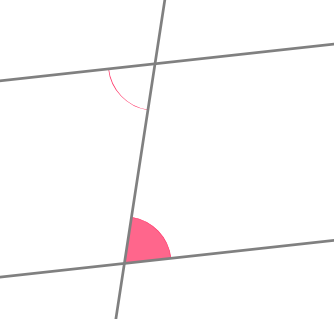
This GeoGebra example dynamically demonstrates the property of alternate interior angles formed when a transversal intersects two parallel lines. The core mathematical concept is the alternate interior angles theorem: when two parallel lines are cut by a transversal, the pairs of angles lying between the parallel lines on opposite sides of the transversal are equal. The construction uses GeoGebra commands such as Point, Line, Rotate, Angle, Intersect, Circle, CircleSector, Dilate, Vector, Translate, and CircleArc to create the parallel lines, transversal, intersection points, and angle arcs. Objects like m, A, a, B, α, β, b, c, d, e, f, and various transformed copies are used to clearly visualize the equal angles. This resource is ideal for middle school or high school geometry lessons, helping students grasp the concept through interactive manipulation, and is also useful for teachers in classroom demonstrations or for self-study.
GeoGebra Commands & Parameters
Point(a) → BRotate(B, α, A) → B'Angle(B, A, B') → βLine(A, B') → bCircle(A, 1) → eIntersect(b, d) → CCircle(C, 1) → fIntersect(e, a) → D, EIntersect(e, b) → F, GIntersect(f, b) → H, IIntersect(f, d) → J, KCircleSector(C, J, H) → kCircleSector(C, H, K) → pCircleSector(A, E, G) → qCircleSector(A, G, D) → rCircleSector(A, F, E) → tDilate(A, If[0 < i < 1, 1 - i], C) → A'Vector(A, A') → uTranslate(q, u) → q'Translate(r, u) → r'Translate(t, u) → t'CircleArc(A, E, G) → c_1CircleArc(A, G, D) → f_1CircleArc(C, J, H) → h_1CircleArc(C, H, K) → p_1Vector(A, C) → vTranslate(q, v) → q'_1Rotate(q'_1, ((-(i - 1)) * 180°), C) → gTranslate(r, v) → r'_1Rotate(r'_1, ((i - 1) * 180°), C) → h
AI Drawing Prompt Reference
Draw two parallel horizontal lines intersected by a transversal line, creating eight angles. Identify a pair of alternate interior angles lying between the parallels on opposite sides of the transversal. Mark each angle with a circular arc, and ensure the arcs have equal size. Translate one arc along the direction of the parallel line from its vertex to the other vertex, so the two arcs overlap, visually proving their equality. Add dashed auxiliary lines connecting relevant intersection points and label the angles with symbols to clearly illustrate the alternate interior angles theorem.
The prompt above was compiled from the original drawing commands and is for reference only.