
Airplane Flight Path and Trigonometric Function Example
Loading the math board and drawing, please wait…
In collections
UCSS Secondary Math II Unit 5 Lesson 8
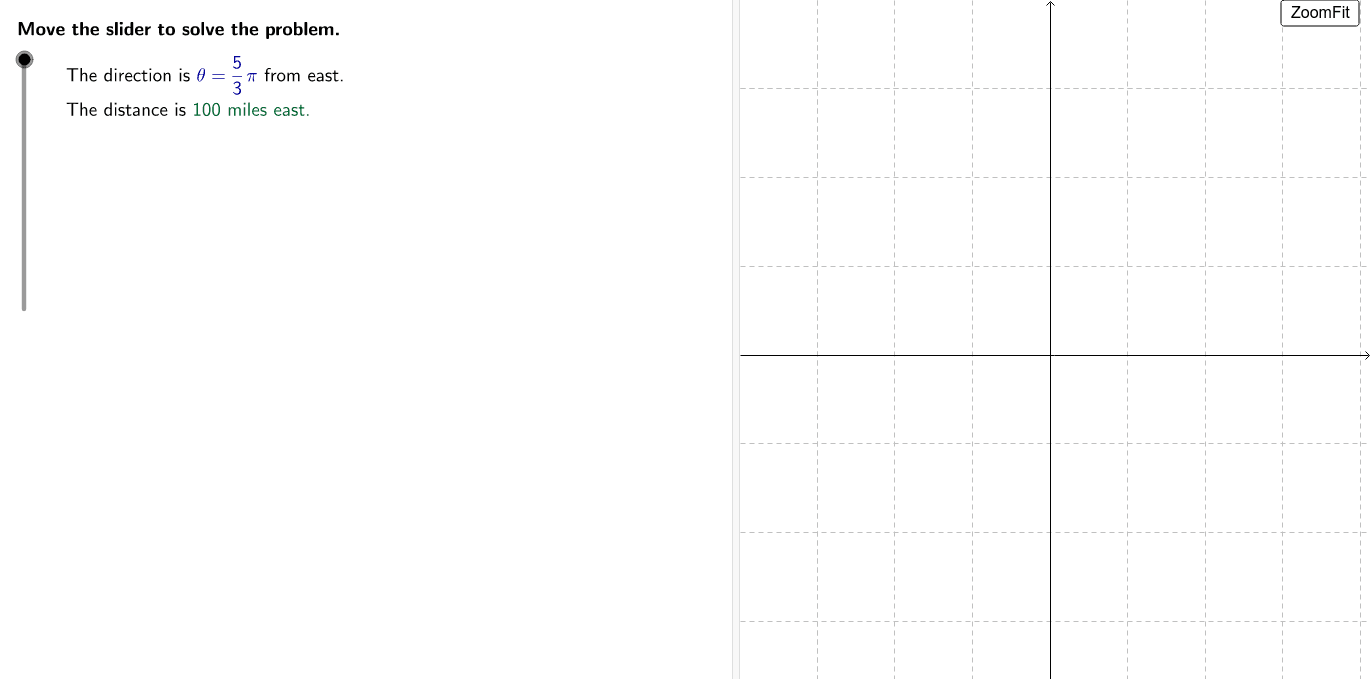
This example demonstrates the relationship between the flight path of an airplane and trigonometric functions. Key mathematical concepts include trigonometry, angle measurement, and vector analysis. Construction involves using GeoGebra commands like Ray, Angle, and Segment to build the flight trajectory, along with Corner and FractionText for labeling. Suitable for high school students learning trigonometry and geometric constructions, or for math teaching demonstrations.
GeoGebra Commands & Parameters
LaTeX(steps) → counterLaTeX("\text{Move the slider to solve the problem.}") → text0Corner(1) → ACorner(3) → BFractionText(Element[fractions, n]) → fractextIf((n < 4) ∨ (9 < n), "east", "west") → directionRay((0, 0), (cos(angleR), sin(angleR))) → aRay((0, 0), (1, 0)) → bAngle(b, a) → θIf((n < 4) ∨ (9 < n), Vector[(0, 0), (dist, 0)], Vector[(0, 0), ((-dist), 0)]) → uIf((n < 4) ∨ (9 < n), (dist / 2, 0), (((-dist)) / 2, 0)) → CLaTeX(dist) → distlabIf(n ≤ 3, Ray[(dist, 0), Vector[(0, 1)]], If[4 ≤ n ≤ 6, Ray[((-dist), 0), Vector[(0, 1)]], If[7 ≤ n ≤ 9, Ray[((-dist), 0), Vector[(0, -1)]], Ray[(dist, 0), Vector[(0, -1)]]]]) → cIf((n < 4) ∨ (9 < n), Segment[(0, 0), (dist, 0)], Segment[(0, 0), ((-dist), 0)]) → hiddenline1Segment((0, 0), (cos(angleR), sin(angleR))) → hiddenline2If(n ≤ 3, Angle[hiddenline1, hiddenline2], If[4 ≤ n ≤ 6, Angle[hiddenline2, hiddenline1], If[7 ≤ n ≤ 9, Angle[hiddenline1, hiddenline2], Angle[hiddenline2, hiddenline1]]]) → βFractionText(Element[refractions, n]) → refractextLaTeX((("\text{Determine the quadrant in which }\textcolor{#000099}{\theta=" * fractext) * "\pi}\text{ lies.}")) → text1LaTeX((("\text{Determine the reference angle for }\textcolor{#000099}{\theta=" * fractext) * "\pi}.")) → text4LaTeX((("\text{Determine which trigonometric function relates the distance travelled " * direction) * " }\cr\text{to the total distance travelled.}")) → text6LaTeX("\text{Use the buttons below to return to the original problem or}\cr\text{randomly generate a similar practice problem.}") → RandomizationTextIf(1 ≤ n ≤ 3, LaTeX[(((("\text{Since }\textcolor{#000099}{0 \le " * fractext) * "\pi \le \frac{\pi}{2}}\text{ (or, after multiplying}\cr\text{radians by }\textcolor{#000099}{\frac{180^{\circ}}{\pi \text{ radians}}}\text{ to get degrees, }\cr\textcolor{#000099}{0^{\circ}\le ") * angleD) * "^{\circ} \le 90^{\circ}}\text{), the angle is in the first quadrant.}\cr\text{The plane is flying in a northeasterly direction.}")], If[4 ≤ n ≤ 6, LaTeX[(((("\text{Since }\textcolor{#000099}{\frac{\pi}{2} < " * fractext) * "\pi \le \pi }\text{ (or, after multiplying}\cr\text{radians by }\textcolor{#000099}{\frac{180^{\circ}}{\pi \text{ radians}}}\text{ to get degrees, }\cr\textcolor{#000099}{ 90^{\circ} < ") * angleD) * "^{\circ} \le 180^{\circ}}\text{), the angle is in the second quadrant.}\cr\text{The plane is flying in a northwesterly direction.}")], If[7 ≤ n ≤ 9, LaTeX[(((("\text{Since }\textcolor{#000099}{ \pi < " * fractext) * "\pi \le \frac{3\pi}{2} }\text{ (or, after multiplying}\cr\text{radians by }\textcolor{#000099}{\frac{180^{\circ}}{\pi \text{ radians}}}\text{ to get degrees, }\cr\textcolor{#000099}{ 180^{\circ} < ") * angleD) * "^{\circ} \le 270^{\circ}}\text{), the angle is in the third quadrant.}\cr\text{The plane is flying in a southwesterly direction.}")], LaTeX[(((("\text{Since }\textcolor{#000099}{ \frac{3\pi}{2} < " * fractext) * "\pi \le 2\pi }\text{ (or, after multiplying}\cr\text{radians by }\textcolor{#000099}{\frac{180^{\circ}}{\pi \text{ radians}}}\text{ to get degrees, }\cr\textcolor{#000099}{ 270^{\circ} < ") * angleD) * "^{\circ} \le 360^{\circ}}\text{), the angle is in the fourth quadrant.}\cr\text{The plane is flying in a southeasterly direction.}")]]]) → text2LaTeX((((((("\text{The direction is }\textcolor{#000099}{\theta=" * fractext) * "\pi}\text{ from east.}\cr\text{The distance is }\textcolor{#006633}{") * dist) * "\text{ miles ") * direction) * "}.}")) → ProblemLaTeX((((("\text{Determine the total miles the airplane has traveled}\text{ after traveling}\cr\textcolor{#006633}{\text{" * dist) * " miles ") * direction) * "}.}")) → text3LaTeX((("\text{Use }\textcolor{#CC0000}{\cos\left(" * refractext) * "\pi\right)}\text{ to calculate the total distance.}")) → text8LaTeX((("\text{The distance " * direction) * " is }\textcolor{#006633}{adjacent}\text{ to the reference angle. }\cr\text{The total distance traveled is the }\textcolor{#000099}{hypotenuse}\text{ of the reference triangle. }\cr\text{We know that }\textcolor{#CC0000}{ \cos(\theta)=\frac{\textcolor{#006633}\text{adjacent}}{\textcolor{#000099}{\text{hypotenuse}}}}.")) → text7LaTeX((((((((((("\textcolor{#CC0000}{ \cos(\theta)}\text{ =}\frac{\textcolor{#006633}\text{adjacent}}{\textcolor{#000099}{\text{hypotenuse}}} \cr\textcolor{#CC0000}{ \cos(\theta)\textcolor{#000099}{\text{(hypotenuse)}}\text{ =}\frac{\textcolor{#006633}{\text{adjacent}}}{\textcolor{#000099}{\text{hypotenuse}}}\textcolor{#000099}{\text{(hypotenuse)}}} \cr\textcolor{#CC0000}{\cos(\theta)\textcolor{#000099}{\text{(hypotenuse)}}=\textcolor{#006633}{\text{adjacent}}} \cr\textcolor{#CC0000}{\cos(\theta)\textcolor{#000099}{\text{(hypotenuse)}}\frac{1}{\cos(\theta)}=\textcolor{#006633}{\text{adjacent}}\frac{1}{\cos(\theta)}} \cr\textcolor{#000099}{\text{hypotenuse}=\frac{\textcolor{#006633}{\text{adjacent}}}{\textcolor{#CC0000}{\cos(\theta)}}} \cr\textcolor{#000099}{\text{hypotenuse}=\frac{\textcolor{#006633}{" * dist) * "\text{ miles}}}{\textcolor{#CC0000}{\cos\left(") * refractext) * "\pi\right)}}} \cr\textcolor{#000099}{\text{hypotenuse} = \frac{\textcolor{#006633}{") * dist) * " \text{ miles}}}{\textcolor{#CC0000}{") * Element[cosval, n]) * "}}} \cr\textcolor{#000099}{\text{hypotenuse}=") * travel) * "\text{ miles}}")) → text9LaTeX((("\text{The airplane traveled }\textcolor{#000099}{" * travel) * " \,miles}\text{.}")) → text10If(1 ≤ n ≤ 3, LaTeX[(("\text{Since }\textcolor{#000099}{\theta= " * fractext) * "\pi }\text{ is in the first quadrant,}\cr\text{the angle is its own reference angle.}")], If[4 ≤ n ≤ 6, LaTeX[(((("\text{Since }\textcolor{#000099}{\theta= " * fractext) * "\pi }\text{ is in the second quadrant, the reference angle is }\textcolor{#CC0000}{") * refractext) * "\pi}\cr\text{measured up from the negative }\textit{x}\text{-axis as shown.}")], If[7 ≤ n ≤ 9, LaTeX[(((("\text{Since }\textcolor{#000099}{ \theta= " * fractext) * "\pi }\text{ is in the third quadrant, the reference angle is }\textcolor{#CC0000}{") * refractext) * "\pi}\cr\text{measured down from the negative }\textit{x}\text{-axis as shown.}")], LaTeX[(((("\text{Since }\textcolor{#000099}{ \theta= " * fractext) * "\pi }\text{ is in the fourth quadrant, the reference angle is }\textcolor{#CC0000}{") * refractext) * "\pi}\cr\text{measured down from the positive }\textit{x}\text{-axis as shown.}")]]]) → text5
AI Drawing Prompt Reference
Draw an airplane's flight path starting from the origin with two rays representing east and west directions. Use trigonometric functions to show the distance and angle, label the angle and distance, and indicate the flight direction and distance relationship. First, draw the origin and two rays, then label the angle and distance, and finally determine the flight direction based on the angle.
The prompt above was compiled from the original drawing commands and is for reference only.