
Aerodynamic Vectors
Loading the math board and drawing, please wait…
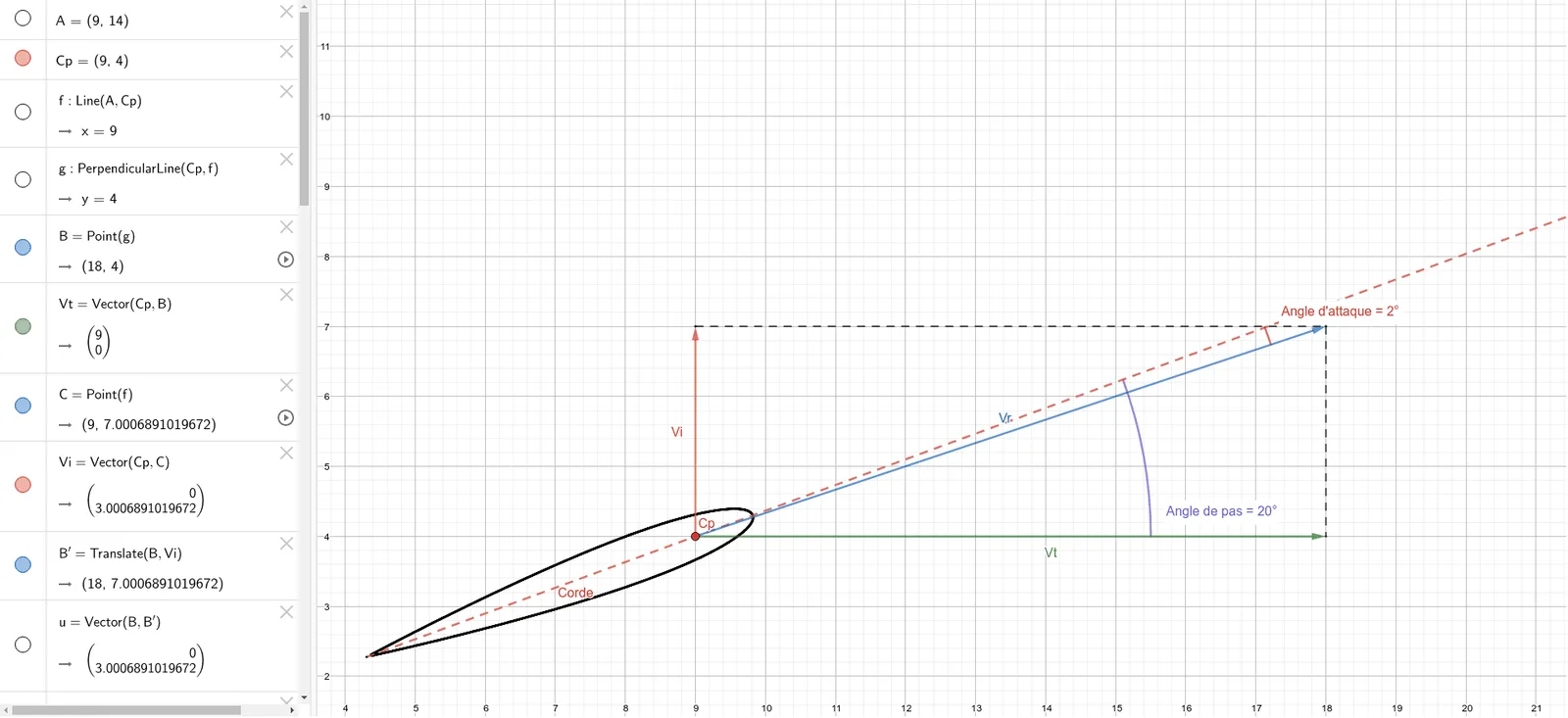
This example demonstrates the geometric representation of aerodynamic vectors. Key mathematical concepts include vectors, cosine, and angles. Using GeoGebra commands such as Line, Vector, and Translate, a dynamic model of aerodynamic vectors can be constructed. Suitable for high school physics and mathematics education.
GeoGebra Commands & Parameters
Line(A, Cp) → fOrthogonalLine(Cp, f) → gPoint(g) → BVector(Cp, B) → VtPoint(f) → CVector(Cp, C) → ViTranslate(B, Vi) → B'Vector(B, B') → uSegment(C, B') → hSegment(B', B) → iVector(Cp, B') → VrPoint(Circle[Cp, 5]) → PasSegment(Cp, Pas) → jRay(Pas, Cp) → CordeOrthogonalLine(Pas, Corde) → kPoint(Corde) → DOrthogonalLine(D, Corde) → lPoint(k) → ELine(E, Corde) → mIntersect(l, m) → FPoint(Vr) → IPoint(Corde) → JCircleArc(Cp, I, J) → cPoint(Vt) → KPoint(Corde) → LCircleArc(Cp, K, L) → dLength(c) → aPointIn(c) → PointcLength(d) → bPointIn(d) → PointdAngle(K, Cp, L) → αAngle(I, Cp, J) → β
AI Drawing Prompt Reference
Draw an aerodynamic vector diagram with a point Cp as the starting point. Draw two perpendicular lines f and g from Cp, and find points B and C on g and f respectively. Use vectors Vt and Vi to represent the vectors from Cp to B and C. Then, translate point B along Vi to get B', and use vector u to represent BB'. Draw line segments h and i from B to B', and vector Vr from C to B'. Find point Pas on the circle centered at Cp, and use vector u and arc c to represent the vector and arc from Cp to Pas. Use points I and J to represent the endpoints of arcs c and d, and angles α and β to represent the central angles of arcs c and d.
The prompt above was compiled from the original drawing commands and is for reference only.