
Act 6 2020: Incircle and Similar Triangles in a Random Experiment
Loading the math board and drawing, please wait…
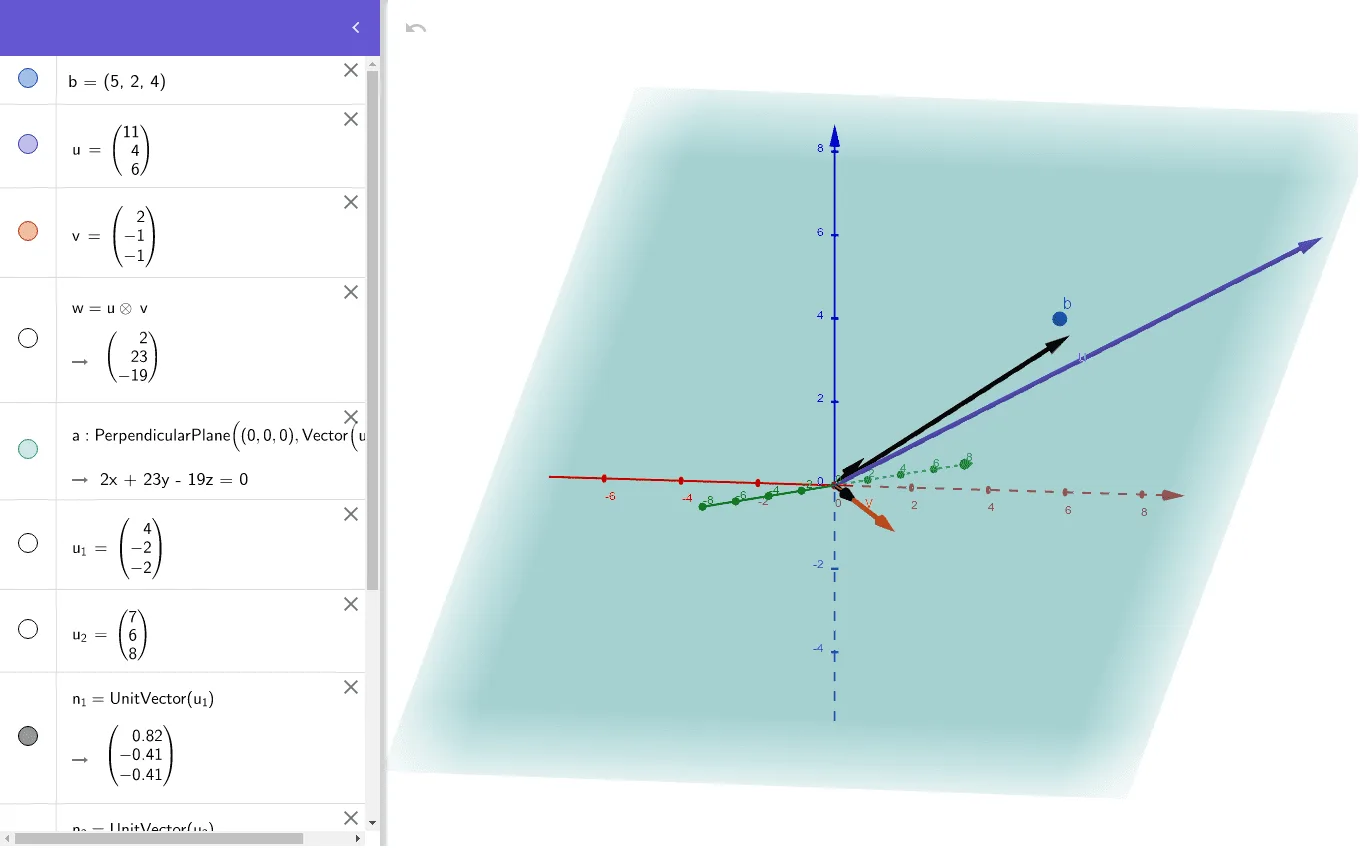
① This example demonstrates a dynamic geometric construction involving a quadrilateral with an incircle, enhanced by similar triangles, within a random experiment framework. ② Core mathematical concepts include incircles, quadrilaterals, similar triangles, random experiments, and Poisson distribution as a modeling tool. ③ The construction uses GeoGebra commands OrthogonalPlane and UnitVector to define vectors and planes, with objects b, u, v, w, a, u₁, u₂, n₁, n₂, c, f, enabling the creation of the quadrilateral, its incircle, and similarity-based transformations. ④ Suitable for high school or undergraduate geometry classes, this example helps explore properties of incircles, similarity, and the influence of random parameters on geometric figures, and can serve as a mathematical experiment or competition preparation.
GeoGebra Commands & Parameters
OrthogonalPlane((0, 0, 0), Vector[u ⊗ v]) → aUnitVector(u_{1}) → n_{1}UnitVector(u_{2}) → n_{2}
AI Drawing Prompt Reference
Draw a dynamic geometric construction for a random experiment involving a quadrilateral with an incircle and similar triangles. Start by defining two orthogonal planes and unit vectors, then use these to construct the quadrilateral and its incircle. Show the similarity transformations between the quadrilateral and the incircle to illustrate the effects of random parameters on the geometric figures.
The prompt above was compiled from the original drawing commands and is for reference only.