
Geometric Mean and Expected Value with Fraction Data (Boxplot Example)
Loading the math board and drawing, please wait…
In collections
Linear Algebra with Applications-Interactive Demonstrations
This example demonstrates how fraction-based data can be visualized to compare the data’s typical center and behavior using geometric mean and expected value, often alongside a boxplot-style summary. It centers on key concepts: the geometric mean (a multiplicative notion of central tendency), expected value (the mean meaning for random variables or probabilistic models), and the representation of values as fractions. The construction is parameterized using GeoGebra objects a, p, b, q, c, r, which can serve as the components of fraction values or as parameters defining the dataset/underlying model. Using these objects, the example computes the geometric mean and expected value and links them to the corresponding statistical/graphical elements (e.g., boxplot and related annotations). Suitable for secondary-school probability and statistics lessons and for training in data visualization and interpretation.
GeoGebra Commands & Parameters
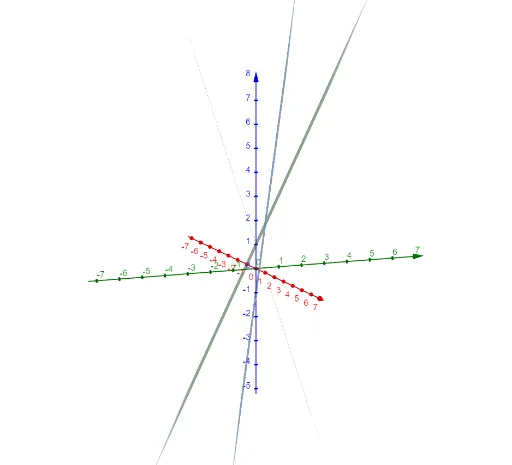
Numeric a(1)x + (3 * y) + z = aNumeric b(1)(-x) - (2 * y) + z = bNumeric c(1)(3 * x) + (7 * y) - z = c
AI Drawing Prompt Reference
On a single coordinate space, construct a geometric setup defined by three linear equations linking x, y, and z. Create the first plane/equation as x plus 3y plus z equals a, where a is a numeric parameter source. Create the second equation using −x and −2y with z, set as −x − 2y + z equals b, with b as another numeric parameter. Create the third equation using 3x and 7y with z, set as 3x + 7y − z equals c, with c as a numeric parameter. Arrange these three parameterized relations in a way that clearly represents fraction-based data inputs for later visualization of geometric mean and expected value, without introducing extra graphical elements beyond the three constructions.
The prompt above was compiled from the original drawing commands and is for reference only.